
Join Our JEE Preparation Group
Prep with like-minded aspirants; Get access to free daily tests and study material.
Sign in
Please select an account to continue using cracku.in
↓ →
Join Our JEE Preparation Group
Prep with like-minded aspirants; Get access to free daily tests and study material.
Let $$A = \{1, 3, 7, 9, 11\}$$ and $$B = \{2, 4, 5, 7, 8, 10, 12\}$$. Then the total number of one-one maps $$f : A \to B$$, such that $$f(1) + f(3) = 14$$, is :
Let the sets be $$A = \{1, 3, 7, 9, 11\}$$ and $$B = \{2, 4, 5, 7, 8, 10, 12\}$$.
We seek one-one maps $$f: A \to B$$ such that $$f(1) + f(3) = 14$$.
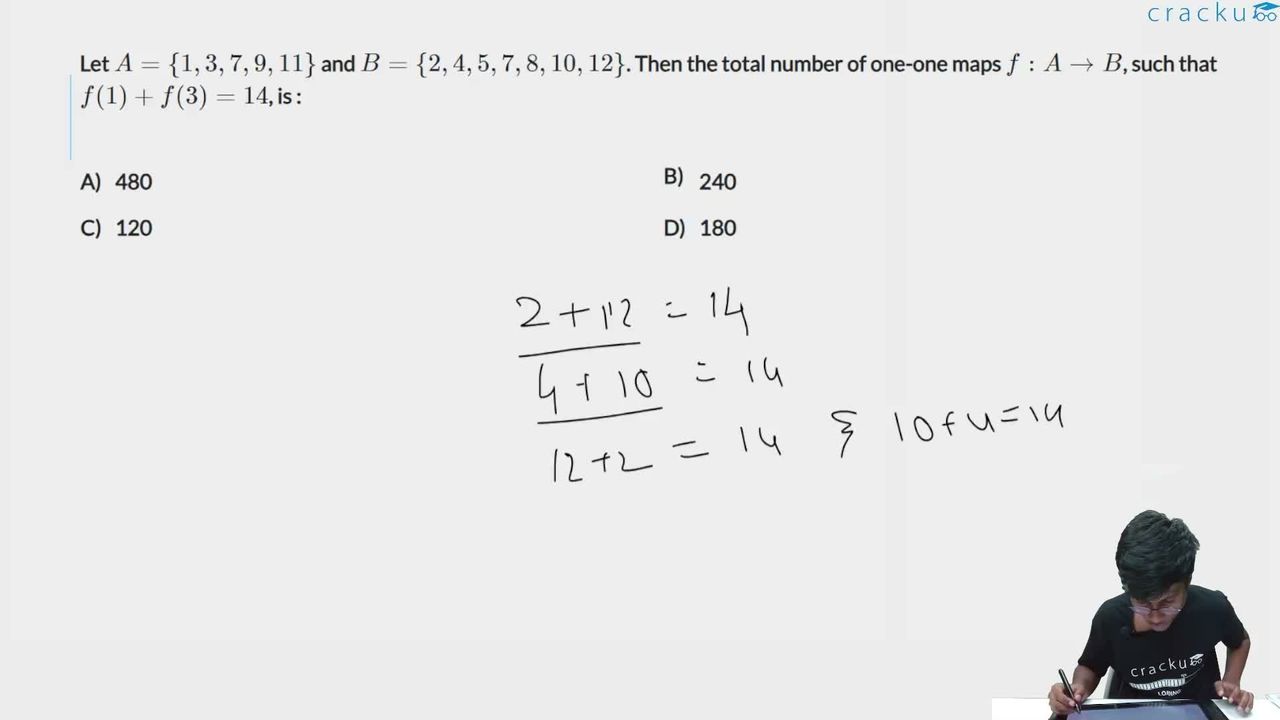
Considering ordered pairs from B that sum to 14, we have $$(2,12), (4,10), (7,7)$$, but $$(7,7)$$ is not allowed under a one-one mapping, so the valid pairs are $$(2,12)$$ and $$(4,10)$$.
Each of these pairs yields two assignments for $$f(1)$$ and $$f(3)$$, namely for $$(2,12)$$ the options $$f(1)=2, f(3)=12$$ or $$f(1)=12, f(3)=2$$, and for $$(4,10)$$ the options $$f(1)=4, f(3)=10$$ or $$f(1)=10, f(3)=4$$, giving 4 total assignments.
Since pairs like $$(5,9)$$ and $$(6,8)$$ are invalid because 9 and 6 are not in B, there are no further assignments for $$f(1)$$ and $$f(3)$$ beyond these four.
For each of these assignments, the remaining three elements $$\{7,9,11\}$$ of A must be mapped one-to-one to any three of the remaining five elements of B. The number of such mappings is $$P(5,3) = 5 \times 4 \times 3 = 60$$.
Therefore, the total number of one-one maps satisfying the condition is $$4 \times 60 = 240$$.
The correct answer is Option (2): 240.
Was this solution helpful?
Click on the Email ☝️ to Watch the Video Solution
Create a FREE account and get:
_1.webp)

Educational materials for JEE preparation

Ask our AI anything

AI can make mistakes. Please verify important information.
AI can make mistakes. Please verify important information.
