
Join Our JEE Preparation Group
Prep with like-minded aspirants; Get access to free daily tests and study material.
Sign in
Please select an account to continue using cracku.in
↓ →
Join Our JEE Preparation Group
Prep with like-minded aspirants; Get access to free daily tests and study material.
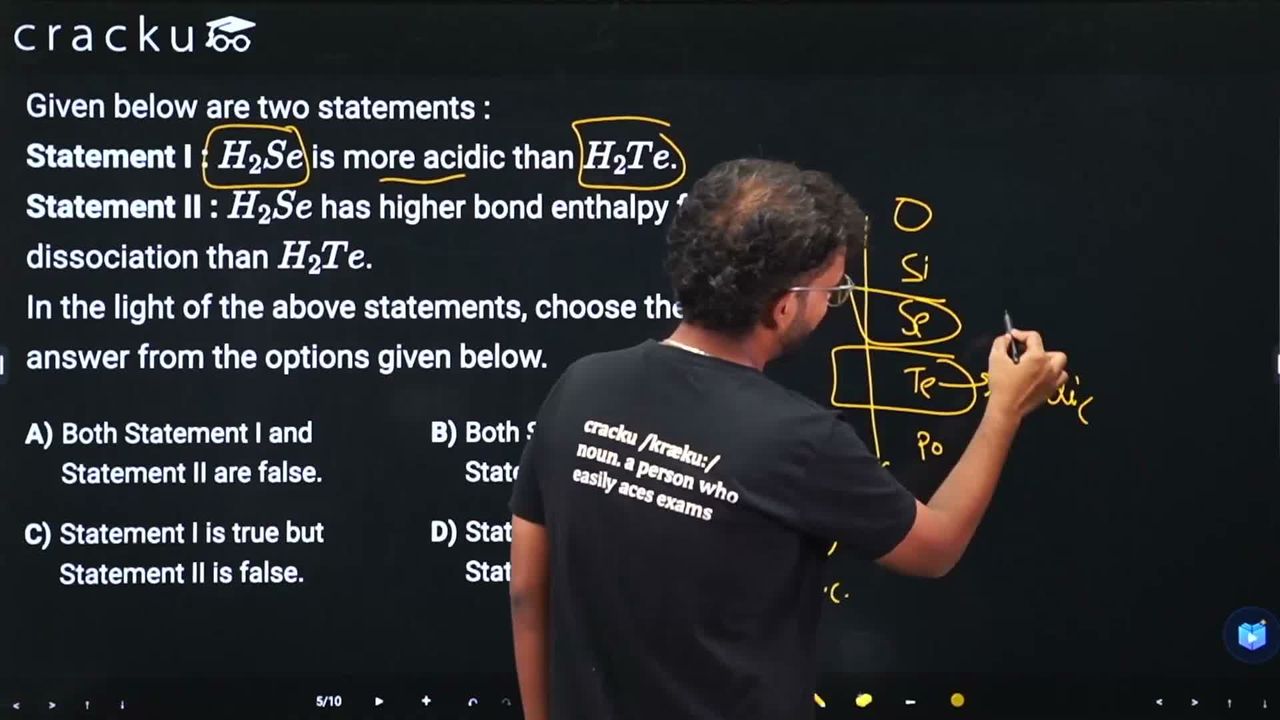
Given below are two statements :
Statement I : $$H_2Se$$ is more acidic than $$H_2Te$$.
Statement II : $$H_2Se$$ has higher bond enthalpy for dissociation than $$H_2Te$$.
In the light of the above statements, choose the correct answer from the options given below.
For the hydrides of group-16 elements $$H_2E$$ (where $$E = O,S,Se,Te$$) two experimental trends are important:
(i) Acidic strength: as we move down the group, the $$E-H$$ bond becomes longer and weaker. It breaks more easily, liberating $$H^+$$, so acidity
follows $$H_2O \lt H_2S \lt H_2Se \lt H_2Te$$.
(ii) Bond dissociation enthalpy: down the group the $$E-H$$ bond dissociation enthalpy decreases because atomic size increases. Thus
$$\text{BDE}(O-H) \gt \text{BDE}(S-H) \gt \text{BDE}(Se-H) \gt \text{BDE}(Te-H).$$
Now analyse the statements.
Statement I: “$$H_2Se$$ is more acidic than $$H_2Te$$.”
Actual trend shows $$H_2Te$$ is more acidic than $$H_2Se$$, so the statement is false.
Statement II: “$$H_2Se$$ has higher bond enthalpy for dissociation than $$H_2Te$$.”
From trend (ii), $$\text{BDE}(Se-H) \gt \text{BDE}(Te-H)$$, so the statement is true.
Therefore Statement I is false while Statement II is true ⟹ Option D.
Was this solution helpful?
Click on the Email ☝️ to Watch the Video Solution
Create a FREE account and get:
_1.webp)

Educational materials for JEE preparation

Ask our AI anything

AI can make mistakes. Please verify important information.
AI can make mistakes. Please verify important information.
