
Join Our JEE Preparation Group
Prep with like-minded aspirants; Get access to free daily tests and study material.
Sign in
Please select an account to continue using cracku.in
↓ →
Join Our JEE Preparation Group
Prep with like-minded aspirants; Get access to free daily tests and study material.
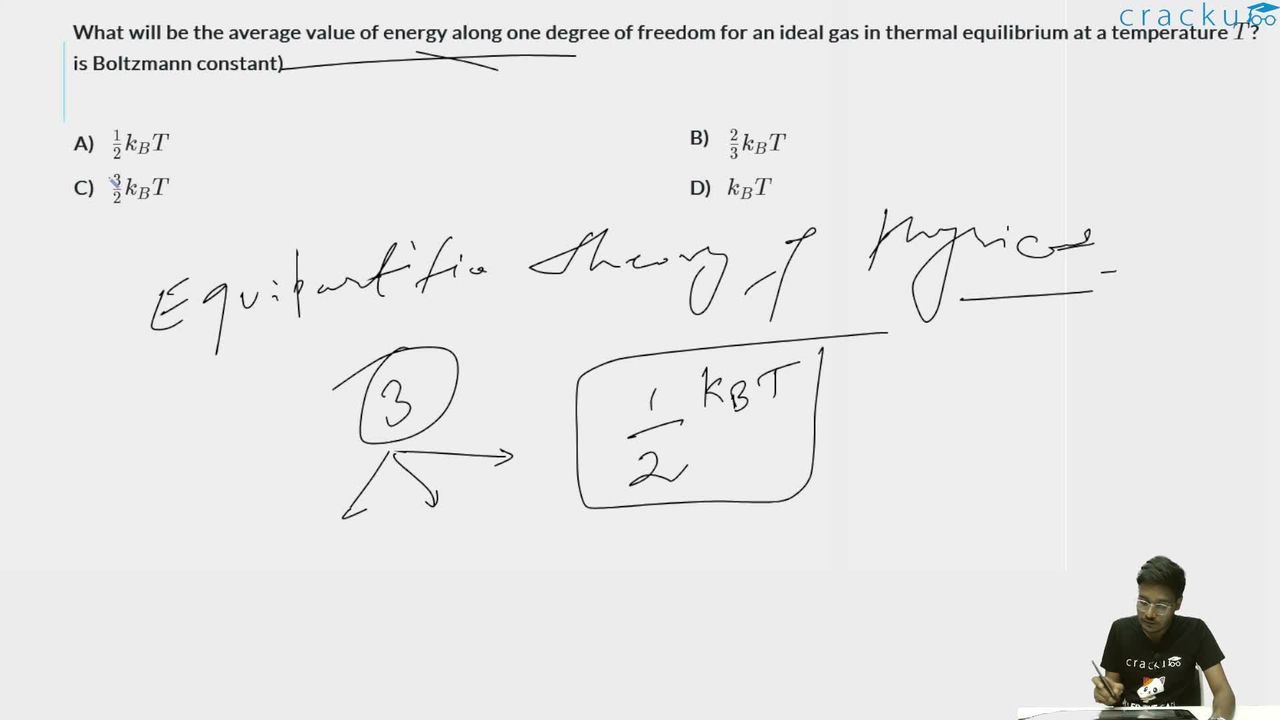
What will be the average value of energy along one degree of freedom for an ideal gas in thermal equilibrium at a temperature $$T$$? ($$k_B$$ is Boltzmann constant)
An ideal gas contains a very large number of molecules randomly moving in all directions. A quantity that helps us describe these independent ways in which the molecules can store energy is called a degree of freedom.
Statement of the equipartition theorem:
For a system in thermal equilibrium at temperature $$T$$, every independent quadratic term in the total energy contributes an average energy of $$\tfrac12 k_B T$$, where $$k_B$$ is the Boltzmann constant.
Translational kinetic energy of a single molecule in, say, the $$x$$-direction is quadratic in the velocity component $$v_x$$: $$\tfrac12 m v_x^2$$. Hence this translational motion about the $$x$$-axis represents one quadratic (i.e., one degree of freedom) term.
Applying the equipartition theorem to this single quadratic term, the average energy associated with that one degree of freedom is therefore
$$\frac12 k_B T$$.
Thus, the average value of energy along one degree of freedom for an ideal gas at temperature $$T$$ is $$\tfrac12 k_B T$$.
Option A is correct.
Was this solution helpful?
Click on the Email ☝️ to Watch the Video Solution
_1.webp)

Educational materials for JEE preparation

Ask our AI anything

AI can make mistakes. Please verify important information.
AI can make mistakes. Please verify important information.