
Join Our JEE Preparation Group
Prep with like-minded aspirants; Get access to free daily tests and study material.
Sign in
Please select an account to continue using cracku.in
↓ →
Join Our JEE Preparation Group
Prep with like-minded aspirants; Get access to free daily tests and study material.
Four particles, each of mass $$M$$ and equidistant from each other, move along a circle of radius $$R$$ under the action of their mutual gravitational attraction. The speed of each particle is:
We begin by fixing our picture. The four identical particles, each of mass $$M$$, are placed at the four vertices of a square that is inscribed in a circle of radius $$R$$. The centre of the circle is also the centre of the square. Because the particles are equally spaced (every $$90^{\circ}$$), the arrangement is
A: $$\left(R,0\right)$$, B: $$\left(0,R\right)$$, C: $$\left(-R,0\right)$$, D: $$\left(0,-R\right)$$.
The side length of the square is obtained from the well-known relation “diagonal of a square $$= \sqrt{2}\,$$ (side)”. Here the diagonal $$AC$$ equals the diameter $$2R$$, so
$$\text{side}\;s=\frac{2R}{\sqrt{2}}=\sqrt{2}\,R.$$
Thus the distance between adjacent particles is $$s=\sqrt{2}\,R$$ and the distance between opposite particles is the diameter $$2R$$.
We now calculate, one by one, the gravitational forces on particle $$A$$ due to the other three particles.
1. Magnitude of the force exerted by each adjacent particle (for example, by $$B$$ or $$D$$): we use Newton’s law of gravitation,
$$F=\frac{G\,M\,M}{r^{2}},$$
and insert $$r=s=\sqrt{2}\,R$$, giving
$$F_{\text{adj}}=\frac{G M^{2}}{\left(\sqrt{2}\,R\right)^{2}} =\frac{G M^{2}}{2R^{2}}.$$
2. Magnitude of the force exerted by the opposite particle $$C$$ (distance $$2R$$):
$$F_{\text{opp}}=\frac{G M^{2}}{(2R)^{2}} =\frac{G M^{2}}{4R^{2}}.$$
Next we resolve these vector forces into radial (towards the centre) components. Choosing the positive $$x$$-axis to point from the centre to particle $$A$$, the radial direction for $$A$$ is along the negative $$x$$-axis.
• Force on $$A$$ due to $$B$$. The displacement vector from $$A(R,0)$$ to $$B(0,R)$$ is $$(-R,\,R)$$. Its length is $$s=\sqrt{2}\,R$$, so the unit vector is $$\left(-\tfrac{1}{\sqrt{2}},\,\tfrac{1}{\sqrt{2}}\right).$$ Multiplying by the magnitude $$F_{\text{adj}}$$ we obtain
$$\vec F_{AB}=F_{\text{adj}} \left(-\frac{1}{\sqrt{2}},\,\frac{1}{\sqrt{2}}\right).$$
Its radial (negative $$x$$) component is therefore
$$F_{AB,x}=-\frac{F_{\text{adj}}}{\sqrt{2}}.$$
• Force on $$A$$ due to $$D$$ has a displacement vector $$(-R,-R)$$ and hence
$$F_{AD,x}=-\frac{F_{\text{adj}}}{\sqrt{2}}.$$
Adding the two adjacent contributions, the transverse $$y$$-components cancel and the combined radial contribution becomes
$$F_{\text{adj,\,rad}}=F_{AB,x}+F_{AD,x} =-\,\frac{F_{\text{adj}}}{\sqrt{2}} -\,\frac{F_{\text{adj}}}{\sqrt{2}} =-\,\sqrt{2}\,F_{\text{adj}}.$$
• Force on $$A$$ due to the opposite particle $$C$$ acts exactly along the diameter toward the centre, so its entire magnitude contributes radially:
$$F_{\text{opp,\,rad}}=-\,F_{\text{opp}}.$$
Hence the total radial (inward) gravitational force on particle $$A$$ is the algebraic sum of the two inward negatives, i.e. an inward magnitude
$$F_{\text{net}} =\sqrt{2}\,F_{\text{adj}}+F_{\text{opp}} =\sqrt{2}\left(\frac{G M^{2}}{2R^{2}}\right) +\left(\frac{G M^{2}}{4R^{2}}\right).$$
Simplifying term by term, first multiply out the coefficient of the adjacent term:
$$\sqrt{2}\,F_{\text{adj}} =\sqrt{2}\left(\frac{G M^{2}}{2R^{2}}\right) =\frac{\sqrt{2}\,G M^{2}}{2R^{2}} =\frac{2\sqrt{2}\,G M^{2}}{4R^{2}}.$$
Now place both terms over the common denominator $$4R^{2}$$:
$$F_{\text{net}} =\frac{2\sqrt{2}\,G M^{2}}{4R^{2}} +\frac{G M^{2}}{4R^{2}} =\frac{G M^{2}}{4R^{2}} \left(1+2\sqrt{2}\right).$$
This net gravitational attraction towards the centre must supply the necessary centripetal force for uniform circular motion. The centripetal force law is
$$\frac{M v^{2}}{R}=F_{\text{net}}.$$
Substituting the expression for $$F_{\text{net}}$$ gives
$$\frac{M v^{2}}{R} =\frac{G M^{2}}{4R^{2}}\left(1+2\sqrt{2}\right).$$
We now solve for $$v^{2}$$ by multiplying both sides by $$R/M$$:
$$v^{2} =\frac{G M}{4R}\left(1+2\sqrt{2}\right).$$
Taking the positive square root (speed is positive) we obtain the required speed of each particle:
$$v =\frac{1}{2}\sqrt{\frac{G M}{R}\left(1+2\sqrt{2}\right)}.$$
This expression exactly matches Option D.
Hence, the correct answer is Option D.
Was this solution helpful?
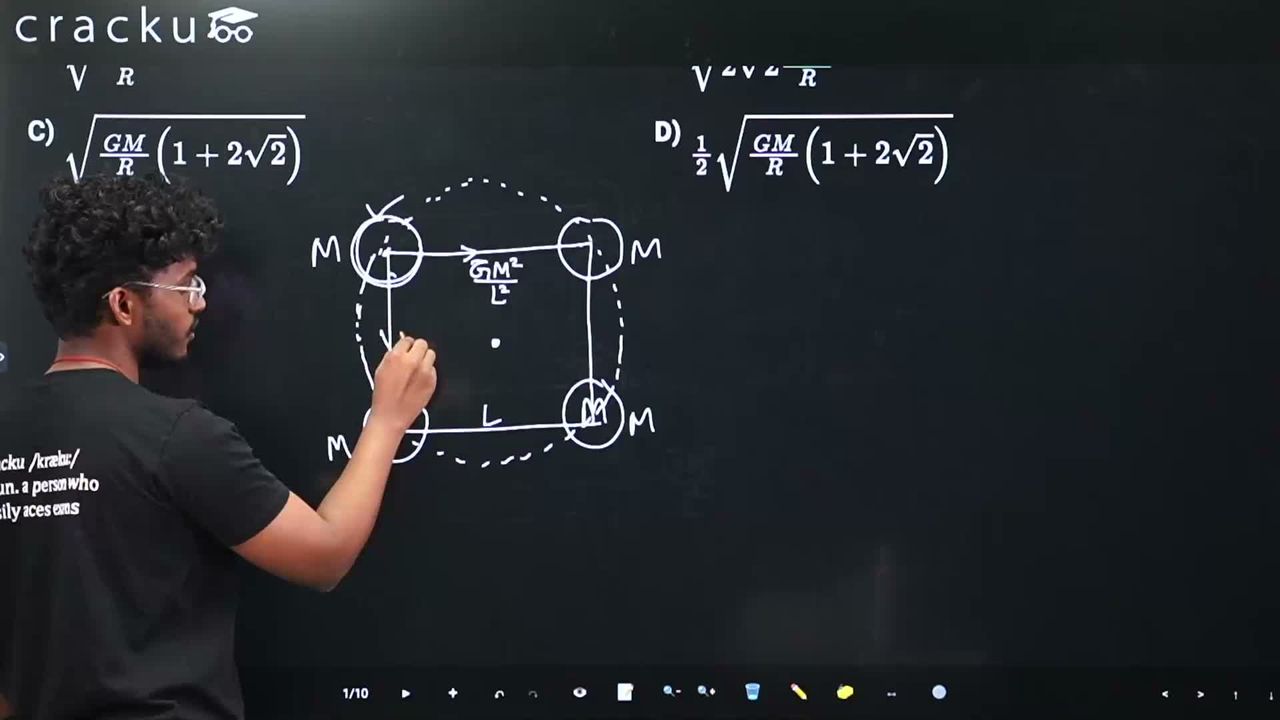
Click on the Email ☝️ to Watch the Video Solution
Create a FREE account and get:
_1.webp)

Educational materials for JEE preparation

Ask our AI anything

AI can make mistakes. Please verify important information.
AI can make mistakes. Please verify important information.


