
Join Our JEE Preparation Group
Prep with like-minded aspirants; Get access to free daily tests and study material.
Sign in
Please select an account to continue using cracku.in
↓ →
Join Our JEE Preparation Group
Prep with like-minded aspirants; Get access to free daily tests and study material.
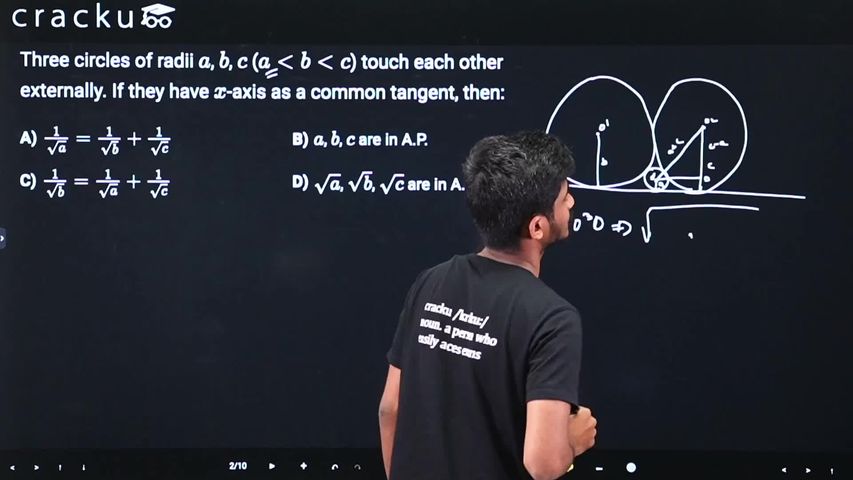
Three circles of radii $$a$$, $$b$$, $$c$$ ($$a < b < c$$) touch each other externally. If they have $$x$$-axis as a common tangent, then:
First we note that each of the three circles is tangent to the $$x$$-axis from above. Hence the centre of the circle whose radius is $$a$$ can be written as $$O_{1}(x_{1},\,a)$$, the centre of the circle whose radius is $$b$$ as $$O_{2}(x_{2},\,b)$$ and that of the circle whose radius is $$c$$ as $$O_{3}(x_{3},\,c)$$.
Because all three circles touch one another externally, the distance between any two centres equals the sum of the corresponding radii. Using the distance formula $$\text{(distance)}^{2}=(\text{difference of abscissae})^{2}+(\text{difference of ordinates})^{2},$$ we can write three separate equations.
For the pair $$O_{1}O_{2}$$ we have
$$\bigl(x_{1}-x_{2}\bigr)^{2}+\bigl(a-b\bigr)^{2}=\bigl(a+b\bigr)^{2}.$$
For $$O_{1}O_{3}$$ we have
$$\bigl(x_{1}-x_{3}\bigr)^{2}+\bigl(a-c\bigr)^{2}=\bigl(a+c\bigr)^{2}.$$
For $$O_{2}O_{3}$$ we have
$$\bigl(x_{2}-x_{3}\bigr)^{2}+\bigl(b-c\bigr)^{2}=\bigl(b+c\bigr)^{2}.$$
From the first equation we obtain
$$\bigl(x_{1}-x_{2}\bigr)^{2}=(a+b)^{2}-(b-a)^{2}=4ab,$$ so $$|x_{1}-x_{2}|=2\sqrt{ab}.$$
The second equation gives
$$\bigl(x_{1}-x_{3}\bigr)^{2}=(a+c)^{2}-(c-a)^{2}=4ac,$$ so $$|x_{1}-x_{3}|=2\sqrt{ac}.$$
The third gives
$$\bigl(x_{2}-x_{3}\bigr)^{2}=(b+c)^{2}-(c-b)^{2}=4bc,$$ so $$|x_{2}-x_{3}|=2\sqrt{bc}.$$
Because $$a<b<c,$$ the smallest circle is most naturally sandwiched between the other two on the common tangent. We therefore assume the left-to-right order
$$x_{2}\;<\;x_{1}\;<\;x_{3},$$
so that
$$x_{1}-x_{2}=2\sqrt{ab},\qquad x_{3}-x_{1}=2\sqrt{ac},\qquad x_{3}-x_{2}=2\sqrt{bc}.$$
Now we use the simple relation of collinear points on a line:
$$x_{3}-x_{2}=(x_{3}-x_{1})+(x_{1}-x_{2}).$$
Substituting the expressions just found, we get
$$2\sqrt{bc}=2\sqrt{ac}+2\sqrt{ab}.$$
Dividing every term by $$2\sqrt{abc}$$ simplifies the equation:
$$\frac{\sqrt{bc}}{\sqrt{abc}}=\frac{\sqrt{ac}}{\sqrt{abc}}+\frac{\sqrt{ab}}{\sqrt{abc}}.$$
Simplifying each fraction separately, we find
$$\frac{1}{\sqrt{a}}=\frac{1}{\sqrt{b}}+\frac{1}{\sqrt{c}}.$$
This is exactly the relation stated in Option A, while none of the other options follow from the geometry. Hence, the correct answer is Option A.
Was this solution helpful?
Click on the Email ☝️ to Watch the Video Solution
Create a FREE account and get:
_1.webp)

Educational materials for JEE preparation

Ask our AI anything

AI can make mistakes. Please verify important information.
AI can make mistakes. Please verify important information.
