
Join Our JEE Preparation Group
Prep with like-minded aspirants; Get access to free daily tests and study material.
Sign in
Please select an account to continue using cracku.in
↓ →
Join Our JEE Preparation Group
Prep with like-minded aspirants; Get access to free daily tests and study material.
Pair of transition metal ions having the same number of unpaired electrons is:
First list the atomic numbers and ground-state electronic configurations of the elements involved (outer part only).
Ti (22): $$3d^2\,4s^2$$ V (23): $$3d^3\,4s^2$$ Cr (24): $$3d^5\,4s^1$$ Mn (25): $$3d^5\,4s^2$$ Fe (26): $$3d^6\,4s^2$$ Co (27): $$3d^7\,4s^2$$
When a transition metal forms a positive ion, electrons are removed first from the $$4s$$ orbital and then from $$3d$$.
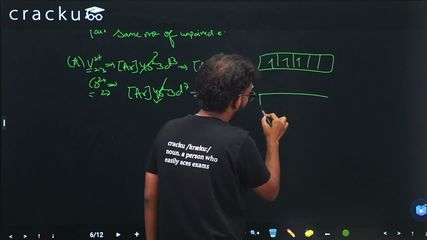
Case 1: $$V^{2+}$$ and $$Co^{2+}$$
$$V^{2+}:$$ remove two $$4s$$ electrons ⇒ $$3d^3$$ Number of unpaired $$d$$ electrons = 3 (one in each of the first three $$d$$ orbitals).
$$Co^{2+}:$$ remove two $$4s$$ electrons ⇒ $$3d^7$$ High-spin $$d^7$$ distribution: $$t_{2g}^{5}\,e_g^{2}$$ ⇒ 3 unpaired electrons.
Both ions have 3 unpaired electrons.
Case 2: $$Ti^{2+}$$ and $$Co^{2+}$$
$$Ti^{2+}:$$ $$3d^2$$ ⇒ 2 unpaired electrons.
$$Co^{2+}:$$ 3 unpaired electrons. ⇒ Not equal.
Case 3: $$Fe^{3+}$$ and $$Cr^{2+}$$
$$Fe^{3+}:$$ remove two $$4s$$ and one $$3d$$ ⇒ $$3d^5$$ (high spin) ⇒ 5 unpaired electrons.
$$Cr^{2+}:$$ remove two $$4s$$ ⇒ $$3d^4$$ ⇒ 4 unpaired electrons. ⇒ Not equal.
Case 4: $$Ti^{3+}$$ and $$Mn^{2+}$$
$$Ti^{3+}:$$ $$3d^1$$ ⇒ 1 unpaired electron.
$$Mn^{2+}:$$ $$3d^5$$ (high spin) ⇒ 5 unpaired electrons. ⇒ Not equal.
The only pair with the same number of unpaired electrons is $$V^{2+}$$ and $$Co^{2+}$$.
Hence, the correct option is Option A.
Was this solution helpful?
Click on the Email ☝️ to Watch the Video Solution
Create a FREE account and get:
_1.webp)

Educational materials for JEE preparation

Ask our AI anything

AI can make mistakes. Please verify important information.
AI can make mistakes. Please verify important information.
