
Join Our JEE Preparation Group
Prep with like-minded aspirants; Get access to free daily tests and study material.
Sign in
Please select an account to continue using cracku.in
↓ →
Join Our JEE Preparation Group
Prep with like-minded aspirants; Get access to free daily tests and study material.
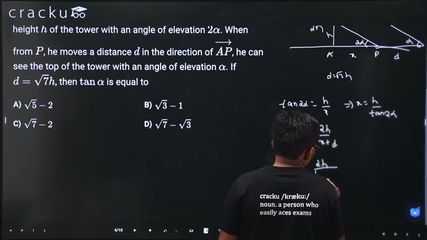
Let a vertical tower $$AB$$ of height $$2h$$ stands on a horizontal ground. Let from a point $$P$$ on the ground a man can see upto height $$h$$ of the tower with an angle of elevation $$2\alpha$$. When from $$P$$, he moves a distance $$d$$ in the direction of $$\overrightarrow{AP}$$, he can see the top of the tower with an angle of elevation $$\alpha$$. If $$d = \sqrt{7}h$$, then $$\tan \alpha$$ is equal to
Let
$$AP=x$$
Initially, the man sees the point on the tower at height
$$h$$
with angle of elevation
$$2\alpha$$.
Therefore,
$$\tan 2\alpha=\frac{h}{x}$$
After moving a distance
$$d=\sqrt7\,h$$
away from the tower, his distance from the foot of the tower becomes
$$x+\sqrt7\,h$$
and he sees the top of the tower of height
$$2h$$
with angle of elevation
$$\alpha$$.
Hence,
$$\tan\alpha=\frac{2h}{x+\sqrt7\,h}$$
Let
$$t=\tan\alpha$$
Then
$$x=\frac{h}{\tan2\alpha}$$
Using
$$\tan2\alpha=\frac{2t}{1-t^2}$$
we get
$$x=\frac{h(1-t^2)}{2t}$$
Substituting into
$$t=\frac{2h}{x+\sqrt7\,h}$$
gives
$$t=\frac{2}{\frac{1-t^2}{2t}+\sqrt7}$$
Multiplying through,
$$\frac{1-t^2}{2t}+\sqrt7=\frac{2}{t}$$
Multiplying by
$$2t$$,
$$1-t^2+2\sqrt7\,t=4$$
$$t^2-2\sqrt7\,t+3=0$$
Solving,
$$t=\frac{2\sqrt7\pm\sqrt{28-12}}{2}$$
$$=\frac{2\sqrt7\pm4}{2}$$
$$=\sqrt7\pm2$$
Since
$$\alpha$$
is acute and
$$2\alpha<90^\circ$$,
we must have
$$\tan\alpha<1$$.
Therefore,
$$t=\sqrt7-2$$
Hence
$$\tan\alpha=\sqrt7-2$$
Final Answer :
$$\sqrt7-2$$
Was this solution helpful?
Click on the Email ☝️ to Watch the Video Solution
Create a FREE account and get:
_1.webp)

Educational materials for JEE preparation

Ask our AI anything

AI can make mistakes. Please verify important information.
AI can make mistakes. Please verify important information.
