
Join Our JEE Preparation Group
Prep with like-minded aspirants; Get access to free daily tests and study material.
Sign in
Please select an account to continue using cracku.in
↓ →
Join Our JEE Preparation Group
Prep with like-minded aspirants; Get access to free daily tests and study material.
Let $$A = \begin{bmatrix} 1 & 0 & 0 \\ 0 & \alpha & \beta \\ 0 & \beta & \alpha \end{bmatrix}$$ and $$|2A|^3 = 2^{21}$$ where $$\alpha, \beta \in Z$$, Then a value of $$\alpha$$ is
Given matrix $$A = \begin{bmatrix} 1 & 0 & 0 \\ 0 & \alpha & \beta \\ 0 & \beta & \alpha \end{bmatrix}$$ and the condition $$|2A|^3 = 2^{21}$$, with $$\alpha, \beta \in \mathbb{Z}$$.
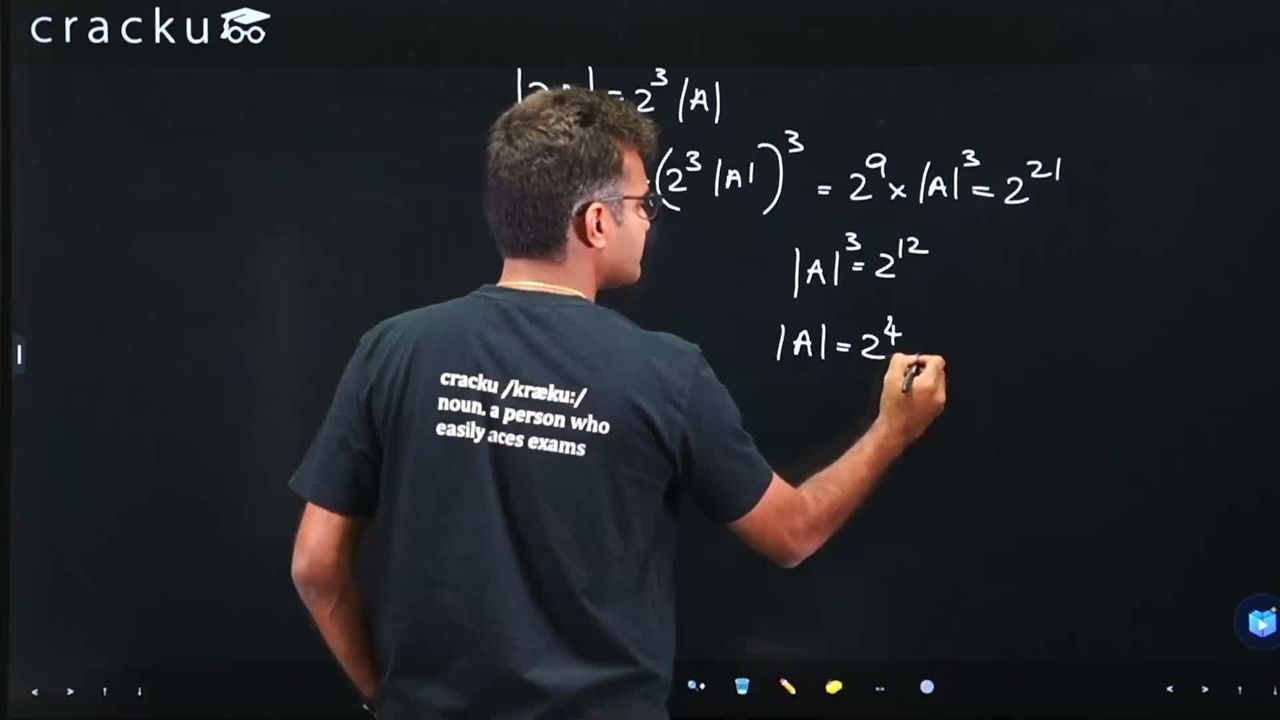
First, recall that for an $$n \times n$$ matrix, $$|kA| = k^n |A|$$. Here, $$A$$ is a 3x3 matrix, so $$n=3$$. Thus, $$|2A| = 2^3 |A| = 8 |A|$$.
Substitute into the given condition: $$(8 |A|)^3 = 2^{21}$$. Since $$8 = 2^3$$, this becomes: $$(2^3 |A|)^3 = 2^{21}$$. Simplifying the exponents: $$2^{9} |A|^3 = 2^{21}$$.
Divide both sides by $$2^9$$: $$|A|^3 = 2^{12}$$. Taking the cube root: $$|A| = 2^{4} = 16$$. Therefore, the determinant of $$A$$ is 16.
Now, compute the determinant of $$A$$. Expanding along the first row: $$|A| = 1 \cdot \begin{vmatrix} \alpha & \beta \\ \beta & \alpha \end{vmatrix} - 0 \cdot (\ldots) + 0 \cdot (\ldots) = \alpha^2 - \beta^2$$.
So, $$\alpha^2 - \beta^2 = 16$$. Factorizing: $$(\alpha - \beta)(\alpha + \beta) = 16$$. Since $$\alpha$$ and $$\beta$$ are integers, both $$\alpha - \beta$$ and $$\alpha + \beta$$ are integers and must be even (as their product is even and both must have the same parity).
Set $$x = \alpha - \beta$$ and $$y = \alpha + \beta$$, so $$x \cdot y = 16$$, and both $$x$$ and $$y$$ are even integers. The even factor pairs of 16 are: $$(2,8)$$, $$(4,4)$$, $$(8,2)$$, $$(-2,-8)$$, $$(-4,-4)$$, $$(-8,-2)$$.
Solve for $$\alpha$$ and $$\beta$$ in each pair using $$\alpha = \frac{x + y}{2}$$ and $$\beta = \frac{y - x}{2}$$:
The possible values of $$\alpha$$ are $$5, 4, -5, -4$$. Comparing with the options: A. $$3$$, B. $$5$$, C. $$17$$, D. $$9$$, the value $$\alpha = 5$$ is present (option B).
Verification for $$\alpha = 5$$, $$\beta = 3$$: $$A = \begin{bmatrix} 1 & 0 & 0 \\ 0 & 5 & 3 \\ 0 & 3 & 5 \end{bmatrix}$$, $$|A| = 5^2 - 3^2 = 25 - 9 = 16$$. Then $$|2A| = 8 \times 16 = 128$$, and $$|2A|^3 = 128^3 = (2^7)^3 = 2^{21}$$, which satisfies the condition.
Checking other options:
Thus, the only valid value from the options is $$\alpha = 5$$.
Was this solution helpful?
Click on the Email ☝️ to Watch the Video Solution
Create a FREE account and get:
_1.webp)

Educational materials for JEE preparation

Ask our AI anything

AI can make mistakes. Please verify important information.
AI can make mistakes. Please verify important information.
