
Join Our JEE Preparation Group
Prep with like-minded aspirants; Get access to free daily tests and study material.
Sign in
Please select an account to continue using cracku.in
↓ →
Join Our JEE Preparation Group
Prep with like-minded aspirants; Get access to free daily tests and study material.
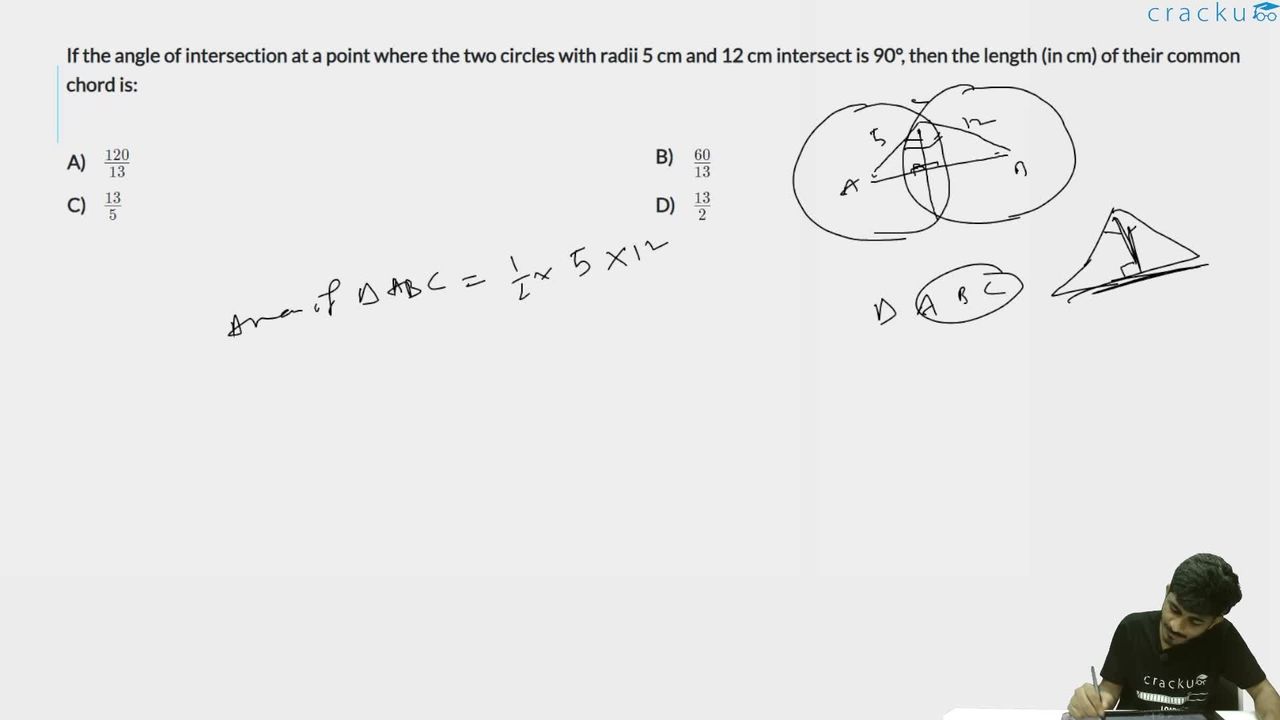
If the angle of intersection at a point where the two circles with radii 5 cm and 12 cm intersect is 90°, then the length (in cm) of their common chord is:
Let the centres of the two circles be $$O_1$$ and $$O_2$$ with radii
$$O_1P = r_1 = 5\ \text{cm},\qquad O_2P = r_2 = 12\ \text{cm}.$$
At the point of intersection $$P$$ the angle of intersection of the circles is given to be $$90^\circ$$. The angle of intersection is defined as the angle between the tangents drawn to the two circles at the common point, and this angle is equal to the angle between the radii drawn to that point because a radius is always perpendicular to the tangent at its end point on the circle. Hence
$$\angle O_1 P O_2 = 90^\circ.$$
Thus the triangle $$\triangle O_1 P O_2$$ is a right-angled triangle with the right angle at $$P$$. Therefore, by the Pythagoras theorem, the distance $$d$$ between the two centres is
$$d = O_1O_2 = \sqrt{O_1P^2 + O_2P^2} = \sqrt{5^2 + 12^2} = \sqrt{25 + 144} = \sqrt{169} = 13\ \text{cm}.$$
The two circles intersect in two points. Denote the second intersection point by $$Q$$. The segment $$PQ$$ is their common chord. It is well known (and can be proved from symmetry) that the common chord is perpendicular to the line joining the two centres, and its midpoint $$M$$ lies on $$\overline{O_1O_2}$$. Let
$$O_1M = x,\qquad O_2M = d - x = 13 - x.$$
In the right triangle $$\triangle O_1MP$$ we have
$$O_1P = 5,\quad O_1M = x,\quad MP = \sqrt{O_1P^2 - O_1M^2} = \sqrt{5^2 - x^2} = \sqrt{25 - x^2}.$$
Similarly, in the right triangle $$\triangle O_2MP$$ we have
$$O_2P = 12,\quad O_2M = 13 - x,\quad MP = \sqrt{O_2P^2 - O_2M^2} = \sqrt{12^2 - (13 - x)^2} = \sqrt{144 - (13 - x)^2}.$$
Because both expressions represent the same length $$MP$$, we equate them:
$$\sqrt{25 - x^2} = \sqrt{144 - (13 - x)^2}.$$
Squaring both sides gives
$$25 - x^2 = 144 - (13 - x)^2.$$
First expand the square on the right:
$$(13 - x)^2 = 13^2 - 2\cdot13\cdot x + x^2 = 169 - 26x + x^2.$$
Substituting this, we obtain
$$25 - x^2 = 144 - \bigl(169 - 26x + x^2\bigr).$$
Remove the parentheses:
$$25 - x^2 = 144 - 169 + 26x - x^2.$$
Notice that $$-x^2$$ appears on both sides; adding $$x^2$$ to each side eliminates it:
$$25 = -25 + 26x.$$
Now isolate $$x$$:
$$26x = 25 + 25 = 50 \quad\Longrightarrow\quad x = \frac{50}{26} = \frac{25}{13}\ \text{cm}.$$
With $$x$$ known, find the half-length of the chord:
$$MP = \sqrt{25 - x^2} = \sqrt{25 - \left(\frac{25}{13}\right)^2} = \sqrt{25 - \frac{625}{169}} = \sqrt{\frac{25\cdot169 - 625}{169}} = \sqrt{\frac{4225 - 625}{169}} = \sqrt{\frac{3600}{169}} = \frac{60}{13}\ \text{cm}.$$
Therefore the full length of the common chord is
$$PQ = 2\,MP = 2\left(\frac{60}{13}\right) = \frac{120}{13}\ \text{cm}.$$
Hence, the correct answer is Option A.
Was this solution helpful?
Click on the Email ☝️ to Watch the Video Solution
Create a FREE account and get:
_1.webp)

Educational materials for JEE preparation

Ask our AI anything

AI can make mistakes. Please verify important information.
AI can make mistakes. Please verify important information.
