
Join Our JEE Preparation Group
Prep with like-minded aspirants; Get access to free daily tests and study material.
Sign in
Please select an account to continue using cracku.in
↓ →
Join Our JEE Preparation Group
Prep with like-minded aspirants; Get access to free daily tests and study material.
First recall some basic logical equivalences that we will use repeatedly.
$$p \rightarrow q$$ is equivalent to $$\neg p \vee q$$ $$-(1)$$
De Morgan’s laws: $$\neg(p \wedge q)=\neg p \vee \neg q$$ and $$\neg(p \vee q)=\neg p \wedge \neg q$$.
We will analyse every option one by one and see whether the statement is always true (tautology) or not.
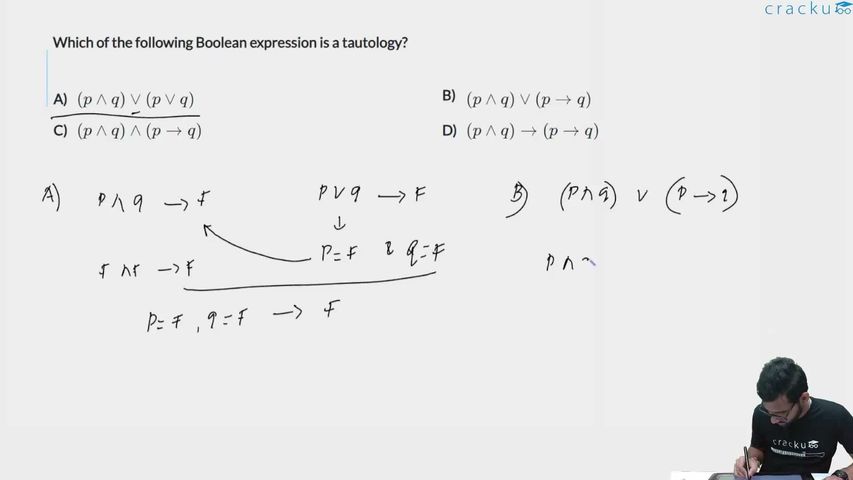
Case A:
Expression: $$ (p \wedge q) \vee (p \vee q) $$
The term $$p \vee q$$ already contains every situation covered by $$p \wedge q$$, so using the absorption law
$$ (p \wedge q) \vee (p \vee q)=p \vee q $$.
$$p \vee q$$ is not always true (for $$p=\text{False},\,q=\text{False}$$ it is False).
Hence Option A is NOT a tautology.
Case B:
Expression: $$ (p \wedge q) \vee (p \rightarrow q) $$
Using $$-(1)$$, rewrite:
$$ (p \wedge q) \vee (\neg p \vee q) $$.
Group the disjunctions:
$$ =(\neg p \vee q) \vee (p \wedge q) $$.
Construct a truth-table for the three literals $$\neg p,\,q,\,p \wedge q$$ (or test the four combinations of $$p,q$$):
• $$p=\text{T},\,q=\text{T}$$: expression T
• $$p=\text{T},\,q=\text{F}$$: $$\neg p \vee q=\text{F},\,p\wedge q=\text{F}$$ ⇒ overall F
As it becomes False, the statement is not a tautology. Hence Option B is NOT a tautology.
Case C:
Expression: $$ (p \wedge q) \wedge (p \rightarrow q) $$
Again substitute $$p \rightarrow q=\neg p \vee q$$:
$$ (p \wedge q) \wedge (\neg p \vee q) $$.
If $$p=\text{F},\;q=\text{T}$$ then the first part $$p \wedge q=\text{F}$$, so whole expression is False. Therefore it is NOT a tautology.
Case D:
Expression: $$ (p \wedge q) \rightarrow (p \rightarrow q) $$
First convert the implication using $$-(1)$$:
$$ (p \wedge q) \rightarrow (p \rightarrow q)=\neg(p \wedge q) \vee (p \rightarrow q) $$
Apply De Morgan’s law on the first term and $$-(1)$$ on the second term:
$$ =(\neg p \vee \neg q) \vee (\neg p \vee q) $$
Associativity and commutativity of $$\vee$$ let us group the literals:
$$ =\neg p \vee \neg q \vee q $$
But $$\neg q \vee q$$ is always True, so
$$\neg p \vee (\neg q \vee q)=\neg p \vee \text{True}=\text{True}$$
Since the expression reduces to True for every choice of $$p$$ and $$q$$, it is a tautology.
Therefore, only Option D $$\big((p \wedge q) \rightarrow (p \rightarrow q)\big)$$ is a tautology.
Final Answer: Option D.
Was this solution helpful?
Click on the Email ☝️ to Watch the Video Solution
Create a FREE account and get:
_1.webp)

Educational materials for JEE preparation

Ask our AI anything

AI can make mistakes. Please verify important information.
AI can make mistakes. Please verify important information.
