
Join Our JEE Preparation Group
Prep with like-minded aspirants; Get access to free daily tests and study material.
Sign in
Please select an account to continue using cracku.in
↓ →
Join Our JEE Preparation Group
Prep with like-minded aspirants; Get access to free daily tests and study material.
The value of $$\lim_{n \to \infty} \frac{[r] + [2r] + \ldots + [nr]}{n^2}$$, where $$r$$ is non-zero real number and $$[r]$$ denotes the greatest integer less than or equal to $$r$$, is equal to:
We need to find $$\lim_{n \to \infty} \frac{[r] + [2r] + \ldots + [nr]}{n^2}$$, where $$[x]$$ denotes the greatest integer function.
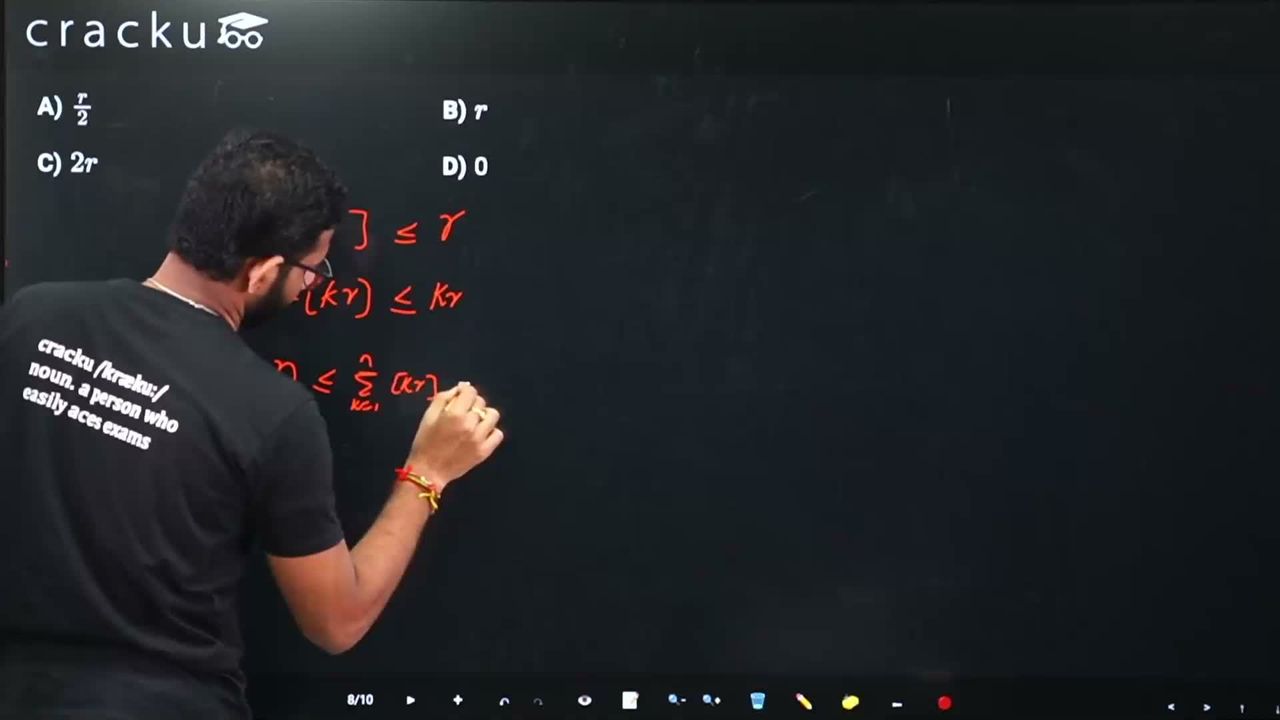
We use the property that for any real number $$x$$, we have $$x - 1 < [x] \leq x$$. Applying this to each term $$[kr]$$ for $$k = 1, 2, \ldots, n$$:
$$kr - 1 < [kr] \leq kr$$.
Summing from $$k = 1$$ to $$n$$: $$\sum_{k=1}^{n}(kr - 1) < \sum_{k=1}^{n}[kr] \leq \sum_{k=1}^{n}kr$$.
The right side equals $$r \cdot \frac{n(n+1)}{2}$$, and the left side equals $$r \cdot \frac{n(n+1)}{2} - n$$.
Dividing everything by $$n^2$$: $$\frac{r \cdot \frac{n(n+1)}{2} - n}{n^2} < \frac{\sum_{k=1}^{n}[kr]}{n^2} \leq \frac{r \cdot \frac{n(n+1)}{2}}{n^2}$$.
As $$n \to \infty$$, the left bound becomes $$\frac{r}{2} \cdot \frac{n+1}{n} - \frac{1}{n} \to \frac{r}{2}$$, and the right bound becomes $$\frac{r}{2} \cdot \frac{n+1}{n} \to \frac{r}{2}$$.
By the Squeeze Theorem, the limit equals $$\frac{r}{2}$$, which is Option A.
Was this solution helpful?
Click on the Email ☝️ to Watch the Video Solution
Create a FREE account and get:
_1.webp)

Educational materials for JEE preparation

Ask our AI anything

AI can make mistakes. Please verify important information.
AI can make mistakes. Please verify important information.


