
Join Our JEE Preparation Group
Prep with like-minded aspirants; Get access to free daily tests and study material.
Sign in
Please select an account to continue using cracku.in
↓ →
Join Our JEE Preparation Group
Prep with like-minded aspirants; Get access to free daily tests and study material.
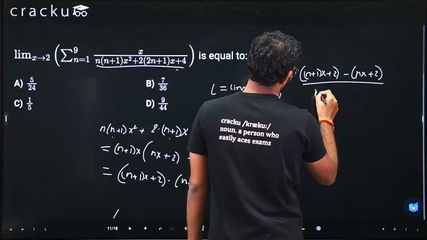
$$\lim_{x \to 2}\left(\sum_{n=1}^{9} \frac{x}{n(n+1)x^2 + 2(2n+1)x + 4}\right)$$ is equal to:
We have to evaluate the limit
$$\displaystyle \lim_{x\to 2}\left(\sum_{n=1}^{9}\frac{x}{n(n+1)x^{2}+2(2n+1)x+4}\right).$$
The first task is to understand the algebraic structure of the denominator. Observe that
$$n(n+1)x^{2}+2(2n+1)x+4$$
resembles the expansion of a product of two linear factors in $$x$$. Let us check whether it actually factors as $$(nx+2)\bigl((n+1)x+2\bigr)$$:
$$\bigl(nx+2\bigr)\bigl((n+1)x+2\bigr)=n(n+1)x^{2}+2n\,x+2(n+1)\,x+4 =n(n+1)x^{2}+2(2n+1)x+4.$$
The match is exact, so we may replace the quadratic by the product of two binomials:
$$n(n+1)x^{2}+2(2n+1)x+4=(nx+2)\bigl((n+1)x+2\bigr).$$
Substituting this factorization into the summand yields
$$\frac{x}{n(n+1)x^{2}+2(2n+1)x+4}=\frac{x}{(nx+2)\bigl((n+1)x+2\bigr)}.$$
Now we apply the standard partial-fraction decomposition for a difference of reciprocals. The useful identity is
$$\frac{1}{\alpha}-\frac{1}{\beta}=\frac{\beta-\alpha}{\alpha\beta}.$$ For our case, choose $$\alpha=nx+2,\qquad \beta=(n+1)x+2.$$ Then
$$\frac{1}{nx+2}-\frac{1}{(n+1)x+2}=\frac{(n+1)x+2-\bigl(nx+2\bigr)}{(nx+2)\bigl((n+1)x+2\bigr)} =\frac{x}{(nx+2)\bigl((n+1)x+2\bigr)}.$$
Comparing with the fraction we started from, we see that
$$\frac{x}{(nx+2)\bigl((n+1)x+2\bigr)}=\frac{1}{nx+2}-\frac{1}{(n+1)x+2}.$$
Hence every term in the summation can be rewritten as a simple difference:
$$\sum_{n=1}^{9}\frac{x}{(nx+2)\bigl((n+1)x+2\bigr)} =\sum_{n=1}^{9}\left(\frac{1}{nx+2}-\frac{1}{(n+1)x+2}\right).$$
The expression inside the large parentheses is telescopic; consecutive positive and negative terms cancel when expanded. Writing the first few and the last few terms makes the pattern clear:
$$\Bigl(\frac{1}{x+2}-\frac{1}{2x+2}\Bigr) +\Bigl(\frac{1}{2x+2}-\frac{1}{3x+2}\Bigr) +\dots +\Bigl(\frac{1}{9x+2}-\frac{1}{10x+2}\Bigr).$$
Every intermediate $$\displaystyle \frac{1}{kx+2}$$ for $$k=2,3,\dots,9$$ appears once with a plus sign and once with a minus sign, so they cancel pairwise. Only the very first positive term and the very last negative term remain:
$$\sum_{n=1}^{9}\left(\frac{1}{nx+2}-\frac{1}{(n+1)x+2}\right) =\frac{1}{x+2}-\frac{1}{10x+2}.$$
Therefore the whole limit problem reduces to substituting $$x=2$$ in this much simpler expression. Because both denominators stay non-zero at $$x=2$$, no indeterminate form arises, and we simply plug in:
$$\lim_{x\to 2}\left(\sum_{n=1}^{9}\frac{x}{n(n+1)x^{2}+2(2n+1)x+4}\right) =\frac{1}{2+2}-\frac{1}{10\cdot 2+2} =\frac{1}{4}-\frac{1}{22}.$$
To combine the fractions, use a common denominator $$4\times 22 = 88$$:
$$\frac{1}{4}-\frac{1}{22} =\frac{22-4}{88} =\frac{18}{88} =\frac{9}{44}.$$
Hence, the correct answer is Option D.
Was this solution helpful?
Click on the Email ☝️ to Watch the Video Solution
Create a FREE account and get:
_1.webp)

Educational materials for JEE preparation

Ask our AI anything

AI can make mistakes. Please verify important information.
AI can make mistakes. Please verify important information.
