
Join Our JEE Preparation Group
Prep with like-minded aspirants; Get access to free daily tests and study material.
Sign in
Please select an account to continue using cracku.in
↓ →
Join Our JEE Preparation Group
Prep with like-minded aspirants; Get access to free daily tests and study material.
Let $$y = y(x)$$ be a solution of the differential equation, $$\sqrt{1 - x^2}\frac{dy}{dx} + \sqrt{1 - y^2} = 0$$, $$|x| < 1$$. If $$y\left(\frac{1}{2}\right) = \frac{\sqrt{3}}{2}$$, then $$y\left(\frac{-1}{\sqrt{2}}\right)$$ is equal to
We are given the differential equation
$$\sqrt{1 - x^{2}}\;\frac{dy}{dx}\;+\;\sqrt{1 - y^{2}}\;=\;0,\qquad |x| < 1.$$
First we isolate the derivative term. We have
$$\sqrt{1 - x^{2}}\;\frac{dy}{dx} \;=\;-\sqrt{1 - y^{2}}.$$
Now we divide both sides by $$\sqrt{1 - y^{2}}$$ and by $$\sqrt{1 - x^{2}}$$ and then multiply by $$dx$$ so that every expression involving $$y$$ is on the left and every expression involving $$x$$ is on the right:
$$\frac{dy}{\sqrt{1 - y^{2}}}\;=\;-\;\frac{dx}{\sqrt{1 - x^{2}}}.$$
We integrate both sides. We recall the standard integral formula
$$\int\frac{du}{\sqrt{1 - u^{2}}}\;=\;\arcsin u\;+\;C,$$
where $$C$$ is the constant of integration. Using this formula on each side gives
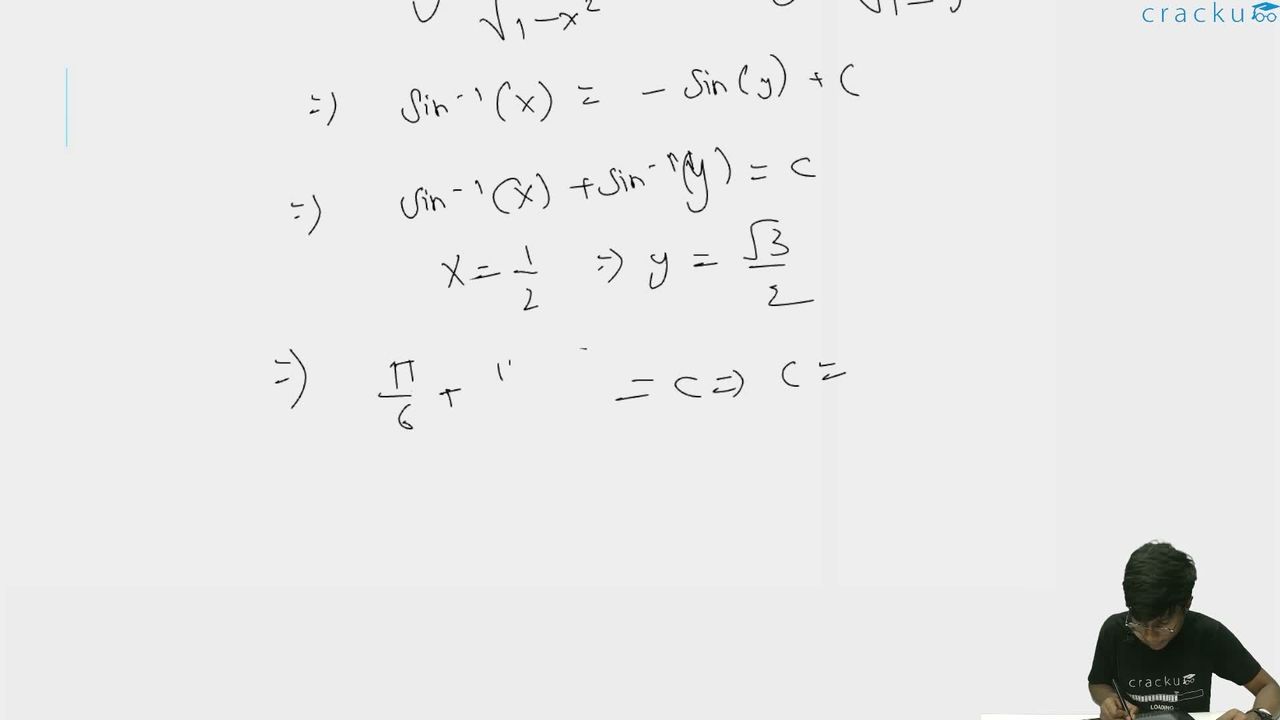
$$\arcsin y\;=\;-\,\arcsin x\;+\;C_{1}.$$
For convenience we shift the minus sign to the other term and write
$$\arcsin y\;+\;\arcsin x\;=\;C_{1}.$$
To evaluate the constant $$C_{1}$$ we employ the initial condition $$y\!\left(\dfrac12\right)=\dfrac{\sqrt3}{2}.$$ Substituting $$x=\dfrac12$$ and $$y=\dfrac{\sqrt3}{2}$$ into the last equation, we obtain
$$\arcsin\!\left(\dfrac{\sqrt3}{2}\right)\;+\;\arcsin\!\left(\dfrac12\right)\;=\;C_{1}.$$
We know the exact values $$\arcsin\!\left(\dfrac{\sqrt3}{2}\right)=\dfrac{\pi}{3}$$ and $$\arcsin\!\left(\dfrac12\right)=\dfrac{\pi}{6}.$$ Hence
$$C_{1}\;=\;\dfrac{\pi}{3}\;+\;\dfrac{\pi}{6}\;=\;\dfrac{\pi}{2}.$$
So our integral relation becomes
$$\arcsin y\;+\;\arcsin x\;=\;\dfrac{\pi}{2}.$$
We rearrange this to express $$\arcsin y$$ explicitly:
$$\arcsin y\;=\;\dfrac{\pi}{2}\;-\;\arcsin x.$$
Now we take sine on both sides. Using the co-function identity $$\sin\!\left(\dfrac{\pi}{2}-\theta\right)=\cos\theta,$$ we obtain
$$y\;=\;\sin\!\left(\dfrac{\pi}{2}-\arcsin x\right)\;=\;\cos\!\left(\arcsin x\right).$$
For any $$x$$ with $$|x|<1,$$ the right-hand side simplifies further because if $$\arcsin x = \theta,$$ then $$\sin\theta = x$$ and hence $$\cos\theta = \sqrt{1 - x^{2}}.$$ Therefore
$$y\;=\;\sqrt{1 - x^{2}}.$$
Having the explicit solution, we evaluate $$y$$ at the required point $$x=-\dfrac{1}{\sqrt2}:$$
$$y\!\left(-\dfrac{1}{\sqrt2}\right)\;=\;\sqrt{1-\left(-\dfrac{1}{\sqrt2}\right)^{2}} =\;\sqrt{1-\dfrac12} =\;\sqrt{\dfrac12} =\;\dfrac{1}{\sqrt2}.$$
Hence, the correct answer is Option C.
Was this solution helpful?
Click on the Email ☝️ to Watch the Video Solution
Create a FREE account and get:
_1.webp)

Educational materials for JEE preparation

Ask our AI anything

AI can make mistakes. Please verify important information.
AI can make mistakes. Please verify important information.
