
Join Our JEE Preparation Group
Prep with like-minded aspirants; Get access to free daily tests and study material.
Sign in
Please select an account to continue using cracku.in
↓ →
Join Our JEE Preparation Group
Prep with like-minded aspirants; Get access to free daily tests and study material.
If $$\int \frac{\cos x \, dx}{\sin^3 x (1+\sin^6 x)^{2/3}} = f(x)(1 + \sin^6 x)^{1/\lambda} + c$$, where c is a constant of integration, then $$\lambda f\left(\frac{\pi}{3}\right)$$ is equal to
We have to evaluate the integral
$$I=\int \dfrac{\cos x \, dx}{\sin^3x\,(1+\sin^6x)^{2/3}}$$
and then express the result in the form
$$I=f(x)\,(1+\sin^6x)^{1/\lambda}+c,$$
so that the numbers $$\lambda$$ and $$f\!\left(\dfrac{\pi}{3}\right)$$ can be identified.
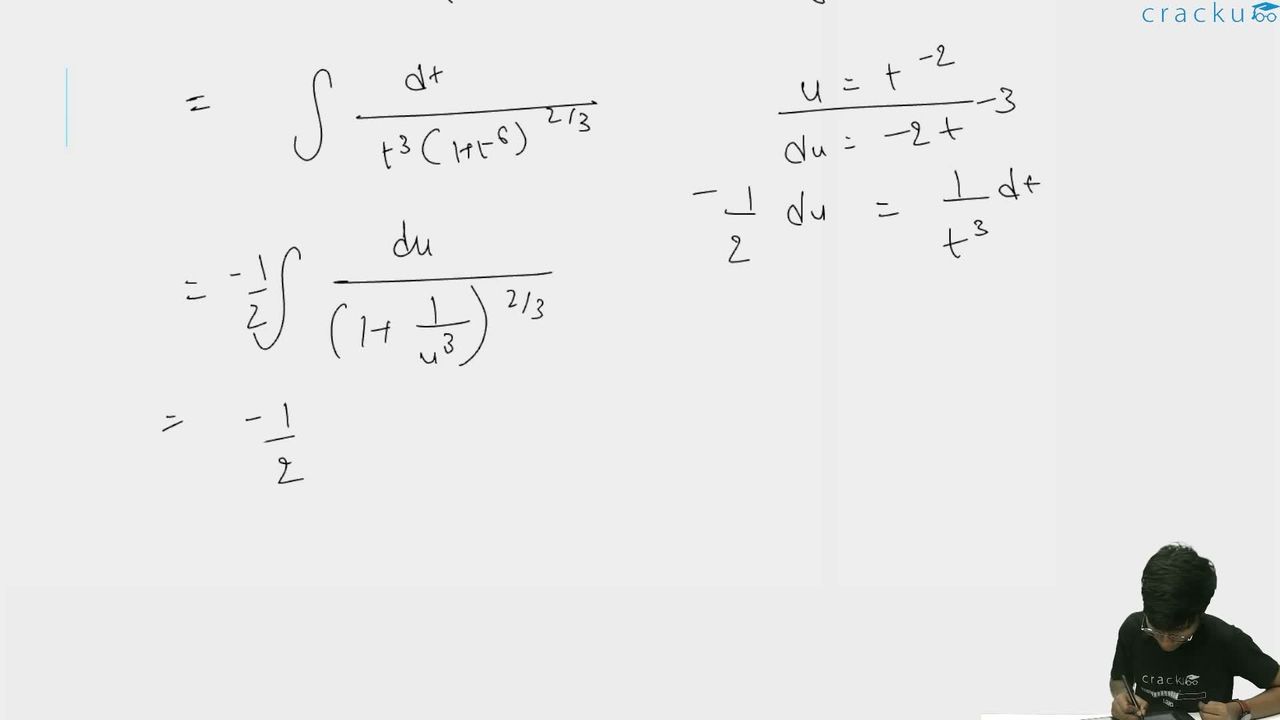
First put $$t=\sin x\;.$$ Then $$dt=\cos x\,dx,$$ and the integral becomes
$$I=\int \dfrac{dt}{t^{3}\,(1+t^{6})^{2/3}}.$$
To remove the power $$t^{-3}$$ we introduce a second substitution. Let
$$v=t^{-2}\quad\Longrightarrow\quad dv=-2t^{-3}\,dt,$$
or equivalently
$$t^{-3}\,dt=-\dfrac12\,dv.$$
Hence
$$I=-\dfrac12\int \dfrac{dv}{\bigl(1+t^{6}\bigr)^{2/3}} =-\dfrac12\int \dfrac{dv}{\bigl(1+v^{-3}\bigr)^{2/3}},\qquad \text{since }t^{6}=v^{-3}.$$
Now write
$$1+v^{-3}=\dfrac{v^{3}+1}{v^{3}},$$
so that
$$\bigl(1+v^{-3}\bigr)^{-2/3} =\bigl(v^{3}+1\bigr)^{-2/3}\,v^{2}.$$
Therefore
$$I=-\dfrac12\int (v^{3}+1)^{-2/3}\,v^{2}\,dv.$$
At this stage make the third and final substitution
$$u=v^{3}+1\quad\Longrightarrow\quad du=3v^{2}\,dv,$$
so that $$v^{2}\,dv=\dfrac{du}{3}.$$ The integral now simplifies to
$$I=-\dfrac12\int u^{-2/3}\,\dfrac{du}{3} =-\dfrac16\int u^{-2/3}\,du.$$
We use the power-rule formula
$$\int u^{n}\,du=\dfrac{u^{n+1}}{n+1}\quad(n\neq-1).$$
Here $$n=-\dfrac23,$$ so $$n+1=\dfrac13.$$ Thus
$$I=-\dfrac16\;\dfrac{u^{1/3}}{1/3} =-\dfrac16\cdot3\,u^{1/3} =-\dfrac12\,u^{1/3}+C,$$
where $$C$$ is the constant of integration.
Re-substituting successively $$u=v^{3}+1$$ and $$v=t^{-2}=\sin^{-2}x,$$ we get
$$u^{1/3}=(v^{3}+1)^{1/3} =\Bigl(\sin^{-6}x+1\Bigr)^{1/3} =\dfrac{(1+\sin^{6}x)^{1/3}}{\sin^{2}x}.$$
Hence
$$I=-\dfrac12\,\dfrac{(1+\sin^{6}x)^{1/3}}{\sin^{2}x}+C.$$
Comparing this with the required pattern
$$I=f(x)\,(1+\sin^{6}x)^{1/\lambda}+c,$$
we clearly have
$$\frac1\lambda=\frac13\quad\Longrightarrow\quad\boxed{\lambda=3},$$
and
$$f(x)=-\dfrac{1}{2\sin^{2}x}.$$
We now evaluate $$f(x)$$ at $$x=\dfrac{\pi}{3}:$$
$$\sin\!\left(\dfrac{\pi}{3}\right)=\dfrac{\sqrt3}{2} \;\Longrightarrow\; \sin^{2}\!\left(\dfrac{\pi}{3}\right)=\dfrac34.$$
Therefore
$$f\!\left(\dfrac{\pi}{3}\right) =-\dfrac12\;\dfrac1{\frac34} =-\dfrac12\cdot\dfrac43 =-\dfrac23.$$
Finally,
$$\lambda\,f\!\left(\dfrac{\pi}{3}\right) =3\left(-\dfrac23\right) =-2.$$
Hence, the correct answer is Option D.
Was this solution helpful?
Click on the Email ☝️ to Watch the Video Solution
Create a FREE account and get:
_1.webp)

Educational materials for JEE preparation

Ask our AI anything

AI can make mistakes. Please verify important information.
AI can make mistakes. Please verify important information.
