
Join Our JEE Preparation Group
Prep with like-minded aspirants; Get access to free daily tests and study material.
Sign in
Please select an account to continue using cracku.in
↓ →
Join Our JEE Preparation Group
Prep with like-minded aspirants; Get access to free daily tests and study material.
If $$y = y(x)$$ is the solution of the differential equation, $$e^y\left(\frac{dy}{dx} - 1\right) = e^x$$ such that $$y(0) = 0$$, then $$y(1)$$ is equal to
We start with the given differential equation
$$e^{y}\left(\frac{dy}{dx}-1\right)=e^{x}.$$
First, divide both sides by $$e^{y}$$ to make the derivative term explicit. This gives
$$\frac{dy}{dx}-1=e^{x-y}.$$
Now add $$1$$ to both sides so that $$\dfrac{dy}{dx}$$ appears alone on the left:
$$\frac{dy}{dx}=1+e^{x-y}.$$
The presence of the combination $$x-y$$ in the exponential suggests the substitution
$$v=x-y.$$
Because $$y=x-v$$, we find its derivative with respect to $$x$$:
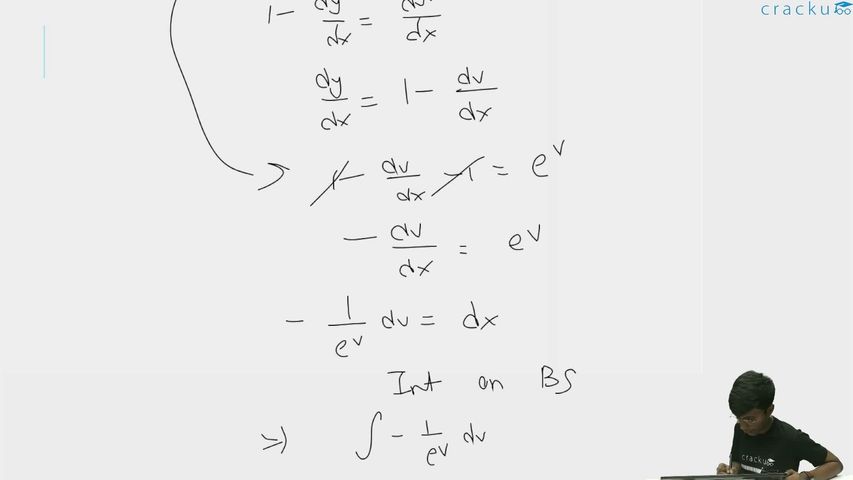
$$\frac{dy}{dx}=1-\frac{dv}{dx}.$$
Substitute this expression for $$\dfrac{dy}{dx}$$ back into the equation $$\dfrac{dy}{dx}=1+e^{x-y}$$. We obtain
$$1-\frac{dv}{dx}=1+e^{v},$$
because $$x-y=v$$ implies $$e^{x-y}=e^{v}.$$
Subtract $$1$$ from both sides:
$$-\frac{dv}{dx}=e^{v}.$$
Multiply both sides by $$-1$$ to isolate $$\dfrac{dv}{dx}$$ with a positive coefficient:
$$\frac{dv}{dx}=-e^{v}.$$
We now have a separable first-order differential equation. Rewrite it in the separated form
$$\frac{dv}{e^{v}}=-\,dx.$$
Recall the integral formula $$\displaystyle\int e^{-v}\,dv=-e^{-v}+C$$. Express $$\dfrac{1}{e^{v}}$$ as $$e^{-v}$$ and integrate both sides:
$$\int e^{-v}\,dv=\int -\,dx.$$
The left integral evaluates to $$-e^{-v}$$, while the right integral simply gives $$-x+C$$, where $$C$$ is an arbitrary constant of integration. Hence
$$-e^{-v}=-x+C.$$
Multiply through by $$-1$$ to tidy the constants:
$$e^{-v}=x-C.$$
Rename $$-C$$ as a new constant $$C_1$$ for simplicity:
$$e^{-v}=x+C_1.$$
Take the reciprocal exponential to a logarithmic form by noticing that $$e^{-v}=e^{-(x-y)}=e^{y-x}$$. Therefore
$$e^{y-x}=x+C_1.$$
Apply the natural logarithm on both sides to solve for $$y$$:
$$y-x=\ln\!\bigl(x+C_1\bigr).$$
Add $$x$$ to both sides, giving the general solution
$$y=x+\ln\!\bigl(x+C_1\bigr).$$
Use the initial condition $$y(0)=0$$ to determine the constant $$C_1$$. Substituting $$x=0$$ and $$y=0$$ gives
$$0=0+\ln\!\bigl(0+C_1\bigr)\quad\Longrightarrow\quad \ln C_1=0.$$
The only positive number whose natural logarithm is zero is $$1$$, so
$$C_1=1.$$
Therefore the particular solution satisfying the initial condition is
$$y=x+\ln\!\bigl(x+1\bigr).$$
We now evaluate this at $$x=1$$:
$$y(1)=1+\ln(1+1)=1+\ln 2.$$
Hence, the correct answer is Option A.
Was this solution helpful?
Click on the Email ☝️ to Watch the Video Solution
Create a FREE account and get:
_1.webp)

Educational materials for JEE preparation

Ask our AI anything

AI can make mistakes. Please verify important information.
AI can make mistakes. Please verify important information.


