
Join Our JEE Preparation Group
Prep with like-minded aspirants; Get access to free daily tests and study material.
Sign in
Please select an account to continue using cracku.in
↓ →
Join Our JEE Preparation Group
Prep with like-minded aspirants; Get access to free daily tests and study material.
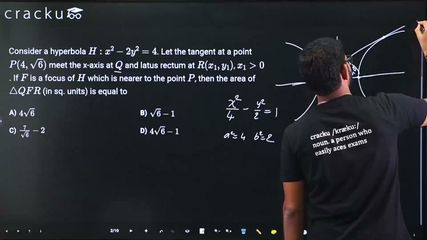
Consider a hyperbola $$H : x^2 - 2y^2 = 4$$. Let the tangent at a point $$P(4, \sqrt{6})$$ meet the x-axis at $$Q$$ and latus rectum at $$R(x_1, y_1)$$, $$x_1 > 0$$. If $$F$$ is a focus of $$H$$ which is nearer to the point $$P$$, then the area of $$\triangle QFR$$ (in sq. units) is equal to
The hyperbola is $$\frac{x^2}{4} - \frac{y^2}{2} = 1$$, so $$a^2 = 4$$, $$b^2 = 2$$, $$c^2 = a^2 + b^2 = 6$$, and $$c = \sqrt{6}$$. The foci are at $$(\pm\sqrt{6}, 0)$$. Since $$P = (4, \sqrt{6})$$ has $$x > 0$$, the nearer focus is $$F = (\sqrt{6}, 0)$$.
The tangent at $$P(4, \sqrt{6})$$ to $$\frac{x^2}{4} - \frac{y^2}{2} = 1$$ is $$\frac{4x}{4} - \frac{\sqrt{6}\,y}{2} = 1$$, i.e., $$x - \frac{\sqrt{6}}{2}y = 1$$. Setting $$y = 0$$ gives the x-intercept $$Q = (1, 0)$$.
The right latus rectum is the vertical line $$x = \sqrt{6}$$. Substituting into the tangent equation: $$\sqrt{6} - \frac{\sqrt{6}}{2}y = 1$$, so $$\frac{\sqrt{6}}{2}y = \sqrt{6} - 1$$, giving $$y = \frac{2(\sqrt{6}-1)}{\sqrt{6}} = 2 - \frac{2}{\sqrt{6}}$$. Thus $$R = \left(\sqrt{6},\; 2 - \frac{2}{\sqrt{6}}\right)$$.
We have $$Q = (1, 0)$$, $$F = (\sqrt{6}, 0)$$, and $$R = \left(\sqrt{6}, 2 - \frac{2}{\sqrt{6}}\right)$$. Since $$Q$$ and $$F$$ both lie on the x-axis, the base $$QF$$ has length $$\sqrt{6} - 1$$. The height is the y-coordinate of $$R$$, which is $$2 - \frac{2}{\sqrt{6}}$$. So the area is $$\frac{1}{2}(\sqrt{6}-1)\left(2 - \frac{2}{\sqrt{6}}\right) = \frac{1}{2}(\sqrt{6}-1) \cdot \frac{2(\sqrt{6}-1)}{\sqrt{6}} = \frac{(\sqrt{6}-1)^2}{\sqrt{6}} = \frac{6 - 2\sqrt{6} + 1}{\sqrt{6}} = \frac{7 - 2\sqrt{6}}{\sqrt{6}} = \frac{7}{\sqrt{6}} - 2$$.
Was this solution helpful?
Click on the Email ☝️ to Watch the Video Solution
Create a FREE account and get:
_1.webp)

Educational materials for JEE preparation

Ask our AI anything

AI can make mistakes. Please verify important information.
AI can make mistakes. Please verify important information.
