JEE WhatsApp Group
Sign in
Please select an account to continue using cracku.in
↓ →
JEE WhatsApp Group

Join Our JEE Preparation Group
Prep with like-minded aspirants; Get access to free daily tests and study material.
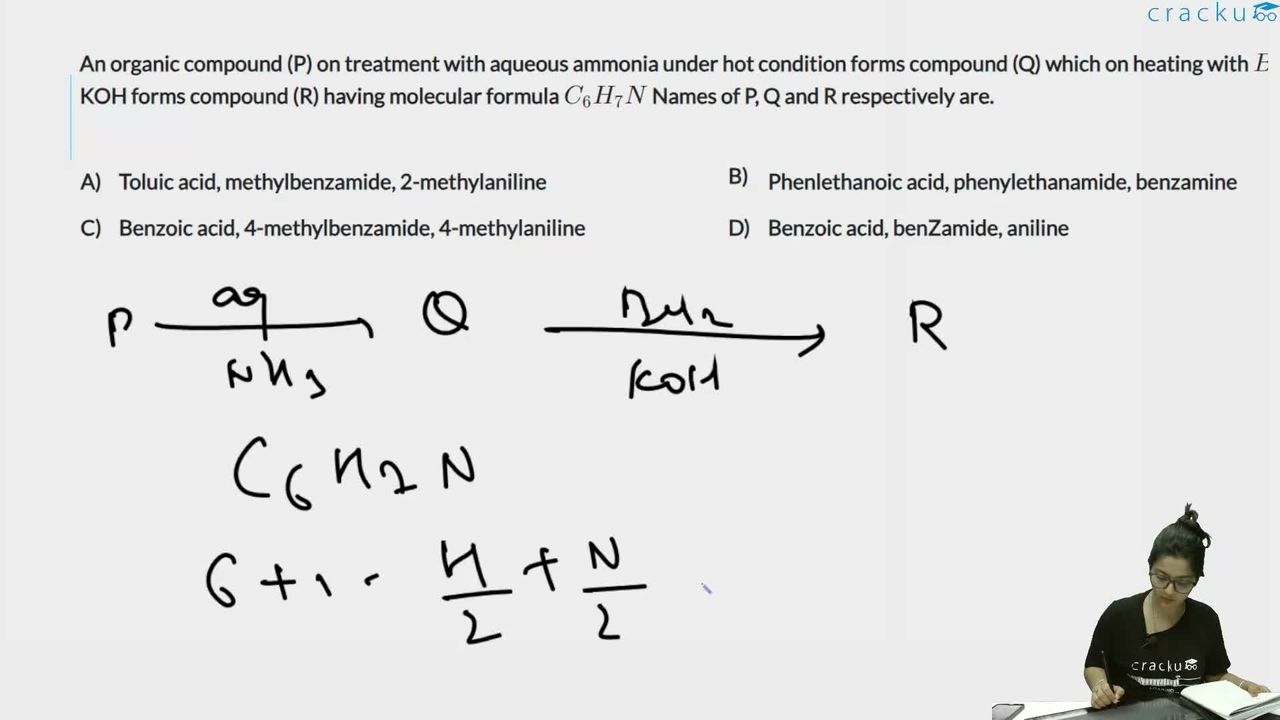
An organic compound (P) on treatment with aqueous ammonia under hot condition forms compound (Q) which on heating with $$Br_{2}$$ and KOH forms compound (R) having molecular formula $$C_{6}H_{7}N$$ Names of P, Q and R respectively are.
Organic compound P reacts with aqueous ammonia (hot) to form Q, which on Hofmann degradation (Br₂/KOH) gives R with molecular formula $$C_6H_7N$$. We need to identify P, Q, and R.
$$C_6H_7N$$ corresponds to aniline ($$C_6H_5NH_2$$): molecular formula check: 6C + 7H + 1N = $$C_6H_7N$$ $$\checkmark$$.
In Hofmann degradation, an amide ($$RCONH_2$$) is converted to an amine ($$RNH_2$$) with one fewer carbon atom:
$$ RCONH_2 + Br_2 + 4KOH \rightarrow RNH_2 + K_2CO_3 + 2KBr + 2H_2O $$
Since R is aniline ($$C_6H_5NH_2$$), Q must be benzamide ($$C_6H_5CONH_2$$), which has one more carbon than aniline.
Q (benzamide) is formed from P by reaction with aqueous ammonia under hot conditions. The reaction of a carboxylic acid with ammonia under heating produces an amide:
$$ C_6H_5COOH + NH_3 \rightarrow C_6H_5COONH_4 \xrightarrow{\Delta} C_6H_5CONH_2 + H_2O $$
Therefore, P is benzoic acid ($$C_6H_5COOH$$).
The correct answer is Option (4): Benzoic acid, benzamide, aniline.
Click on the Email ☝️ to Watch the Video Solution
Create a FREE account and get:
_1.webp)

Educational materials for JEE preparation

Ask our AI anything

AI can make mistakes. Please verify important information.
AI can make mistakes. Please verify important information.