
Join Our JEE Preparation Group
Prep with like-minded aspirants; Get access to free daily tests and study material.
Sign in
Please select an account to continue using cracku.in
↓ →
Join Our JEE Preparation Group
Prep with like-minded aspirants; Get access to free daily tests and study material.
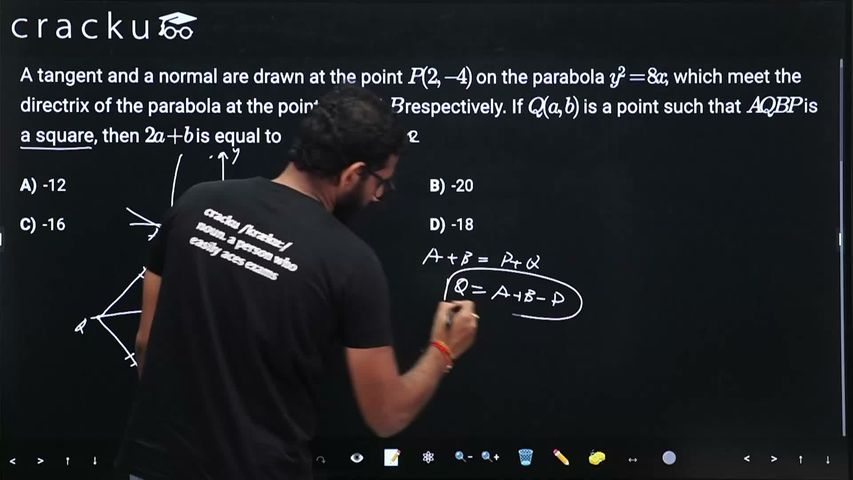
A tangent and a normal are drawn at the point $$P(2, -4)$$ on the parabola $$y^2 = 8x$$, which meet the directrix of the parabola at the points $$A$$ and $$B$$ respectively. If $$Q(a, b)$$ is a point such that $$AQBP$$ is a square, then $$2a + b$$ is equal to
We have the parabola $$y^{2}=8x$$.
First we compare it with the standard form $$y^{2}=4ax$$. Thus $$4a=8$$ and we get $$a=2$$. The directrix of a parabola $$y^{2}=4ax$$ is always $$x=-a$$, so here the directrix is the vertical line $$x=-2$$.
The point given on the curve is $$P(2,-4)$$. Because $$( -4)^{2}=16=8\cdot 2$$, the point indeed lies on the parabola.
For a parabola in the form $$y^{2}=4ax$$, the tangent at a point $$(x_{1},y_{1})$$ on the curve is given by the standard formula
$$yy_{1}=2a\,(x+x_{1}).$$
Substituting $$x_{1}=2,\;y_{1}=-4,\;a=2$$ gives
$$y(-4)=2\cdot 2\,(x+2).$$
So $$-4y=4(x+2)\;\Longrightarrow\;-4y=4x+8.$$
Dividing by $$-4$$ we obtain the equation of the tangent:
$$x+y+2=0.$$
To find its intersection with the directrix $$x=-2$$, we put $$x=-2$$ in this equation:
$$-2+y+2=0\;\Longrightarrow\;y=0.$$
Hence the tangent meets the directrix at $$A(-2,0).$$
Now we need the normal at $$P(2,-4)$$. First we compute the slope of the tangent. Differentiating $$y^{2}=8x$$ gives $$2y\dfrac{dy}{dx}=8,$$ hence
$$\dfrac{dy}{dx}=\frac{4}{y}.$$
At $$P(2,-4)$$ we have $$\dfrac{dy}{dx}=\dfrac{4}{-4}=-1.$$ Therefore the slope of the tangent is $$-1,$$ while the slope of the normal is the negative reciprocal, namely $$1.$$
The normal passing through $$P(2,-4)$$ with slope $$1$$ has equation
$$y+4=1\,(x-2),$$
which simplifies to
$$x-y-6=0.$$
This normal meets the directrix $$x=-2$$ at the point obtained by substituting $$x=-2$$:
$$-2-y-6=0\;\Longrightarrow\;-y-8=0\;\Longrightarrow\;y=-8.$$
Hence the normal meets the directrix at $$B(-2,-8).$$
At this stage we know three vertices of the desired square: $$A(-2,0),\;P(2,-4),\;B(-2,-8).$$
Let us check some distances. The segment $$AB$$ lies entirely on the directrix and its length is
$$AB=\sqrt{(-2+2)^{2}+(0+8)^{2}}=\sqrt{0^{2}+8^{2}}=8.$$
The segments $$PA$$ and $$PB$$ have lengths
$$PA=\sqrt{(2+2)^{2}+(-4-0)^{2}}=\sqrt{4^{2}+(-4)^{2}}=\sqrt{16+16}=4\sqrt{2},$$
$$PB=\sqrt{(2+2)^{2}+(-4+8)^{2}}=\sqrt{4^{2}+4^{2}}=\sqrt{16+16}=4\sqrt{2}.$$
Thus $$PA=PB,$$ and $$AB=8=4\sqrt{2}\times\sqrt{2}.$$ Therefore $$AB$$ is a diagonal of a square whose side is $$4\sqrt{2}.$$ The square is $$AQBP$$ in that cyclic order, so indeed $$A$$ and $$B$$ are opposite vertices, while $$P$$ and the unknown $$Q(a,b)$$ are the other opposite vertices.
For any square, the two diagonals are perpendicular and bisect each other. Hence their common midpoint is the centre of the square. The midpoint of the diagonal $$AB$$ is therefore the centre $$O$$ of the square:
$$O\left(\frac{-2+(-2)}{2},\;\frac{0+(-8)}{2}\right)=(-2,-4).$$
Because $$OP$$ is half of one diagonal and $$OA$$ is half of the other, we calculate $$\overrightarrow{OP}=(2-(-2),\; -4-(-4))=(4,0),$$ $$\overrightarrow{OA}=(-2-(-2),\; 0-(-4))=(0,4).$$ Indeed $$\overrightarrow{OP}$$ is perpendicular to $$\overrightarrow{OA},$$ as required.
The second vertex on the same diagonal as $$P$$ is obtained by reversing this vector through the centre, i.e. by taking the negative of $$\overrightarrow{OP}$$. Hence
$$\overrightarrow{OQ}=-\overrightarrow{OP}=(-4,0).$$
Adding this to the coordinates of $$O(-2,-4)$$ gives the coordinates of $$Q$$:
$$Q(-2-4,\;-4+0)=(-6,-4).$$
Thus $$a=-6,\;b=-4,$$ and we require $$2a+b$$:
$$2a+b=2(-6)+(-4)=-12-4=-16.$$
Hence, the correct answer is Option C.
Was this solution helpful?
Click on the Email ☝️ to Watch the Video Solution
Create a FREE account and get:
_1.webp)

Educational materials for JEE preparation

Ask our AI anything

AI can make mistakes. Please verify important information.
AI can make mistakes. Please verify important information.
