
Join Our JEE Preparation Group
Prep with like-minded aspirants; Get access to free daily tests and study material.
Sign in
Please select an account to continue using cracku.in
↓ →
Join Our JEE Preparation Group
Prep with like-minded aspirants; Get access to free daily tests and study material.
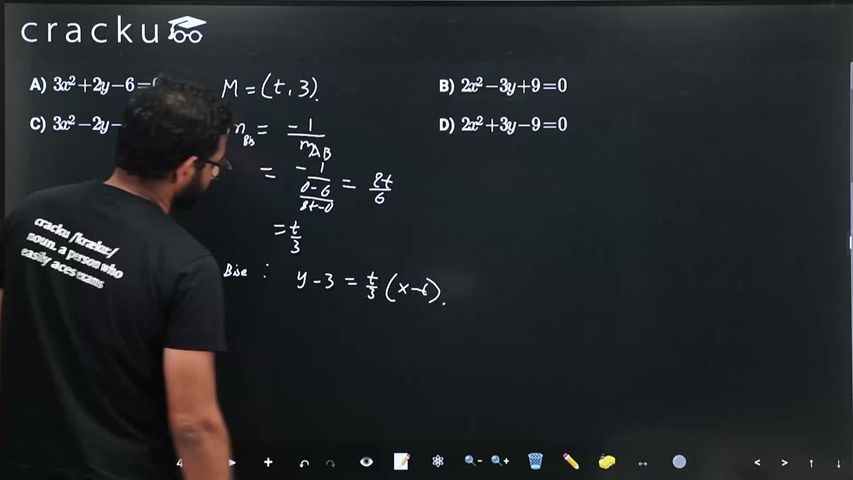
Let $$A$$ be a fixed point $$(0, 6)$$ and $$B$$ be a moving point $$(2t, 0)$$. Let $$M$$ be the mid-point of $$AB$$ and the perpendicular bisector of $$AB$$ meets the y-axis at $$C$$. The locus of the mid-point $$P$$ of MC is
We have the fixed point $$A(0,\,6)$$ and the moving point $$B(2t,\,0)$$, where $$t$$ is a real parameter.
First we find the midpoint $$M$$ of $$AB$$. The midpoint formula states: if the endpoints are $$(x_1,\,y_1)$$ and $$(x_2,\,y_2)$$, then the midpoint is $$\left(\dfrac{x_1+x_2}{2},\;\dfrac{y_1+y_2}{2}\right).$$ Hence
$$M\;=\;\left(\dfrac{0+2t}{2},\;\dfrac{6+0}{2}\right)\;=\;\left(t,\,3\right).$$
Now we write the equation of the perpendicular bisector of $$AB$$. The slope of $$AB$$ is found from the two-point slope formula $$m=\dfrac{y_2-y_1}{x_2-x_1}$$:
$$m_{AB}\;=\;\dfrac{0-6}{2t-0}\;=\;-\dfrac{6}{2t}\;=\;-\dfrac{3}{t}.$$
The slope of a line perpendicular to another is the negative reciprocal, so
$$m_{\perp}\;=\;-\dfrac{1}{m_{AB}}\;=\;-\dfrac{1}{-\dfrac{3}{t}}\;=\;\dfrac{t}{3}.$$
The perpendicular bisector passes through $$M(t,\,3)$$, so using the point-slope form $$y-y_0=m(x-x_0),$$ we get
$$y-3=\dfrac{t}{3}\,(x-t).$$
Next we locate its intersection $$C$$ with the $$y$$-axis. On the $$y$$-axis we have $$x=0$$, so we substitute $$x=0$$:
$$y-3=\dfrac{t}{3}\,(0-t)=-\dfrac{t^2}{3}\;\;\Longrightarrow\;\;y=3-\dfrac{t^2}{3}.$$
Thus $$C\;(0,\,3-\dfrac{t^2}{3}).$$
We are asked for the locus of the midpoint $$P$$ of $$MC$$. Again using the midpoint formula between $$M(t,\,3)$$ and $$C\!\left(0,\,3-\dfrac{t^2}{3}\right)$$, we obtain
$$x_P=\dfrac{t+0}{2}=\dfrac{t}{2},$$ $$y_P=\dfrac{\,3+\left(3-\dfrac{t^2}{3}\right)}{2}=\dfrac{\,6-\dfrac{t^2}{3}}{2}=3-\dfrac{t^2}{6}.$$
Let $$P(x,\,y)$$ denote a general position of this midpoint. Then
$$x=\dfrac{t}{2}\;\;\Longrightarrow\;\;t=2x.$$
Substituting this value of $$t$$ into the expression for $$y$$ gives
$$y=3-\dfrac{(2x)^2}{6}=3-\dfrac{4x^2}{6}=3-\dfrac{2x^2}{3}.$$
To eliminate fractions, multiply by $$3$$:
$$3y=9-2x^2.$$
Rearranging all terms to one side, we finally obtain the Cartesian equation of the locus:
$$2x^2+3y-9=0.$$
This equation coincides with Option D in the given list. Hence, the correct answer is Option D.
Was this solution helpful?
Click on the Email ☝️ to Watch the Video Solution
Create a FREE account and get:
_1.webp)

Educational materials for JEE preparation

Ask our AI anything

AI can make mistakes. Please verify important information.
AI can make mistakes. Please verify important information.
