
Join Our JEE Preparation Group
Prep with like-minded aspirants; Get access to free daily tests and study material.
Sign in
Please select an account to continue using cracku.in
↓ →
Join Our JEE Preparation Group
Prep with like-minded aspirants; Get access to free daily tests and study material.
$$\sum_{k=0}^{20} \left({}^{20}C_k\right)^2$$ is equal to
We begin with the well-known Binomial Theorem, which states that for any non-negative integer $$n$$,
$$ (1+x)^{\,n}= \sum_{k=0}^{n} {^{\,n}C_k}\,x^{\,k}. $$
Now, in our question we see the expression $$\displaystyle\sum_{k=0}^{20}\bigl({^{20}C_k}\bigr)^2$$. A classical way to evaluate such a square-of-coefficients sum is to multiply two identical binomial expansions and compare coefficients.
First, write down two identical expansions of $$(1+x)^{20}$$:
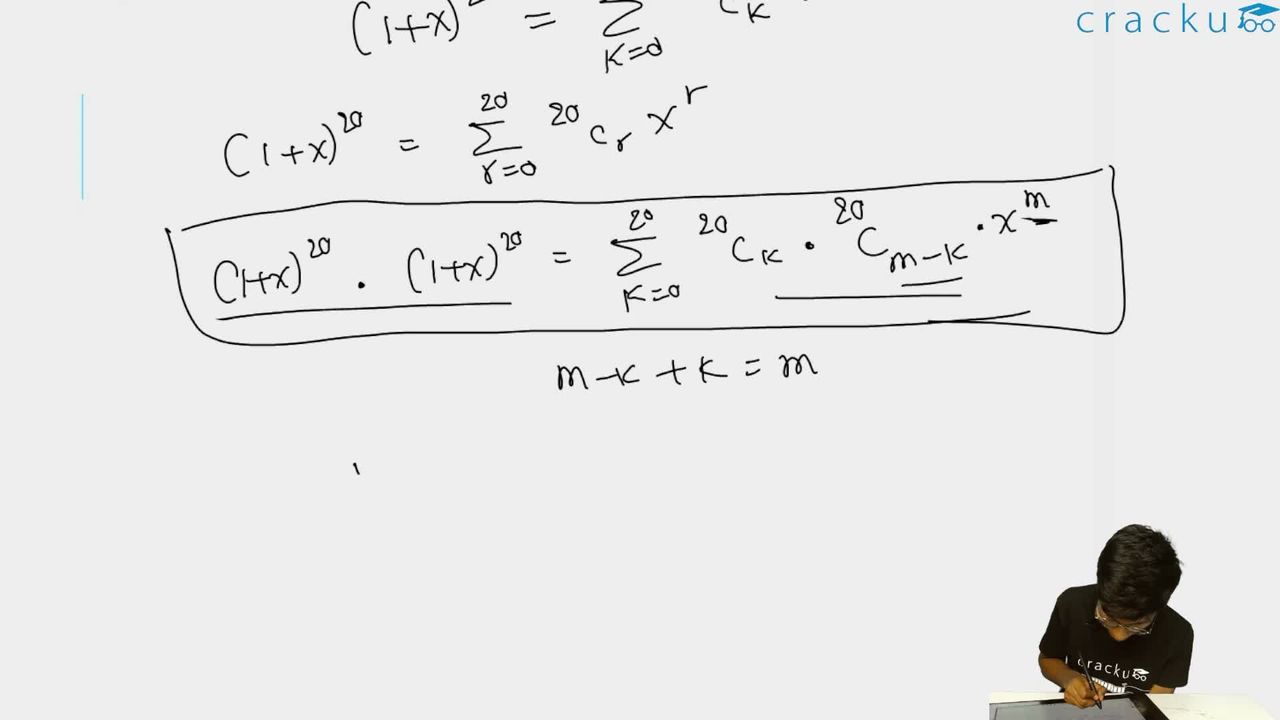
$$ (1+x)^{20}= \sum_{k=0}^{20}{^{20}C_k}\,x^{\,k}, \qquad (1+x)^{20}= \sum_{r=0}^{20}{^{20}C_r}\,x^{\,r}. $$
Multiplying these two series term by term we get
$$ (1+x)^{20}\,(1+x)^{20}= (1+x)^{40}. $$
On the left-hand side, the Cauchy product of the two sums is
$$ \Bigl(\sum_{k=0}^{20}{^{20}C_k}\,x^{\,k}\Bigr) \Bigl(\sum_{r=0}^{20}{^{20}C_r}\,x^{\,r}\Bigr) = \sum_{m=0}^{40}\;\Bigl(\sum_{k=0}^{m}{^{20}C_k}\,{^{20}C_{m-k}}\Bigr)\,x^{\,m}. $$
In particular, we are interested in the coefficient of $$x^{20}$$. Setting $$m=20$$ in the inner sum we have
$$ \sum_{k=0}^{20}{^{20}C_k}\,{^{20}C_{20-k}}. $$
But the symmetry property of binomial coefficients gives $$ {^{20}C_{20-k}}={^{20}C_k}. $$ Therefore the coefficient of $$x^{20}$$ on the left becomes
$$ \sum_{k=0}^{20}\bigl({^{20}C_k}\bigr)^2. $$
On the right-hand side, the expansion of $$(1+x)^{40}$$ using the Binomial Theorem is
$$ (1+x)^{40}= \sum_{m=0}^{40}{^{40}C_m}\,x^{\,m}. $$
Hence the coefficient of $$x^{20}$$ on the right is simply $$ {^{40}C_{20}}. $$
Since both series represent the same polynomial $$(1+x)^{40}$$, their coefficients of the same powers of $$x$$ must be equal. Setting the two expressions for the coefficient of $$x^{20}$$ equal, we get
$$ \sum_{k=0}^{20}\bigl({^{20}C_k}\bigr)^2 \;=\; {^{40}C_{20}}. $$
Thus, the required sum equals $$ {^{40}C_{20}} $$. This matches Option C.
Hence, the correct answer is Option C.
Was this solution helpful?
Click on the Email ☝️ to Watch the Video Solution
Create a FREE account and get:
_1.webp)

Educational materials for JEE preparation

Ask our AI anything

AI can make mistakes. Please verify important information.
AI can make mistakes. Please verify important information.
