
Join Our JEE Preparation Group
Prep with like-minded aspirants; Get access to free daily tests and study material.
Sign in
Please select an account to continue using cracku.in
↓ →
Join Our JEE Preparation Group
Prep with like-minded aspirants; Get access to free daily tests and study material.
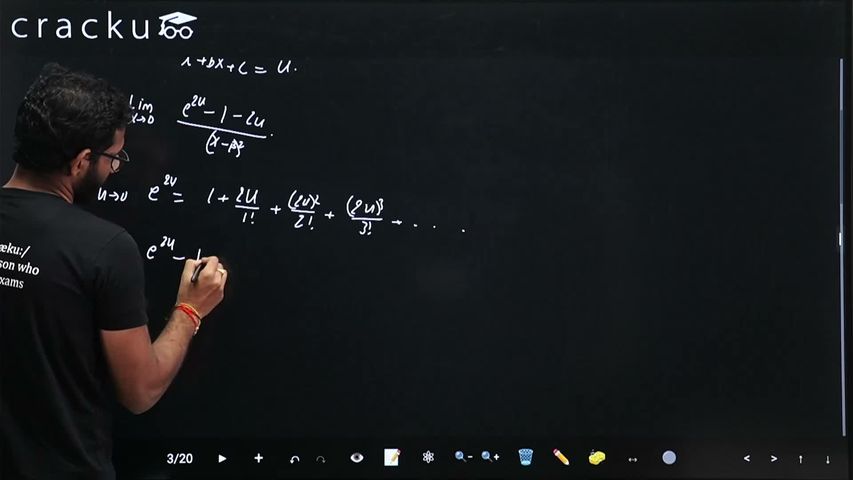
If $$\alpha, \beta$$ are the distinct roots of $$x^2 + bx + c = 0$$, then $$\lim_{x \to \beta} \frac{e^{2(x^2+bx+c)} - 1 - 2(x^2+bx+c)}{(x-\beta)^2}$$ is equal to
We have a quadratic polynomial $$f(x)=x^{2}+bx+c$$ whose distinct real roots are $$\alpha$$ and $$\beta$$, so that $$f(\beta)=0$$.
We must evaluate the limit
$$\displaystyle L=\lim_{x\to\beta}\dfrac{e^{2\bigl(x^{2}+bx+c\bigr)}-1-2\bigl(x^{2}+bx+c\bigr)}{(x-\beta)^{2}}.$$
First recall the Maclaurin expansion of the exponential function. For any real number $$u$$,
$$e^{2u}=1+2u+\dfrac{(2u)^{2}}{2!}+\dfrac{(2u)^{3}}{3!}+\dots$$
Simplifying the first few terms we obtain
$$e^{2u}=1+2u+2u^{2}+\dfrac{4u^{3}}{3!}+\dots.$$
Subtracting $$1+2u$$ from both sides gives
$$e^{2u}-1-2u=2u^{2}+\dfrac{4u^{3}}{3!}+\dots.$$
Near $$u=0$$ the higher-order terms (those containing $$u^{3},u^{4},\dots$$) are negligible compared with $$u^{2}$$, so the dominant behaviour is
$$e^{2u}-1-2u\;=\;2u^{2}+O(u^{3}).$$
In the given limit the role of $$u$$ is played by $$f(x)=x^{2}+bx+c$$. Therefore, when $$x$$ is very close to $$\beta$$, we may write
$$e^{2f(x)}-1-2f(x)=2\bigl(f(x)\bigr)^{2}+O\!\bigl((f(x))^{3}\bigr).$$
Next we express $$f(x)$$ itself in terms of $$x-\beta$$. Because $$f(x)$$ is differentiable, its first-order Taylor expansion about $$x=\beta$$ is
$$f(x)=f(\beta)+f'(\beta)\,(x-\beta)+O\bigl((x-\beta)^{2}\bigr).$$
But $$f(\beta)=0$$ (since $$\beta$$ is a root), so
$$f(x)=f'(\beta)\,(x-\beta)+O\bigl((x-\beta)^{2}\bigr).$$
Keeping only the leading term, we have
$$f(x)\approx f'(\beta)\,(x-\beta).$$
Substituting this approximation into $$2\bigl(f(x)\bigr)^{2}$$ yields
$$e^{2f(x)}-1-2f(x)\;\approx\;2\bigl(f'(\beta)\,(x-\beta)\bigr)^{2}=2\bigl(f'(\beta)\bigr)^{2}(x-\beta)^{2}.$$
Now insert this into the required limit:
$$L=\lim_{x\to\beta}\dfrac{e^{2f(x)}-1-2f(x)}{(x-\beta)^{2}} \;=\;\lim_{x\to\beta}\dfrac{2\bigl(f'(\beta)\bigr)^{2}(x-\beta)^{2}}{(x-\beta)^{2}} \;=\;2\bigl(f'(\beta)\bigr)^{2}.$$
Thus the entire task reduces to finding the derivative $$f'(x)$$ at $$x=\beta$$. Since
$$f(x)=x^{2}+bx+c,\qquad f'(x)=2x+b,$$
we get
$$f'(\beta)=2\beta+b.$$
Therefore
$$L=2\,(2\beta+b)^{2}.$$
To express this purely in terms of the coefficients $$b$$ and $$c$$, we eliminate $$\beta$$ using the relationships between the roots and coefficients. For the quadratic $$x^{2}+bx+c=0$$ with roots $$\alpha,\beta$$ we have
$$\alpha+\beta=-b\quad\text{and}\quad\alpha\beta=c.$$
The root $$\beta$$ itself satisfies its own equation:
$$\beta^{2}+b\beta+c=0\;\Longrightarrow\;\beta^{2}=-b\beta-c.$$
Compute $$(2\beta+b)^{2}$$ explicitly:
$$\begin{aligned} (2\beta+b)^{2}&=4\beta^{2}+4b\beta+b^{2}.\\ \text{Substituting }\beta^{2}&=-b\beta-c,\\ (2\beta+b)^{2}&=4(-b\beta-c)+4b\beta+b^{2}\\ &=(-4b\beta-4c)+4b\beta+b^{2}\\ &=b^{2}-4c. \end{aligned}$$
Finally, multiply by the factor $$2$$ obtained earlier:
$$L=2\,(2\beta+b)^{2}=2\,(b^{2}-4c)=2(b^{2}-4c).$$
Hence, the correct answer is Option C.
Click on the Email ☝️ to Watch the Video Solution
Create a FREE account and get:
_1.webp)

Educational materials for JEE preparation

Ask our AI anything

AI can make mistakes. Please verify important information.
AI can make mistakes. Please verify important information.


