
Join Our JEE Preparation Group
Prep with like-minded aspirants; Get access to free daily tests and study material.
Sign in
Please select an account to continue using cracku.in
↓ →
Join Our JEE Preparation Group
Prep with like-minded aspirants; Get access to free daily tests and study material.
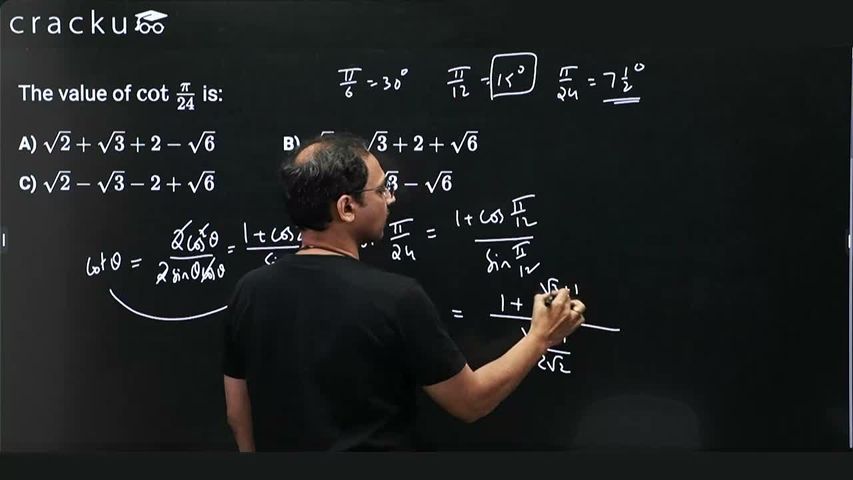
We have to evaluate $$\cot\dfrac{\pi}{24}$$. Since $$\dfrac{\pi}{24}=7.5^{\circ}$$ and $$7.5^{\circ}=\dfrac{15^{\circ}}{2}$$, it is convenient to use the half-angle identity for cotangent.
The cotangent half-angle identity is stated as
$$\cot\dfrac{\theta}{2}\;=\;\dfrac{1+\cos\theta}{\sin\theta}\,.$$
Putting $$\theta=15^{\circ}$$ gives
$$\cot7.5^{\circ}\;=\;\dfrac{1+\cos15^{\circ}}{\sin15^{\circ}}.$$
Now we need the exact values of $$\sin15^{\circ}$$ and $$\cos15^{\circ}$$. We obtain them from the compound-angle formulas with $$15^{\circ}=45^{\circ}-30^{\circ}$$.
The sine difference formula is
$$\sin(A-B)=\sin A\cos B-\cos A\sin B.$$
Hence
$$\sin15^{\circ}= \sin(45^{\circ}-30^{\circ}) = \sin45^{\circ}\cos30^{\circ}-\cos45^{\circ}\sin30^{\circ}.$$
Substituting the exact values $$\sin45^{\circ}=\dfrac{\sqrt2}{2},\; \cos45^{\circ}=\dfrac{\sqrt2}{2},\; \cos30^{\circ}=\dfrac{\sqrt3}{2},\; \sin30^{\circ}=\dfrac12,$$ we get
$$\sin15^{\circ}=\dfrac{\sqrt2}{2}\cdot\dfrac{\sqrt3}{2}-\dfrac{\sqrt2}{2}\cdot\dfrac12 =\dfrac{\sqrt6}{4}-\dfrac{\sqrt2}{4} =\dfrac{\sqrt6-\sqrt2}{4}.$$
Similarly, the cosine difference formula is
$$\cos(A-B)=\cos A\cos B+\sin A\sin B.$$
Thus
$$\cos15^{\circ}= \cos(45^{\circ}-30^{\circ}) = \cos45^{\circ}\cos30^{\circ}+\sin45^{\circ}\sin30^{\circ}.$$
Substituting the same exact values, we find
$$\cos15^{\circ}=\dfrac{\sqrt2}{2}\cdot\dfrac{\sqrt3}{2}+\dfrac{\sqrt2}{2}\cdot\dfrac12 =\dfrac{\sqrt6}{4}+\dfrac{\sqrt2}{4} =\dfrac{\sqrt6+\sqrt2}{4}.$$
With these, return to the half-angle formula:
$$\cot7.5^{\circ}= \dfrac{1+\cos15^{\circ}}{\sin15^{\circ}} = \dfrac{1+\dfrac{\sqrt6+\sqrt2}{4}}{\dfrac{\sqrt6-\sqrt2}{4}}.$$
Combine terms in the numerator:
$$1+\dfrac{\sqrt6+\sqrt2}{4}=\dfrac{4}{4}+\dfrac{\sqrt6+\sqrt2}{4} =\dfrac{4+\sqrt6+\sqrt2}{4}.$$
Therefore
$$\cot7.5^{\circ}= \dfrac{\dfrac{4+\sqrt6+\sqrt2}{4}}{\dfrac{\sqrt6-\sqrt2}{4}} =\dfrac{4+\sqrt6+\sqrt2}{\sqrt6-\sqrt2}.$$
To eliminate the denominator’s square roots we multiply numerator and denominator by the conjugate $$(\sqrt6+\sqrt2):$$
$$\cot7.5^{\circ}= \dfrac{(4+\sqrt6+\sqrt2)(\sqrt6+\sqrt2)} {(\sqrt6-\sqrt2)(\sqrt6+\sqrt2)}.$$
The denominator simplifies first:
$$(\sqrt6-\sqrt2)(\sqrt6+\sqrt2)=(\sqrt6)^2-(\sqrt2)^2=6-2=4.$$
Now expand the numerator term by term:
$$\begin{aligned} (4+\sqrt6+\sqrt2)(\sqrt6+\sqrt2) &=4(\sqrt6+\sqrt2)+\sqrt6(\sqrt6+\sqrt2)+\sqrt2(\sqrt6+\sqrt2)\\[4pt] &=4\sqrt6+4\sqrt2 +\bigl((\sqrt6)^2+\sqrt6\sqrt2\bigr) +\bigl(\sqrt2\sqrt6+(\sqrt2)^2\bigr)\\[4pt] &=4\sqrt6+4\sqrt2 +\bigl(6+\sqrt{12}\bigr) +\bigl(\sqrt{12}+2\bigr)\\[4pt] &=4\sqrt6+4\sqrt2 +6+2+\sqrt{12}+\sqrt{12}\\[4pt] &=4\sqrt6+4\sqrt2 +8+2\sqrt{12}. \end{aligned}$$
Because $$\sqrt{12}=2\sqrt3,$$ we rewrite:
$$4\sqrt6+4\sqrt2+8+2\sqrt{12}=4\sqrt6+4\sqrt2+8+4\sqrt3.$$
Thus the numerator is $$8+4\sqrt2+4\sqrt3+4\sqrt6.$$ Dividing this by the denominator $$4$$ gives
$$\cot7.5^{\circ}=\dfrac{8+4\sqrt2+4\sqrt3+4\sqrt6}{4} =\;2+\sqrt2+\sqrt3+\sqrt6.$$
But $$\cot7.5^{\circ}=\cot\dfrac{\pi}{24},$$ so
$$\cot\dfrac{\pi}{24}=2+\sqrt2+\sqrt3+\sqrt6.$$
This matches option B in the list provided. Hence, the correct answer is Option 2.
Was this solution helpful?
Click on the Email ☝️ to Watch the Video Solution
Create a FREE account and get:
_1.webp)

Educational materials for JEE preparation

Ask our AI anything

AI can make mistakes. Please verify important information.
AI can make mistakes. Please verify important information.
