
Join Our JEE Preparation Group
Prep with like-minded aspirants; Get access to free daily tests and study material.
Sign in
Please select an account to continue using cracku.in
↓ →
Join Our JEE Preparation Group
Prep with like-minded aspirants; Get access to free daily tests and study material.
If $$^nP_r = ^nP_{r+1}$$ and $$^nC_r = ^nC_{r-1}$$, then the value of $$r$$ is equal to:
We have the two relations
$$^nP_r \;=\; ^nP_{\,r+1}\qquad\text{and}\qquad ^nC_r \;=\; ^nC_{\,r-1}.$$
First we use the permutation formula
$$^nP_k \;=\; \frac{n!}{(n-k)!}.$$
Substituting $$k=r$$ and $$k=r+1$$ we obtain
$$^nP_r \;=\; \frac{n!}{(n-r)!},\qquad
^nP_{\,r+1} \;=\; \frac{n!}{(n-r-1)!}.$$
Since these two are equal, their quotient is $$1$$:
$$\frac{^nP_r}{^nP_{\,r+1}}
\;=\;
\frac{\dfrac{n!}{(n-r)!}}{\dfrac{n!}{(n-r-1)!}}
\;=\;
\frac{(n-r-1)!}{(n-r)!}
\;=\;
\frac{1}{n-r}
\;=\; 1.$$
Thus
$$n-r \;=\; 1\;\;\Longrightarrow\;\; r \;=\; n-1. \quad -(1)$$
Next we use the combination formula
$$^nC_k \;=\; \frac{n!}{k!\,(n-k)!}.$$
Putting $$k=r$$ and $$k=r-1$$ we get
$$^nC_r \;=\; \frac{n!}{r!\,(n-r)!},\qquad
^nC_{\,r-1} \;=\; \frac{n!}{(r-1)!\,(n-r+1)!}.$$
Because these two are equal, their quotient is also $$1$$:
$$\frac{^nC_r}{^nC_{\,r-1}}
\;=\;
\frac{\dfrac{n!}{r!\,(n-r)!}}
{\dfrac{n!}{(r-1)!\,(n-r+1)!}}
\;=\;
\frac{(r-1)!\,(n-r+1)!}{r!\,(n-r)!}
\;=\;
\frac{n-r+1}{r}
\;=\; 1.$$
Hence
$$n-r+1 \;=\; r
\;\;\Longrightarrow\;\;
n+1 \;=\; 2r
\;\;\Longrightarrow\;\;
r \;=\; \frac{n+1}{2}. \quad -(2)$$
Now both (1) and (2) must hold simultaneously. Equating the two expressions for $$r$$ we write
$$n-1 \;=\; \frac{n+1}{2}.$$
Multiplying by $$2$$ and simplifying, we have
$$2n-2 \;=\; n+1
\;\;\Longrightarrow\;\;
n-3 \;=\; 0
\;\;\Longrightarrow\;\;
n \;=\; 3.$$
Finally, substituting $$n=3$$ into $$r=n-1$$ gives
$$r \;=\; 3-1 \;=\; 2.$$
Therefore
$$r = 2.$$
Hence, the correct answer is Option C.
Was this solution helpful?
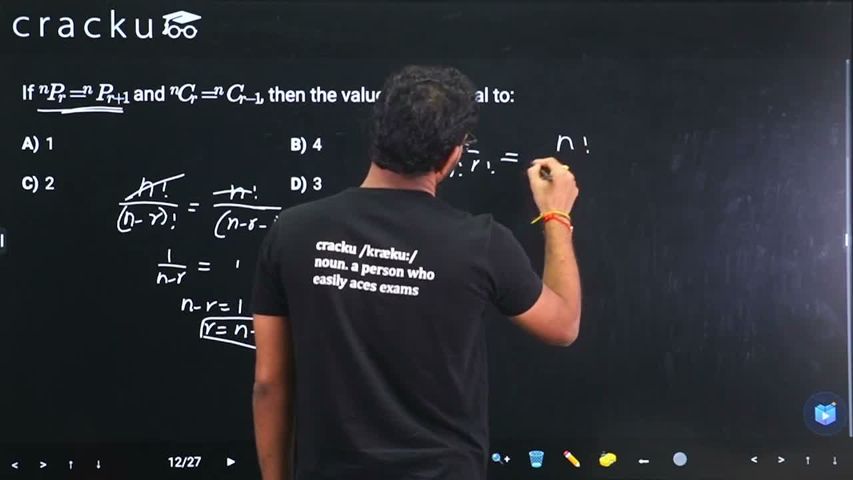
Click on the Email ☝️ to Watch the Video Solution
Create a FREE account and get:
_1.webp)

Educational materials for JEE preparation

Ask our AI anything

AI can make mistakes. Please verify important information.
AI can make mistakes. Please verify important information.
