
Join Our JEE Preparation Group
Prep with like-minded aspirants; Get access to free daily tests and study material.
Sign in
Please select an account to continue using cracku.in
↓ →
Join Our JEE Preparation Group
Prep with like-minded aspirants; Get access to free daily tests and study material.
Let $$C: x^2 + y^2 = 4$$ and $$C': x^2 + y^2 - 4\lambda x + 9 = 0$$ be two circles. If the set of all values of $$\lambda$$ so that the circles $$C$$ and $$C'$$ intersect at two distinct points, is $$\mathbb{R} - \{a, b\} $$, then the point $$8a + 12, 16b - 20$$ lies on the curve:
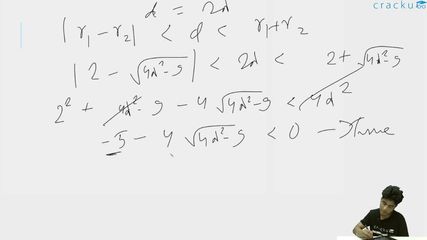
Two circles intersect at two distinct points if $$|r_1 - r_2| < d < r_1 + r_2$$, where $$d$$ is the distance between centers.
o $$C$$: Center $$C_1(0,0)$$, radius $$r_1 = 2$$.
o $$C'$$: Center $$C_2(2\lambda, 0)$$, radius $$r_2 = \sqrt{(2\lambda)^2 - 9} = \sqrt{4\lambda^2 - 9}$$.
$$d = \sqrt{(2\lambda - 0)^2 + 0} = |2\lambda|$$.
$$4\lambda^2 - 9 > 0 \implies |\lambda| > 3/2$$.
Condition: $$|r_1 - r_2| < d < r_1 + r_2 \implies (r_1 - r_2)^2 < d^2 < (r_1 + r_2)^2$$.
$$d^2 < (r_1 + r_2)^2 \implies 4\lambda^2 < (2 + \sqrt{4\lambda^2 - 9})^2$$
$$4\lambda^2 < 4 + (4\lambda^2 - 9) + 4\sqrt{4\lambda^2 - 9} \implies 5 < 4\sqrt{4\lambda^2 - 9}$$
$$25 < 16(4\lambda^2 - 9) \implies 25 < 64\lambda^2 - 144 \implies 64\lambda^2 > 169 \implies |\lambda| > 13/8$$.
Also check $$(r_1 - r_2)^2 < d^2$$, which yields the same result.
The range is $$|\lambda| > 13/8$$, which is $$\mathbb{R} - [-13/8, 13/8]$$.
So, $$a = -13/8$$ and $$b = 13/8$$.
$$x = 8a + 12 = 8(-13/8) + 12 = -13 + 12 = -1$$.
$$y = 16b - 20 = 16(13/8) - 20 = 26 - 20 = 6$$.
Point $$(x, y) = (-1, 6)$$
Plug $$(-1, 6)$$ into $$6x^2 + y^2 = 42$$: $$6(-1)^2 + (6)^2 = 6 + 36 = 42$$.
The point lies on $$6x^2 + y^2 = 42$$.
Was this solution helpful?
Click on the Email ☝️ to Watch the Video Solution
Create a FREE account and get:
_1.webp)

Educational materials for JEE preparation

Ask our AI anything

AI can make mistakes. Please verify important information.
AI can make mistakes. Please verify important information.
