
Join Our JEE Preparation Group
Prep with like-minded aspirants; Get access to free daily tests and study material.
Sign in
Please select an account to continue using cracku.in
↓ →
Join Our JEE Preparation Group
Prep with like-minded aspirants; Get access to free daily tests and study material.
If the three normals drawn to the parabola, $$y^2 = 2x$$ pass through the point $$(a, 0)$$, $$a \neq 0$$, then $$a$$ must be greater than:
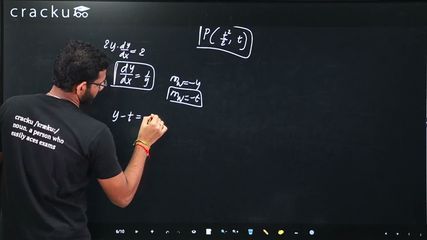
The parabola is $$y^2 = 2x$$, so comparing with $$y^2 = 4a_0 x$$, we get $$a_0 = \frac{1}{2}$$. A point on the parabola can be written in parametric form as $$P = \left(\frac{t^2}{2}, t\right)$$, since $$y = t$$ gives $$x = t^2/2$$.
The slope of the tangent at $$P$$ is obtained by differentiating $$y^2 = 2x$$: $$2y\frac{dy}{dx} = 2$$, so $$\frac{dy}{dx} = \frac{1}{y} = \frac{1}{t}$$. The slope of the normal at $$P$$ is therefore $$-t$$.
The equation of the normal at $$P\left(\frac{t^2}{2}, t\right)$$ with slope $$-t$$ is $$y - t = -t\left(x - \frac{t^2}{2}\right)$$, which simplifies to $$y = -tx + t + \frac{t^3}{2}$$.
Since this normal passes through the point $$(a, 0)$$, we substitute $$x = a$$ and $$y = 0$$: $$0 = -ta + t + \frac{t^3}{2}$$. Factoring out $$t$$: $$t\left(-a + 1 + \frac{t^2}{2}\right) = 0$$.
This gives either $$t = 0$$ (which corresponds to the normal along the x-axis through the vertex) or $$\frac{t^2}{2} = a - 1$$, i.e., $$t^2 = 2(a - 1)$$.
For three distinct normals from $$(a, 0)$$ to the parabola, we need the $$t = 0$$ solution plus two additional distinct real values of $$t$$ from $$t^2 = 2(a-1)$$. The equation $$t^2 = 2(a-1)$$ yields two distinct real roots $$t = \pm\sqrt{2(a-1)}$$ if and only if $$2(a-1) > 0$$, which requires $$a > 1$$.
If $$a = 1$$, then $$t^2 = 0$$ gives only $$t = 0$$, and we get just one normal (not three). If $$a < 1$$, there are no real solutions other than $$t = 0$$. Therefore, for three normals to exist, $$a$$ must be greater than 1.
Click on the Email ☝️ to Watch the Video Solution
Create a FREE account and get:
_1.webp)

Educational materials for JEE preparation

Ask our AI anything

AI can make mistakes. Please verify important information.
AI can make mistakes. Please verify important information.


