
Join Our JEE Preparation Group
Prep with like-minded aspirants; Get access to free daily tests and study material.
Sign in
Please select an account to continue using cracku.in
↓ →
Join Our JEE Preparation Group
Prep with like-minded aspirants; Get access to free daily tests and study material.
If $$\int \frac{d\theta}{\cos^2\theta(\tan 2\theta + \sec 2\theta)} = \lambda \tan\theta + 2\log_e|f(\theta)| + C$$ where $$C$$ is a constant of integration, then the ordered pair $$(\lambda, f(\theta))$$ is equal to:
We start with the given integral
$$I=\int \frac{d\theta}{\cos^2\theta\bigl(\tan 2\theta+\sec 2\theta\bigr)}.$$
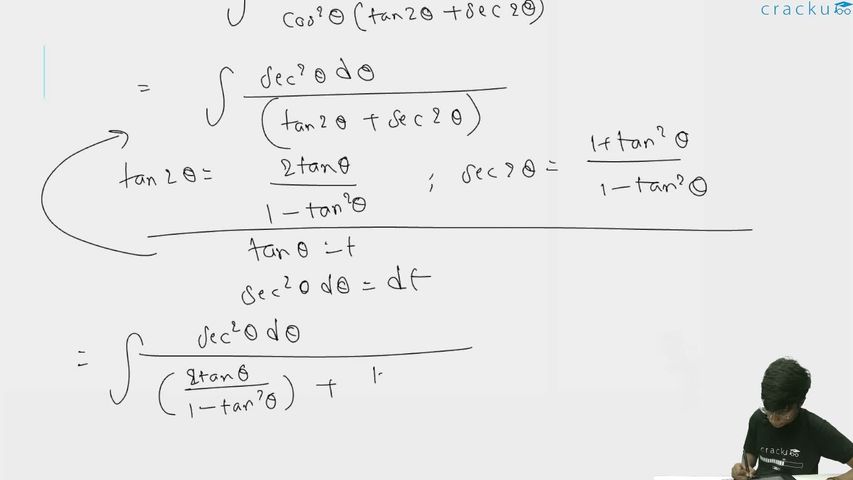
First we rewrite the terms inside the integrand by using the double-angle formulas
$$\tan 2\theta=\frac{2\tan\theta}{1-\tan^2\theta},\qquad \sec 2\theta=\frac{1}{\cos 2\theta} =\frac{1}{\dfrac{1-\tan^2\theta}{1+\tan^2\theta}} =\frac{1+\tan^2\theta}{1-\tan^2\theta}.$$
Adding these two expressions we obtain
$$\tan 2\theta+\sec 2\theta =\frac{2\tan\theta}{1-\tan^2\theta} +\frac{1+\tan^2\theta}{1-\tan^2\theta} =\frac{2\tan\theta+1+\tan^2\theta}{1-\tan^2\theta} =\frac{(\tan\theta+1)^2}{1-\tan^2\theta}.$$
Substituting this result into the original integrand, we get
$$\frac{1}{\cos^2\theta\bigl(\tan 2\theta+\sec 2\theta\bigr)} =\frac{1}{\cos^2\theta}\; \frac{1-\tan^2\theta}{(\tan\theta+1)^2}.$$
Because $$\dfrac{1}{\cos^2\theta}=\sec^2\theta,$$ the integrand becomes
$$\sec^2\theta\,\frac{1-\tan^2\theta}{(\tan\theta+1)^2}.$$
Now we perform the substitution $$t=\tan\theta,$$ so that $$dt=\sec^2\theta\,d\theta.$$ With this substitution the integral simplifies to
$$I=\int\frac{1-t^2}{(t+1)^2}\,dt.$$
Since $$1-t^2=(1-t)(1+t),$$ we can cancel one factor of $$1+t$$ with the denominator:
$$\frac{1-t^2}{(t+1)^2}=\frac{(1-t)(1+t)}{(t+1)^2}=\frac{1-t}{t+1}.$$
Next we divide the numerator by the denominator:
$$\frac{1-t}{t+1}=-1+\frac{2}{t+1},\quad\text{because }-1\cdot(t+1)+2=1-t.$$
Thus the integral becomes
$$I=\int\!\Bigl(-1+\frac{2}{t+1}\Bigr)dt =\int(-1)\,dt+2\int\frac{dt}{t+1}.$$
Evaluating each part gives
$$\int(-1)\,dt=-t,\qquad 2\int\frac{dt}{t+1}=2\ln|t+1|.$$
Therefore
$$I=-t+2\ln|t+1|+C.$$
Finally, recalling that $$t=\tan\theta,$$ we have
$$I=-\tan\theta+2\log_e|1+\tan\theta|+C.$$
Comparing this with the required form $$\lambda\tan\theta+2\log_e|f(\theta)|+C,$$ we identify
$$\lambda=-1,\qquad f(\theta)=1+\tan\theta.$$
Hence, the correct answer is Option C.
Was this solution helpful?
Click on the Email ☝️ to Watch the Video Solution
Create a FREE account and get:
_1.webp)

Educational materials for JEE preparation

Ask our AI anything

AI can make mistakes. Please verify important information.
AI can make mistakes. Please verify important information.
