
Join Our JEE Preparation Group
Prep with like-minded aspirants; Get access to free daily tests and study material.
Sign in
Please select an account to continue using cracku.in
↓ →
Join Our JEE Preparation Group
Prep with like-minded aspirants; Get access to free daily tests and study material.
Amongst the following, the total number of compounds soluble in aqueous NaOH at room temperature is:
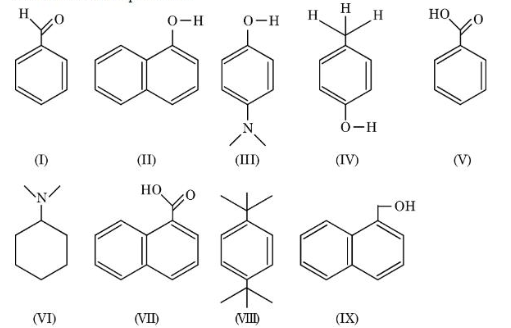
In aqueous $$NaOH$$ only those organic compounds that are sufficiently acidic (so that they can lose $$H^+$$ to give an anion) are able to dissolve, because the anion formed is ionic and hence water-soluble. Let us inspect each of the eight given compounds one by one.
(1) $$C_6H_5OH$$ (phenol)
Phenol has $$pK_a \approx 10$$. A $$10^{-1}\,$$M or stronger $$NaOH$$ solution has $$pH \ge 13$$, so phenol is completely converted into the phenoxide ion $$C_6H_5O^-$$. Therefore it dissolves.
(2) $$o\text{-}NO_2C_6H_4OH$$ (o-nitrophenol)
The $$-NO_2$$ group is an electron-withdrawing group that stabilises the phenoxide ion by $$(-M)$$ and $$(-I)$$ effects, making the compound more acidic than phenol. Hence it is easily deprotonated by $$NaOH$$ and is soluble.
(3) $$p\text{-}NO_2C_6H_4OH$$ (p-nitrophenol)
For the same reason as in (2), p-nitrophenol is even more acidic; it too dissolves after forming its phenoxide ion.
(4) $$C_6H_5SO_3H$$ (benzenesulfonic acid)
Arenesulfonic acids are very strong organic acids ($$pK_a \approx -1$$). They are deprotonated completely by even weak bases; consequently they are freely soluble in $$NaOH$$.
(5) $$C_6H_5COOH$$ (benzoic acid)
Carboxylic acids are stronger acids than phenols ($$pK_a \approx 4-5$$). They react quantitatively with $$NaOH$$ to give sodium benzoate; hence they are soluble.
(6) $$CH_3COOH$$ (acetic acid)
Being a typical carboxylic acid ($$pK_a \approx 4.8$$), it is again converted into acetate ion in the basic medium and therefore dissolves.
(7) $$C_6H_5NH_2$$ (aniline)
Aniline is a base, not an acid. It cannot donate a proton to $$OH^-$$, so it does not dissolve in aqueous $$NaOH$$.
(8) $$C_6H_5CH_2OH$$ (benzyl alcohol)
Aliphatic alcohols have $$pK_a \approx 16-18$$, far less acidic than necessary to be deprotonated by $$NaOH$$ under ordinary conditions. Hence benzyl alcohol also remains insoluble.
Compounds soluble in aqueous $$NaOH$$ at room temperature are therefore (1), (2), (3), (4), (5) and (6) — a total of $$6$$ compounds.
Hence, the correct choice is
Option C which is: $$6$$
Was this solution helpful?
Create a FREE account and get:
_1.webp)

Educational materials for JEE preparation

Ask our AI anything

AI can make mistakes. Please verify important information.
AI can make mistakes. Please verify important information.


