
Join Our JEE Preparation Group
Prep with like-minded aspirants; Get access to free daily tests and study material.
Sign in
Please select an account to continue using cracku.in
↓ →
Join Our JEE Preparation Group
Prep with like-minded aspirants; Get access to free daily tests and study material.
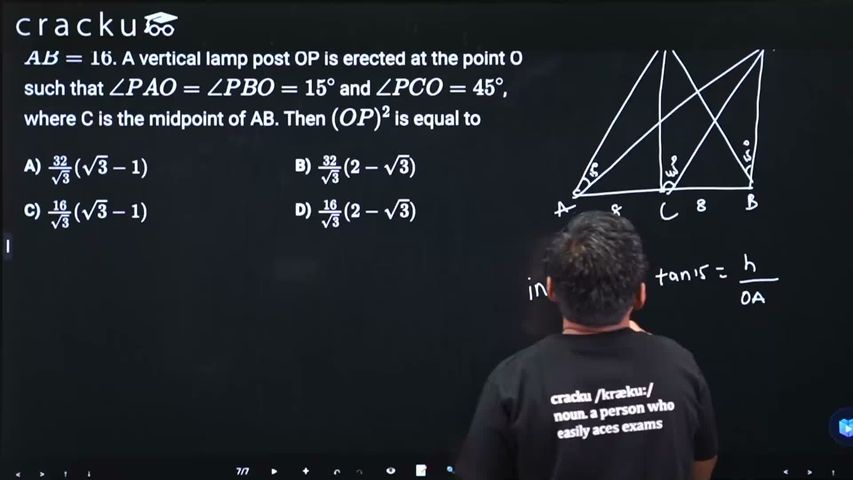
A horizontal park is in the shape of a triangle OAB with $$AB = 16$$. A vertical lamp post OP is erected at the point O such that $$\angle PAO = \angle PBO = 15^\circ$$ and $$\angle PCO = 45^\circ$$, where C is the midpoint of AB. Then $$(OP)^2$$ is equal to
We have a horizontal triangular park OAB with $$AB = 16$$ and a vertical lamp post OP at point O. C is the midpoint of AB, so $$AC = CB = 8$$. We are given $$\angle PAO = \angle PBO = 15°$$ and $$\angle PCO = 45°$$.
Since OP is vertical, the angles of elevation from A, B, and C to P are the given angles. Let $$OP = h$$. Then:
$$\tan(\angle PAO) = \frac{h}{OA} \Rightarrow OA = \frac{h}{\tan 15°}$$
$$\tan(\angle PBO) = \frac{h}{OB} \Rightarrow OB = \frac{h}{\tan 15°}$$
$$\tan(\angle PCO) = \frac{h}{OC} \Rightarrow OC = \frac{h}{\tan 45°} = h$$
Since $$OA = OB$$, triangle OAB is isosceles with O on the perpendicular bisector of AB. Therefore O lies on the line through C perpendicular to AB... actually, O lies on the perpendicular bisector of AB, which passes through C (the midpoint of AB). So O, C are on the same line perpendicular to AB, meaning $$OC$$ is the distance from O to the midpoint C along this perpendicular bisector.
In triangle OAC (right-angled at C, since OC is perpendicular to AB):
$$OA^2 = OC^2 + AC^2$$
$$\frac{h^2}{\tan^2 15°} = h^2 + 64$$
$$h^2\left(\frac{1}{\tan^2 15°} - 1\right) = 64$$
$$h^2 \cdot \frac{1 - \tan^2 15°}{\tan^2 15°} = 64$$
Now $$\tan 15° = 2 - \sqrt{3}$$, so $$\tan^2 15° = (2-\sqrt{3})^2 = 7 - 4\sqrt{3}$$.
And $$1 - \tan^2 15° = 1 - 7 + 4\sqrt{3} = -6 + 4\sqrt{3}$$.
So:
$$h^2 = \frac{64(7 - 4\sqrt{3})}{4\sqrt{3} - 6} = \frac{64(7 - 4\sqrt{3})}{2(2\sqrt{3} - 3)}$$
$$= \frac{32(7 - 4\sqrt{3})}{2\sqrt{3} - 3}$$
Rationalizing by multiplying by $$\frac{2\sqrt{3}+3}{2\sqrt{3}+3}$$:
$$= \frac{32(7 - 4\sqrt{3})(2\sqrt{3}+3)}{(2\sqrt{3})^2 - 9} = \frac{32(7 - 4\sqrt{3})(2\sqrt{3}+3)}{12 - 9} = \frac{32(7 - 4\sqrt{3})(2\sqrt{3}+3)}{3}$$
Expanding the numerator factor: $$(7 - 4\sqrt{3})(2\sqrt{3}+3) = 14\sqrt{3} + 21 - 24 - 12\sqrt{3} = 2\sqrt{3} - 3$$.
So:
$$h^2 = \frac{32(2\sqrt{3} - 3)}{3} = \frac{32}{\sqrt{3}} \cdot \frac{(2\sqrt{3}-3)\sqrt{3}}{3} = \frac{32}{\sqrt{3}} \cdot \frac{6 - 3\sqrt{3}}{3} = \frac{32}{\sqrt{3}}(2 - \sqrt{3})$$
Hence, the correct answer is Option 2.
Was this solution helpful?
Click on the Email ☝️ to Watch the Video Solution
Create a FREE account and get:
_1.webp)

Educational materials for JEE preparation

Ask our AI anything

AI can make mistakes. Please verify important information.
AI can make mistakes. Please verify important information.
