
Join Our JEE Preparation Group
Prep with like-minded aspirants; Get access to free daily tests and study material.
Sign in
Please select an account to continue using cracku.in
↓ →
Join Our JEE Preparation Group
Prep with like-minded aspirants; Get access to free daily tests and study material.
The sum of the solutions $$x \in R$$ of the equation $$\frac{3\cos 2x + \cos^3 2x}{\cos^6 x - \sin^6 x} = x^3 - x^2 + 6$$ is
We need to find the sum of solutions $$x \in \mathbb{R}$$ of the equation:
$$\frac{3\cos 2x + \cos^3 2x}{\cos^6 x - \sin^6 x} = x^3 - x^2 + 6.$$
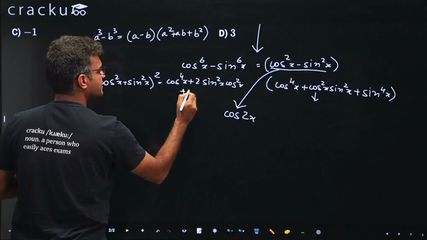
First, simplify the denominator using the factorisation of difference of cubes:
$$\cos^6 x - \sin^6 x = (\cos^2 x)^3 - (\sin^2 x)^3 = (\cos^2 x - \sin^2 x)(\cos^4 x + \cos^2 x \sin^2 x + \sin^4 x) = \cos 2x \cdot [(\cos^2 x + \sin^2 x)^2 - \cos^2 x \sin^2 x] = \cos 2x \cdot \left[1 - \frac{\sin^2 2x}{4}\right] = \cos 2x \cdot \frac{4 - \sin^2 2x}{4} = \cos 2x \cdot \frac{4 - (1 - \cos^2 2x)}{4} = \cos 2x \cdot \frac{3 + \cos^2 2x}{4}.$$
Since the numerator is $$3\cos 2x + \cos^3 2x = \cos 2x(3 + \cos^2 2x),$$ the left-hand side becomes
$$\frac{\cos 2x(3 + \cos^2 2x)}{\cos 2x \cdot \frac{3 + \cos^2 2x}{4}} = \frac{1}{1/4} = 4,$$
provided $$\cos 2x \neq 0$$ and $$3 + \cos^2 2x \neq 0,$$ the latter holding since $$3 + \cos^2 2x \geq 3.$$
Therefore the equation reduces to
$$4 = x^3 - x^2 + 6,$$
which is equivalent to
$$x^3 - x^2 + 2 = 0.$$
Testing $$x = -1$$ gives $$(-1)^3 - (-1)^2 + 2 = -1 - 1 + 2 = 0,$$ so $$(x + 1)$$ is a factor. Polynomial division yields
$$x^3 - x^2 + 2 = (x + 1)(x^2 - 2x + 2).$$
The quadratic $$x^2 - 2x + 2 = 0$$ has discriminant $$4 - 8 = -4 < 0$$ and thus no real roots. The only real solution is $$x = -1.$$ Finally, since $$\cos 2(-1) = \cos(-2) = \cos 2 \approx -0.416 \neq 0,$$ the solution is valid.
The sum of all real solutions is $$-1$$.
Was this solution helpful?
Click on the Email ☝️ to Watch the Video Solution
Create a FREE account and get:
_1.webp)

Educational materials for JEE preparation

Ask our AI anything

AI can make mistakes. Please verify important information.
AI can make mistakes. Please verify important information.
