
Join Our JEE Preparation Group
Prep with like-minded aspirants; Get access to free daily tests and study material.
Sign in
Please select an account to continue using cracku.in
↓ →
Join Our JEE Preparation Group
Prep with like-minded aspirants; Get access to free daily tests and study material.
The point $$P\left(-2\sqrt{6}, \sqrt{3}\right)$$ lies on the hyperbola $$\frac{x^2}{a^2} - \frac{y^2}{b^2} = 1$$ having eccentricity $$\frac{\sqrt{5}}{2}$$. If the tangent and normal at $$P$$ to the hyperbola intersect its conjugate axis at the points $$Q$$ and $$R$$ respectively, then $$QR$$ is equal to:
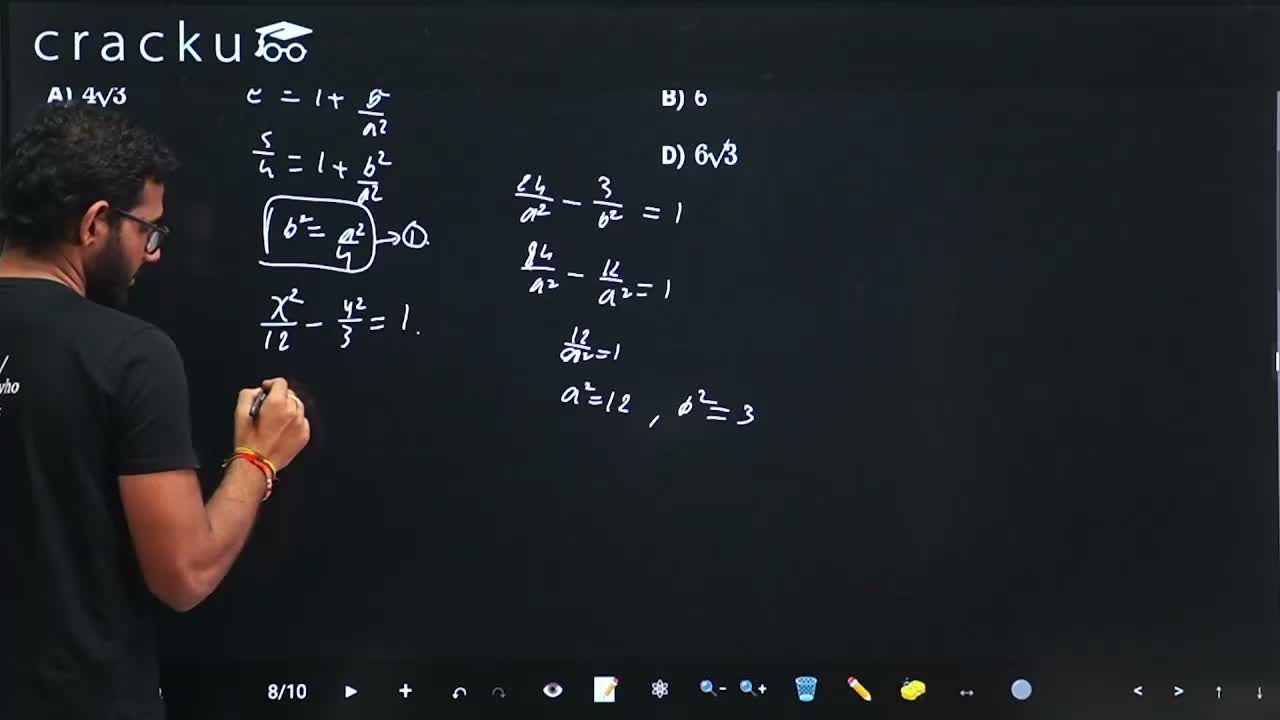
We have the standard form of the hyperbola as $$\dfrac{x^{2}}{a^{2}}-\dfrac{y^{2}}{b^{2}}=1$$ with its centre at the origin and the transverse axis along the $$x$$-axis. For such a hyperbola the eccentricity $$e$$ is connected to the semi-axes by the well-known relation $$e^{2}=1+\dfrac{b^{2}}{a^{2}}.$$
The question tells us that the eccentricity is $$\dfrac{\sqrt5}{2},$$ so first we square it and substitute in the formula:
$$\left(\dfrac{\sqrt5}{2}\right)^{2}=1+\dfrac{b^{2}}{a^{2}}.$$
Hence
$$\dfrac{5}{4}=1+\dfrac{b^{2}}{a^{2}} \;\Longrightarrow\; \dfrac{b^{2}}{a^{2}}=\dfrac{5}{4}-1=\dfrac{1}{4}.$$
So we obtain the proportional relation between the semi-axes,
$$b^{2}=\dfrac{a^{2}}{4}.$$
Now the given point $$P(-2\sqrt6,\;\sqrt3)$$ lies on the hyperbola. Therefore its coordinates satisfy the equation of the curve. Substituting $$x=-2\sqrt6$$ and $$y=\sqrt3$$ we get
$$\dfrac{(-2\sqrt6)^{2}}{a^{2}}-\dfrac{(\sqrt3)^{2}}{b^{2}}=1.$$
Evaluating the squares,
$$\dfrac{4\cdot6}{a^{2}}-\dfrac{3}{b^{2}}=1 \;\Longrightarrow\; \dfrac{24}{a^{2}}-\dfrac{3}{b^{2}}=1.$$
Using the relation $$b^{2}=\dfrac{a^{2}}{4}$$ we replace $$b^{2}$$ in the above equation:
$$\dfrac{24}{a^{2}}-\dfrac{3}{\dfrac{a^{2}}{4}}=1.$$
The denominator of the second fraction simplifies because dividing by $$\dfrac{a^{2}}{4}$$ is the same as multiplying by $$\dfrac{4}{a^{2}}$$:
$$\dfrac{24}{a^{2}}-\dfrac{3\cdot4}{a^{2}}=1 \;\Longrightarrow\; \dfrac{24}{a^{2}}-\dfrac{12}{a^{2}}=1.$$
Combining the numerators gives
$$\dfrac{12}{a^{2}}=1 \;\Longrightarrow\; a^{2}=12.$$
Substituting back,
$$b^{2}=\dfrac{a^{2}}{4}=\dfrac{12}{4}=3.$$
So the explicit equation of the hyperbola is
$$\dfrac{x^{2}}{12}-\dfrac{y^{2}}{3}=1.$$
Next we need the tangent at the point $$P(x_{1},y_{1})=(-2\sqrt6,\;\sqrt3).$$ For a hyperbola in the above form the point-form of the tangent is stated as
$$\dfrac{xx_{1}}{a^{2}}-\dfrac{yy_{1}}{b^{2}}=1.$$
Substituting $$x_{1}=-2\sqrt6$$, $$y_{1}=\sqrt3$$, $$a^{2}=12$$ and $$b^{2}=3$$ gives
$$\dfrac{x(-2\sqrt6)}{12}-\dfrac{y(\sqrt3)}{3}=1.$$
Simplifying each fraction step by step,
$$-\dfrac{\sqrt6}{6}\,x-\dfrac{\sqrt3}{3}\,y=1.$$
To clear the denominators we multiply every term by $$6$$:
$$-\sqrt6\,x-2\sqrt3\,y=6.$$
Moving every term to one side and multiplying by $$-1$$ for convenience, we may also write the tangent as
$$\sqrt6\,x+2\sqrt3\,y+6=0.$$
The conjugate axis of this hyperbola is the line $$x=0$$ (the $$y$$-axis). To find the point $$Q$$ where the tangent meets this axis, we set $$x=0$$ in the tangent equation:
$$\sqrt6\cdot0+2\sqrt3\,y+6=0 \;\Longrightarrow\; 2\sqrt3\,y=-6 \;\Longrightarrow\; y=-\dfrac{6}{2\sqrt3}=-\dfrac{3}{\sqrt3}=-\sqrt3.$$
Thus
$$Q=(0,\,-\sqrt3).$$
Now we turn to the normal at the same point $$P$$. First we determine the slope of the tangent. Writing the earlier tangent form $$-\sqrt6\,x-2\sqrt3\,y=6$$ in $$y=mx+c$$ form,
$$2\sqrt3\,y=-\sqrt6\,x-6 \;\Longrightarrow\; y=-\dfrac{\sqrt6}{2\sqrt3}\,x-\dfrac{6}{2\sqrt3}.$$
Because $$\dfrac{\sqrt6}{\sqrt3}=\sqrt2$$, we get
$$y=-\dfrac{\sqrt2}{2}\,x-\dfrac{3}{\sqrt3}.$$
Hence the slope of the tangent is
$$m_{\text{tan}}=-\dfrac{\sqrt2}{2}.$$
The slope of the normal is the negative reciprocal, so
$$m_{\text{norm}}=\dfrac{1}{-\dfrac{\sqrt2}{2}}=-\dfrac{2}{\sqrt2}=+\sqrt2.$$ (The double negative disappears, giving a positive value.)
The normal passing through $$P(-2\sqrt6,\;\sqrt3)$$ with slope $$\sqrt2$$ is written via the point-slope formula $$y-y_{1}=m(x-x_{1})$$ as
$$y-\sqrt3=\sqrt2\,(x+2\sqrt6).$$
To find its intersection $$R$$ with the conjugate axis $$x=0$$ we substitute $$x=0$$:
$$y-\sqrt3=\sqrt2\,(0+2\sqrt6)=\sqrt2\cdot2\sqrt6=2\sqrt{12}=2\cdot2\sqrt3=4\sqrt3.$$
Therefore
$$y=\sqrt3+4\sqrt3=5\sqrt3$$
and we obtain
$$R=(0,\;5\sqrt3).$$
Both $$Q$$ and $$R$$ lie on the $$y$$-axis, so their distance is simply the absolute difference of their $$y$$-coordinates:
$$QR=\left|\,5\sqrt3-(-\sqrt3)\right|=|6\sqrt3|=6\sqrt3.$$
Hence, the correct answer is Option D.
Was this solution helpful?
Click on the Email ☝️ to Watch the Video Solution
Create a FREE account and get:
_1.webp)

Educational materials for JEE preparation

Ask our AI anything

AI can make mistakes. Please verify important information.
AI can make mistakes. Please verify important information.
