
Join Our JEE Preparation Group
Prep with like-minded aspirants; Get access to free daily tests and study material.
Sign in
Please select an account to continue using cracku.in
↓ →
Join Our JEE Preparation Group
Prep with like-minded aspirants; Get access to free daily tests and study material.
Let $$S_1 : x^2 + y^2 = 9$$ and $$S_2 : (x-2)^2 + y^2 = 1$$. Then the locus of center of a variable circle $$S$$ which touches $$S_1$$ internally and $$S_2$$ externally always passes through the points :
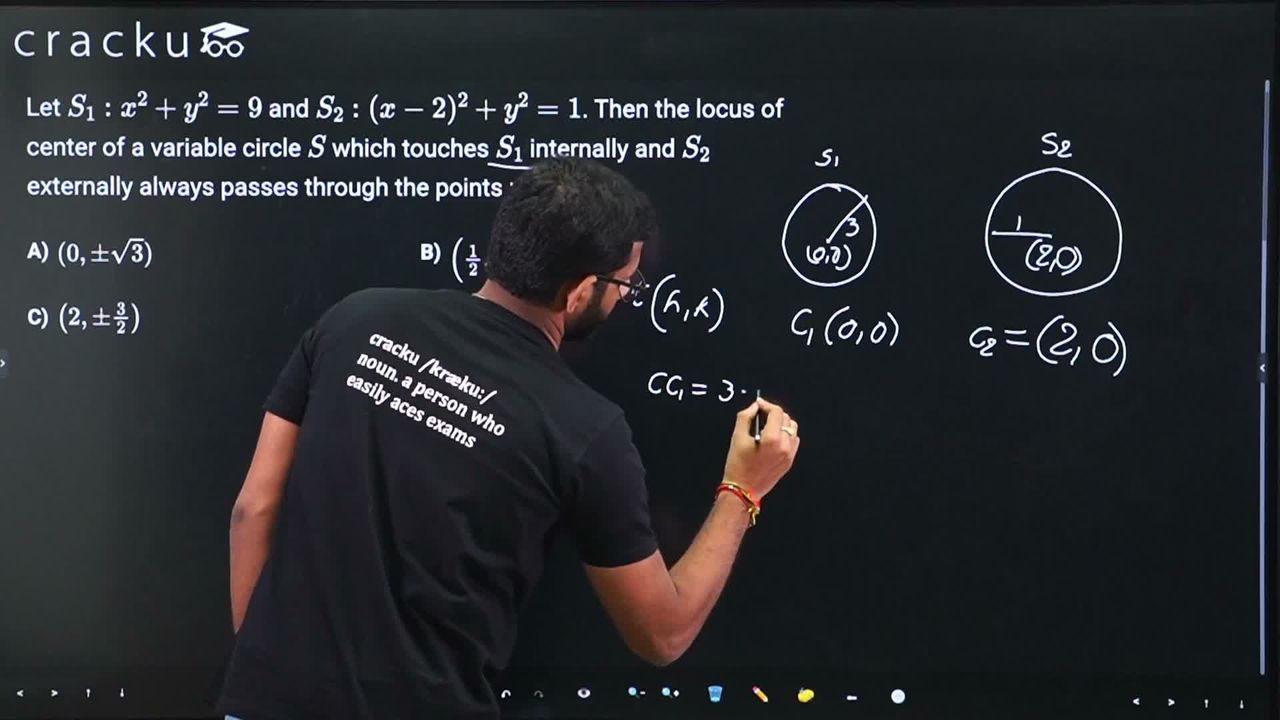
We have $$S_1: x^2 + y^2 = 9$$ with center $$C_1 = (0,0)$$ and radius $$r_1 = 3$$, and $$S_2: (x-2)^2 + y^2 = 1$$ with center $$C_2 = (2,0)$$ and radius $$r_2 = 1$$. Let the variable circle $$S$$ have center $$(h, k)$$ and radius $$R$$.
Since $$S$$ touches $$S_1$$ internally, the distance from $$(h,k)$$ to $$(0,0)$$ satisfies $$\sqrt{h^2 + k^2} = r_1 - R = 3 - R$$. Since $$S$$ touches $$S_2$$ externally, $$\sqrt{(h-2)^2 + k^2} = R + r_2 = R + 1$$.
Adding these two equations gives $$\sqrt{h^2 + k^2} + \sqrt{(h-2)^2 + k^2} = 4$$. This is the equation of an ellipse with foci at $$(0,0)$$ and $$(2,0)$$, where the sum of distances equals $$2a = 4$$, so $$a = 2$$. The distance between foci is $$2c = 2$$, so $$c = 1$$, and $$b^2 = a^2 - c^2 = 4 - 1 = 3$$. The center of the ellipse is $$(1, 0)$$.
The ellipse equation is $$\frac{(x-1)^2}{4} + \frac{y^2}{3} = 1$$. We check each option by substituting. For $$(2, \pm\frac{3}{2})$$: $$\frac{(2-1)^2}{4} + \frac{(3/2)^2}{3} = \frac{1}{4} + \frac{9/4}{3} = \frac{1}{4} + \frac{3}{4} = 1$$. This satisfies the ellipse equation.
Was this solution helpful?
Click on the Email ☝️ to Watch the Video Solution
Create a FREE account and get:
_1.webp)

Educational materials for JEE preparation

Ask our AI anything

AI can make mistakes. Please verify important information.
AI can make mistakes. Please verify important information.
