
Join Our JEE Preparation Group
Prep with like-minded aspirants; Get access to free daily tests and study material.
Sign in
Please select an account to continue using cracku.in
↓ →
Join Our JEE Preparation Group
Prep with like-minded aspirants; Get access to free daily tests and study material.
Let $$A$$ be the set of all points $$\alpha, \beta$$ such that the area of triangle formed by the points $$(5, 6)$$, $$(3, 2)$$ and $$(\alpha, \beta)$$ is 12 square units. Then the least possible length of a line segment joining the origin to a point in $$A$$, is:
We have two fixed points $$P(5,6)$$ and $$Q(3,2)$$. If we take a variable point $$R(\alpha,\beta)$$, the area of $$\triangle PQR$$ is given by the coordinate-geometry formula
Area $$=\frac12\left|\,x_P\,(y_Q-y_R)+x_Q\,(y_R-y_P)+x_R\,(y_P-y_Q)\,\right|.$$
Substituting $$P(5,6)$$ and $$Q(3,2)$$ we get
$$ \frac12\left|\,5(2-\beta)+3(\beta-6)+\alpha(6-2)\,\right|=12. $$
Simplifying step by step, first expand the terms inside the absolute value:
$$5(2-\beta)=10-5\beta$$, $$\qquad 3(\beta-6)=3\beta-18$$, $$\qquad \alpha(6-2)=4\alpha.$$
Adding them, we have
$$ (10-5\beta)+(3\beta-18)+4\alpha \;=\;4\alpha-2\beta-8. $$
So the area condition becomes
$$ \frac12\left|\,4\alpha-2\beta-8\,\right|=12 \;\;\Longrightarrow\;\; \left|\,4\alpha-2\beta-8\,\right|=24. $$
Dividing by $$2$$ gives
$$ \left|\,2\alpha-\beta-4\,\right|=12. $$
Removing the absolute value yields two linear equations:
$$ 2\alpha-\beta-4=12 \quad\text{or}\quad 2\alpha-\beta-4=-12. $$
Simplifying each, we obtain the pair of straight lines
$$ 2\alpha-\beta+8=0 \quad\text{and}\quad 2\alpha-\beta-16=0. $$
Thus the locus $$A$$ consists of all points on these two lines, each of which is parallel to the original line $$PQ$$. To proceed, let us confirm the equation of $$PQ$$ itself. The slope of $$PQ$$ is
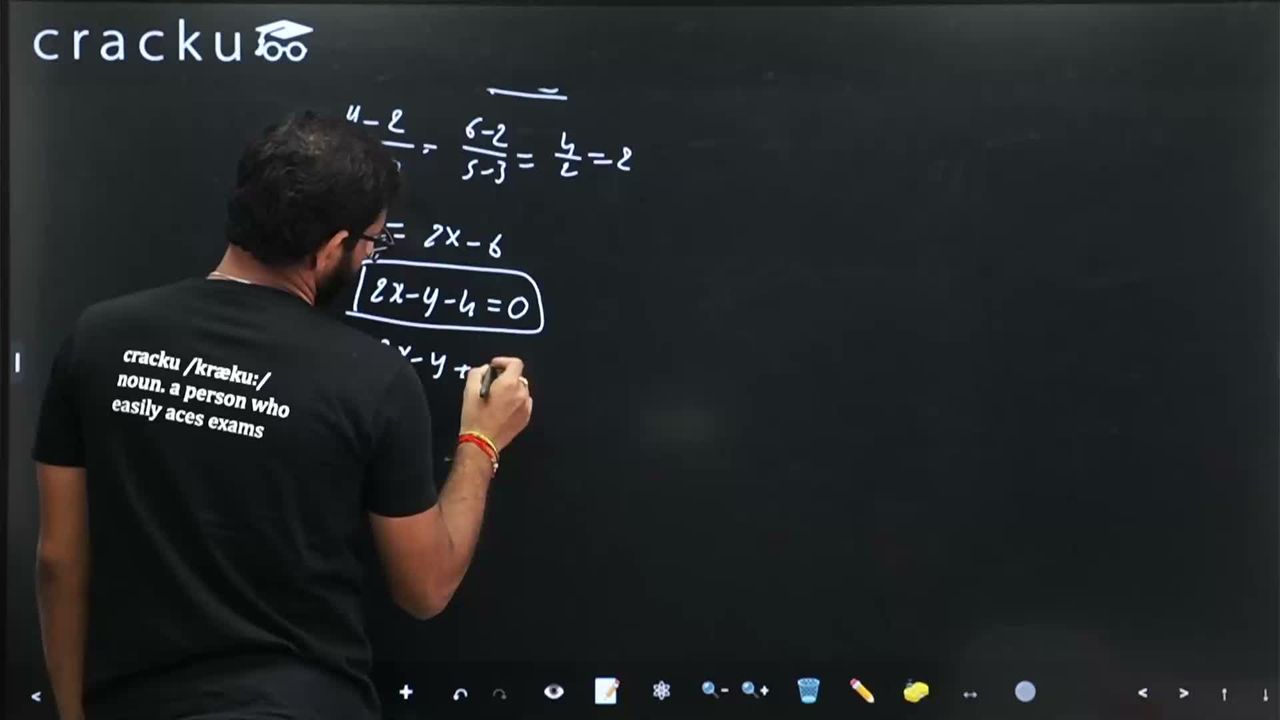
$$ m=\frac{2-6}{3-5}=\frac{-4}{-2}=2, $$
hence $$PQ$$ is $$y=2x-4$$ or equivalently $$2x-y-4=0$$. The two locus lines are obtained by shifting this line by a perpendicular distance such that the triangle’s area is $$12$$. We shall compute that distance explicitly.
The length of the segment $$PQ$$ is
$$ |PQ|=\sqrt{(5-3)^2+(6-2)^2}=\sqrt{2^2+4^2}=\sqrt{4+16}=2\sqrt5. $$
Now, for any triangle,
Area $$=\frac12\times\text{(base)}\times\text{(height)},$$
where “height’’ is the perpendicular distance from the third vertex to the base. Using the base $$PQ$$ and the given area $$12$$, the required height $$h$$ is
$$ h=\frac{2\times\text{Area}}{|PQ|} =\frac{2\times12}{2\sqrt5} =\frac{24}{2\sqrt5} =\frac{12}{\sqrt5}. $$
Indeed, the two new lines must therefore lie a perpendicular distance $$h=12/\sqrt5$$ above and below the line $$PQ:2x-y-4=0$$. The standard distance of a point $$(x,y)$$ from a line $$ax+by+c=0$$ is
$$ \frac{|ax+by+c|}{\sqrt{a^2+b^2}}. $$
For $$2x-y-4=0$$ we have $$a=2,\,b=-1$$ and $$\sqrt{a^2+b^2}=\sqrt{4+1}=\sqrt5$$. Requiring the distance to be $$12/\sqrt5$$ means
$$ \frac{|2x-y-4+c|}{\sqrt5}=\frac{12}{\sqrt5} \;\;\Longrightarrow\;\; |c|=12. $$
Hence $$c=+12$$ or $$c=-12$$, exactly giving the earlier two parallel lines
$$ 2x-y+8=0 \quad\text{and}\quad 2x-y-16=0. $$
We now find the least distance from the origin $$O(0,0)$$ to these two lines, because any point $$(\alpha,\beta)$$ on either line belongs to the set $$A$$.
First line: $$2x-y+8=0$$ Distance from origin:
$$ D_1=\frac{|2\cdot0-1\cdot0+8|}{\sqrt5} =\frac{8}{\sqrt5}. $$
Second line: $$2x-y-16=0$$ Distance from origin:
$$ D_2=\frac{|2\cdot0-1\cdot0-16|}{\sqrt5} =\frac{16}{\sqrt5}. $$
Clearly $$D_1<D_2$$, so the minimum possible length of the segment joining the origin to a point in $$A$$ is
$$ \boxed{\dfrac{8}{\sqrt5}}. $$
Hence, the correct answer is Option A.
Was this solution helpful?
Click on the Email ☝️ to Watch the Video Solution
Create a FREE account and get:
_1.webp)

Educational materials for JEE preparation

Ask our AI anything

AI can make mistakes. Please verify important information.
AI can make mistakes. Please verify important information.
