
Join Our JEE Preparation Group
Prep with like-minded aspirants; Get access to free daily tests and study material.
Sign in
Please select an account to continue using cracku.in
↓ →
Join Our JEE Preparation Group
Prep with like-minded aspirants; Get access to free daily tests and study material.
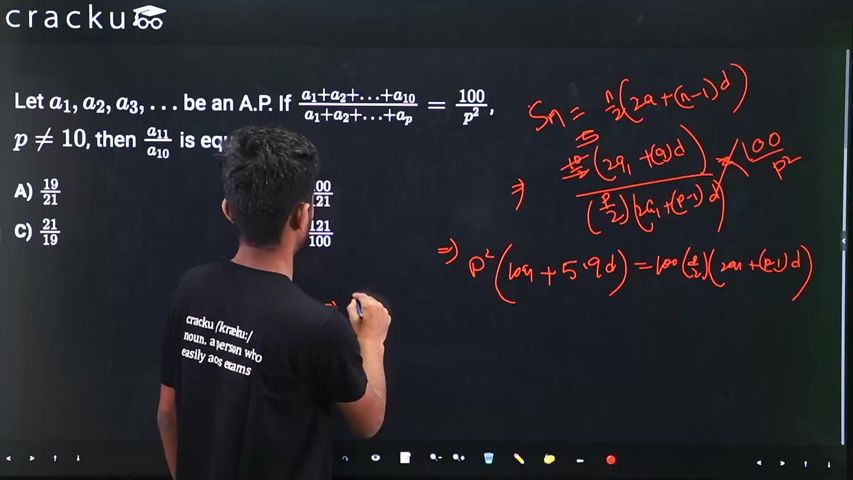
Let $$a_1, a_2, a_3, \ldots$$ be an A.P. If $$\frac{a_1 + a_2 + \ldots + a_{10}}{a_1 + a_2 + \ldots + a_p} = \frac{100}{p^2}$$, $$p \neq 10$$, then $$\frac{a_{11}}{a_{10}}$$ is equal to:
Let the first term of the A.P. be denoted by $$a_1$$ and let the common difference be $$d$$. Therefore every term can be written as $$a_n = a_1 + (n-1)d$$.
We are given a relation between the sums of the first ten terms and the first $$p$$ terms. The sum of the first $$n$$ terms of an A.P. is given by the well-known formula
$$S_n = \frac{n}{2}\,[\,2a_1 + (n-1)d\,].$$
Applying this, we obtain
$$S_{10} = \frac{10}{2}\,[\,2a_1 + 9d\,] = 5\,(2a_1 + 9d),$$
$$S_p = \frac{p}{2}\,[\,2a_1 + (p-1)d\,].$$
The condition in the question is
$$\frac{S_{10}}{S_p} = \frac{100}{p^2}, \qquad p \neq 10.$$
Substituting the explicit expressions of the sums, we have
$$\frac{5\,(2a_1 + 9d)}{\dfrac{p}{2}\,[\,2a_1 + (p-1)d\,]} = \frac{100}{p^2}.$$
Simplifying the left-hand fraction by multiplying numerator and denominator appropriately,
$$\frac{5\,(2a_1 + 9d)\times 2}{p\,[\,2a_1 + (p-1)d\,]} = \frac{10\,(2a_1 + 9d)}{p\,[\,2a_1 + (p-1)d\,]} = \frac{100}{p^2}.$$
Now we cross-multiply:
$$10\,(2a_1 + 9d)\,p^2 = 100\,p\,[\,2a_1 + (p-1)d\,].$$
Dividing both sides by $$10p$$ gives
$$(2a_1 + 9d)\,p = 10\,[\,2a_1 + (p-1)d\,].$$
Expanding both sides, we get
$$2a_1p + 9pd = 20a_1 + 10pd - 10d.$$
We collect like terms in $$a_1$$ and $$d$$ separately:
$$a_1(2p - 20) + d(9p - 10p + 10) = 0,$$
which simplifies to
$$a_1\cdot 2(p - 10) + d(10 - p) = 0.$$
Rewriting $$10 - p = -(p - 10)$$ and factoring out $$(p - 10)$$ (remember $$p \neq 10$$), we obtain
$$(p - 10)\,[\,2a_1 - d\,] = 0.$$
Because $$p - 10 \neq 0$$, the bracketed factor must vanish:
$$2a_1 - d = 0 \;\;\Longrightarrow\;\; d = 2a_1.$$
With the common difference now expressed in terms of the first term, we can evaluate the ratio of the eleventh term to the tenth term. Using the formula for the general term once more,
$$a_{10} = a_1 + 9d, \qquad a_{11} = a_1 + 10d.$$
Substituting $$d = 2a_1$$, we have
$$a_{10} = a_1 + 9(2a_1) = a_1 + 18a_1 = 19a_1,$$
$$a_{11} = a_1 + 10(2a_1) = a_1 + 20a_1 = 21a_1.$$
Therefore, the required ratio is
$$\frac{a_{11}}{a_{10}} = \frac{21a_1}{19a_1} = \frac{21}{19}.$$
Hence, the correct answer is Option 3.
Was this solution helpful?
Click on the Email ☝️ to Watch the Video Solution
Create a FREE account and get:
_1.webp)

Educational materials for JEE preparation

Ask our AI anything

AI can make mistakes. Please verify important information.
AI can make mistakes. Please verify important information.
