
Join Our JEE Preparation Group
Prep with like-minded aspirants; Get access to free daily tests and study material.
Sign in
Please select an account to continue using cracku.in
↓ →
Join Our JEE Preparation Group
Prep with like-minded aspirants; Get access to free daily tests and study material.
If $$z$$ is a complex number such that $$\frac{z-i}{z-1}$$ is purely imaginary, then the minimum value of $$|z - (3 + 3i)|$$ is:
Let us write the unknown complex number in its Cartesian form
$$z = x + iy,\qquad x,y \in \mathbb R.$$
The condition given in the problem is that the complex number
$$\dfrac{z-i}{\,z-1\,}$$
is purely imaginary, that is, its real part is zero. We therefore require
$$\operatorname{Re}\!\left(\dfrac{z-i}{z-1}\right)=0.$$
Substituting $$z = x + iy$$, we first write the numerator and the denominator separately:
$$z-i = (x+iy)-i = x + i(y-1),$$
$$z-1 = (x+iy)-1 = (x-1)+iy.$$
To extract the real part of a complex quotient we multiply numerator and denominator by the conjugate of the denominator. Using the identity
$$\dfrac{a+ib}{c+id} = \dfrac{(a+ib)(c-id)}{(c+id)(c-id)}$$
we get
$$\dfrac{z-i}{z-1}= \dfrac{\bigl[x+i(y-1)\bigr]\bigl[(x-1)-iy\bigr]}{(x-1)^2+y^2}.$$
The denominator $$(x-1)^2+y^2$$ is real and positive, so the real part of the whole fraction is obtained just from the real part of the numerator. We proceed to expand the numerator step by step:
$$$ \begin{aligned} \bigl[x+i(y-1)\bigr]\bigl[(x-1)-iy\bigr] &= x\,(x-1-iy)+i(y-1)\,(x-1-iy)\\[2mm] &= x(x-1)-ixy + i(y-1)(x-1) - i^2(y-1)y\\[2mm] &= x^2 - x - ixy + i(y-1)(x-1) + (y-1)y \end{aligned} $$$
Collecting the real and imaginary parts of the numerator:
Real part:
$$x^2 - x + y(y-1)=x^2 - x + y^2 - y,$$
Imaginary part:
$$-xy + (y-1)(x-1)= -xy + xy - x + y -1 = -x + y -1.$$
(The precise value of the imaginary part is unimportant for the present condition, but it is shown here for completeness.)
Because the overall denominator is real, the fraction is purely imaginary if and only if the real part of the numerator is zero. Therefore we must have
$$x^2 - x + y^2 - y = 0.$$
We now recognise this as the equation of a circle. Completing the square in both variables, we obtain
$$$ \begin{aligned} x^2 - x &= \left(x-\dfrac12\right)^2 - \dfrac14,\\[2mm] y^2 - y &= \left(y-\dfrac12\right)^2 - \dfrac14. \end{aligned} $$$
Hence
$$$ \left(x-\dfrac12\right)^2 - \dfrac14 + \left(y-\dfrac12\right)^2 - \dfrac14 = 0, $$$
which simplifies to
$$$ \left(x-\dfrac12\right)^2 + \left(y-\dfrac12\right)^2 = \dfrac12. $$$
Thus all admissible points $$z$$ lie on the circle with centre
$$C=\left(\dfrac12,\;\dfrac12\right)$$
and radius
$$r=\sqrt{\dfrac12}=\dfrac1{\sqrt2}.$$
Our goal is to minimise the distance from such a point $$z$$ to the fixed point
$$P = 3 + 3i \;\longrightarrow\; (3,3).$$
The distance between the centre $$C$$ and the point $$P$$ is
$$$ \begin{aligned} CP &= \sqrt{(3-\tfrac12)^2 + (3-\tfrac12)^2}\\[2mm] &= \sqrt{\left(\dfrac52\right)^2 + \left(\dfrac52\right)^2}\\[2mm] &= \dfrac52\sqrt{2}=2.5\sqrt2. \end{aligned} $$$
Because the point $$z$$ must stay on the circle of radius $$r$$, the smallest possible distance from $$P$$ to any such $$z$$ is obtained by moving directly towards $$P$$ from the centre $$C$$ and then stopping at the circle. Geometrically, this minimum distance is simply
$$\text{minimum distance}=CP - r.$$
Substituting the two values we have just found,
$$$ \begin{aligned} CP - r &= 2.5\sqrt2 - \dfrac1{\sqrt2}\\[2mm] &= \dfrac{2.5(\sqrt2)^2 - 1}{\sqrt2}\\[2mm] &= \dfrac{2.5\cdot 2 - 1}{\sqrt2}\\[2mm] &= \dfrac{5 - 1}{\sqrt2}\\[2mm] &= \dfrac4{\sqrt2}=2\sqrt2. \end{aligned} $$$
Therefore the minimum value of $$|z-(3+3i)|$$ is $$2\sqrt2$$.
Hence, the correct answer is Option B.
Was this solution helpful?
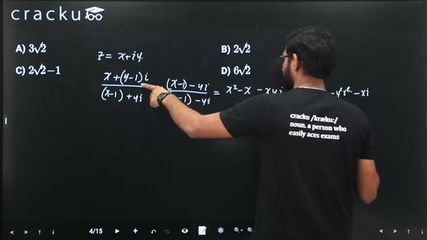
Click on the Email ☝️ to Watch the Video Solution
Create a FREE account and get:
_1.webp)

Educational materials for JEE preparation

Ask our AI anything

AI can make mistakes. Please verify important information.
AI can make mistakes. Please verify important information.
