
Join Our JEE Preparation Group
Prep with like-minded aspirants; Get access to free daily tests and study material.
Sign in
Please select an account to continue using cracku.in
↓ →
Join Our JEE Preparation Group
Prep with like-minded aspirants; Get access to free daily tests and study material.
The locus of mid-points of the line segments joining -3, -5 and the points on the ellipse $$\frac{x^2}{4} + \frac{y^2}{9} = 1$$ is:
Let the fixed end of the line segment be the point $$(-3,\,-5)$$.
We take an arbitrary point on the ellipse $$\dfrac{x^{2}}{4}+\dfrac{y^{2}}{9}=1$$ and denote its coordinates by $$(x_{1},\,y_{1})$$.
The mid-point $$(h,\,k)$$ of the segment joining $$(-3,\,-5)$$ and $$(x_{1},\,y_{1})$$ is obtained from the section formula. We have
$$h=\dfrac{-3+x_{1}}{2},\qquad k=\dfrac{-5+y_{1}}{2}.$$
Now we express $$(x_{1},\,y_{1})$$ in terms of $$(h,\,k)$$ by simply reversing the above relations:
$$x_{1}=2h+3,\qquad y_{1}=2k+5.$$
Because $$(x_{1},\,y_{1})$$ lies on the ellipse, it must satisfy the given equation. So we substitute these expressions:
$$\frac{(2h+3)^{2}}{4}+\frac{(2k+5)^{2}}{9}=1.$$
We expand the squares first:
$$(2h+3)^{2}=4h^{2}+12h+9,$$
$$(2k+5)^{2}=4k^{2}+20k+25.$$
Substituting these back, we get
$$\frac{4h^{2}+12h+9}{4}+\frac{4k^{2}+20k+25}{9}=1.$$
Now we divide term-wise:
$$\bigl(4h^{2}+12h+9\bigr)\!\left(\frac{1}{4}\right)=h^{2}+3h+\frac{9}{4},$$
$$\bigl(4k^{2}+20k+25\bigr)\!\left(\frac{1}{9}\right)=\frac{4}{9}k^{2}+\frac{20}{9}k+\frac{25}{9}.$$
Adding these two expressions and subtracting $$1$$ from both sides, we write
$$h^{2}+3h+\frac{9}{4}+\frac{4}{9}k^{2}+\frac{20}{9}k+\frac{25}{9}-1=0.$$
Next we gather the constant terms. To combine the fractions, we use a common denominator $$36$$:
$$\frac{9}{4}=\frac{81}{36},\qquad\frac{25}{9}=\frac{100}{36},\qquad 1=\frac{36}{36}.$$
So
$$\frac{81}{36}+\frac{100}{36}-\frac{36}{36}=\frac{145}{36}.$$
Hence the equation becomes
$$h^{2}+3h+\frac{4}{9}k^{2}+\frac{20}{9}k+\frac{145}{36}=0.$$
To clear all fractions, we multiply every term by $$36$$:
$$36h^{2}+108h+16k^{2}+80k+145=0.$$
Finally, we replace the temporary symbols $$h$$ and $$k$$ by the usual coordinate variables $$x$$ and $$y$$ for the locus:
$$36x^{2}+16y^{2}+108x+80y+145=0.$$
This equation matches option B.
Hence, the correct answer is Option B.
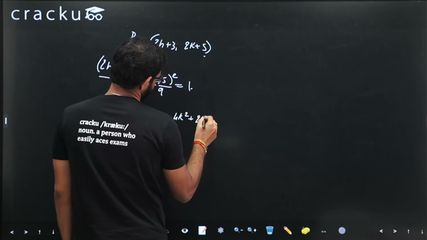
Click on the Email ☝️ to Watch the Video Solution
Create a FREE account and get:
_1.webp)

Educational materials for JEE preparation

Ask our AI anything

AI can make mistakes. Please verify important information.
AI can make mistakes. Please verify important information.


