
Join Our JEE Preparation Group
Prep with like-minded aspirants; Get access to free daily tests and study material.
Sign in
Please select an account to continue using cracku.in
↓ →
Join Our JEE Preparation Group
Prep with like-minded aspirants; Get access to free daily tests and study material.
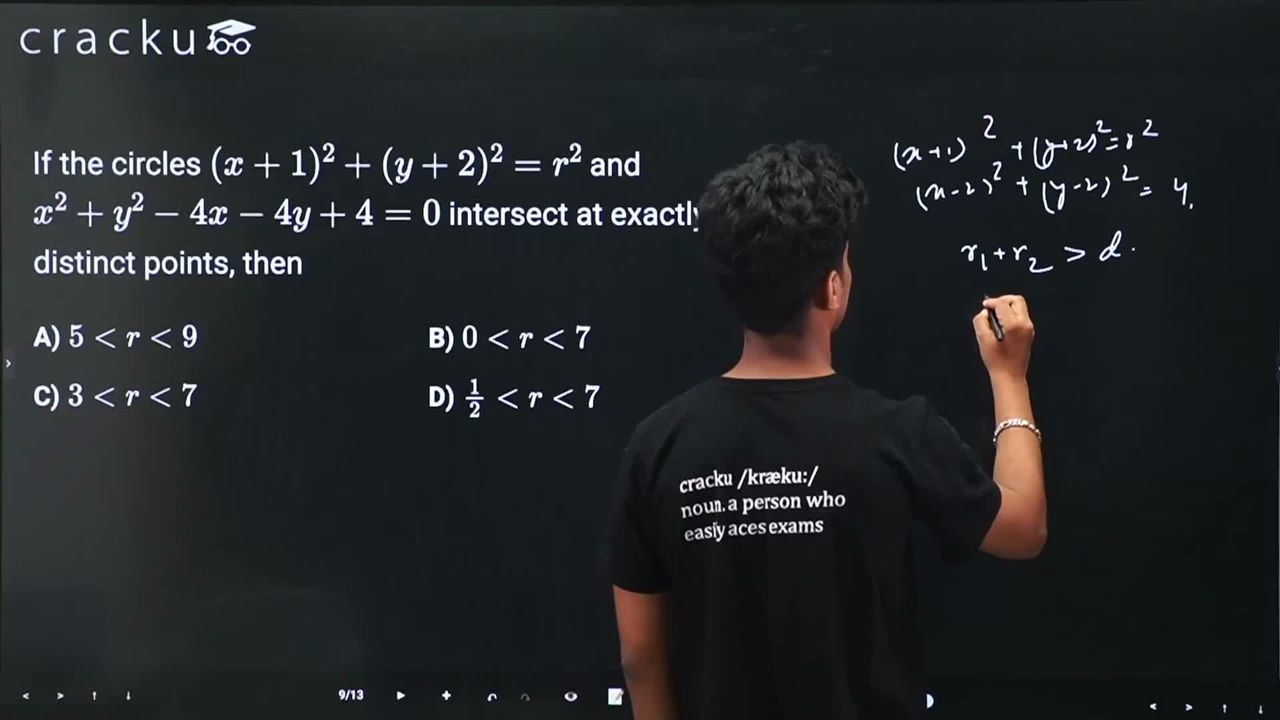
If the circles $$(x + 1)^2 + (y + 2)^2 = r^2$$ and $$x^2 + y^2 - 4x - 4y + 4 = 0$$ intersect at exactly two distinct points, then
The first circle is $$(x+1)^2 + (y+2)^2 = r^2$$.
Its centre is $$C_1(-1,-2)$$ and its radius is $$r$$.
$$\Rightarrow (x-2)^2 + (y-2)^2 = 4$$
Thus the second circle has centre $$C_2(2,2)$$ and radius $$R = 2$$.
Let $$d$$ be the distance between the centres.
$$d = \sqrt{(2+1)^2 + (2+2)^2} = \sqrt{3^2 + 4^2} = \sqrt{25} = 5$$
For two circles of radii $$r$$ and $$R$$ to intersect at exactly two distinct points, the distance between their centres must satisfy
$$|r - R| \lt d \lt r + R$$
$$R = 2$$ and $$d = 5$$:
$$|r - 2| \lt 5 \quad\Longrightarrow\quad -5 \lt r - 2 \lt 5$$
$$\Rightarrow -3 \lt r \lt 7$$
$$5 \lt r + 2 \quad\Longrightarrow\quad r \gt 3$$
Combine the two results:
$$3 \lt r \lt 7$$
Therefore $$r$$ must lie between $$3$$ and $$7$$ (exclusive). This matches Option C.
Was this solution helpful?
Click on the Email ☝️ to Watch the Video Solution
Create a FREE account and get:
_1.webp)

Educational materials for JEE preparation

Ask our AI anything

AI can make mistakes. Please verify important information.
AI can make mistakes. Please verify important information.
