
Join Our JEE Preparation Group
Prep with like-minded aspirants; Get access to free daily tests and study material.
Sign in
Please select an account to continue using cracku.in
↓ →
Join Our JEE Preparation Group
Prep with like-minded aspirants; Get access to free daily tests and study material.
If for some n; $${}^{6}C_{m}+2^{6}C_{m+1}+{}^{6}C_{m+2}>{}^{8}C_{3}$$ and $$^{n-1}P_3 : ^nP_4 = 1:8$$, then $$^nP_{m+1} + ^{n+1}C_m$$ is equal to
First fix the symbol conventions.
Combinations : $${}^{n}C_{r} = \frac{n!}{r!(n-r)!}$$
Permutations : $$^{n}P_{r} = \frac{n!}{(n-r)!} = n(n-1)\dots (n-r+1)$$
Case 1 : Finding $$m$$ from the inequality
The given condition is
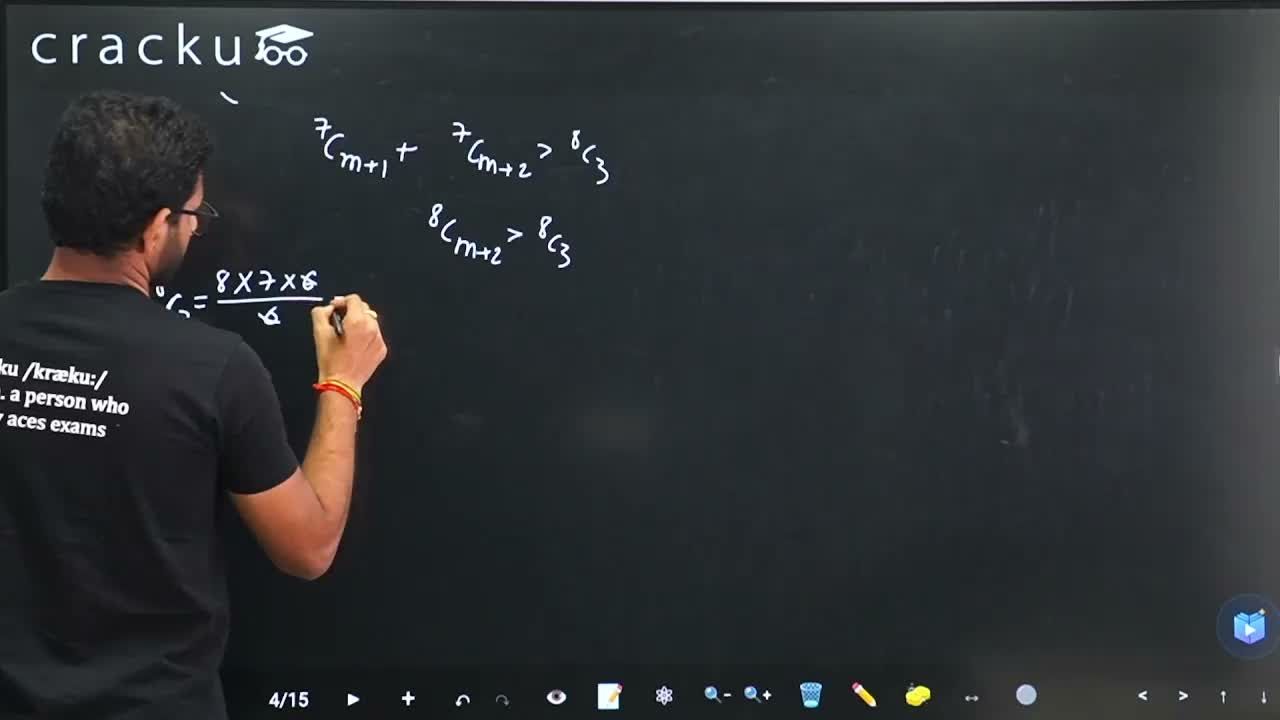
$${}^{6}C_{m} + 2\;{}^{6}C_{m+1} + {}^{6}C_{m+2} \gt {}^{8}C_{3}$$
Compute the right-hand side:
$${}^{8}C_{3} = \frac{8\cdot7\cdot6}{3\cdot2\cdot1}=56$$
The terms $${}^{6}C_{r}$$ are (for $$r=0$$ to $$6$$):
$$1,\;6,\;15,\;20,\;15,\;6,\;1$$
Because $$m+2 \le 6$$, the feasible values are $$m = 0,1,2,3,4$$. Evaluate the left-hand side for each:
$$\begin{aligned} m=0:&\;1 + 2(6) + 15 = 28\\ m=1:&\;6 + 2(15) + 20 = 56\\ m=2:&\;15 + 2(20) + 15 = 70\\ m=3:&\;20 + 2(15) + 6 = 56\\ m=4:&\;15 + 2(6) + 1 = 28 \end{aligned}$$
The inequality $$\gt56$$ is satisfied only for $$m = 2$$.
Case 2 : Finding $$n$$ from the permutation ratio
The second relation is
$$^{\,n-1}P_{3} : {}^{\,n}P_{4} = 1 : 8$$
Write both permutations explicitly:
$$^{\,n-1}P_{3} = (n-1)(n-2)(n-3)$$
$$^{\,n}P_{4} = n(n-1)(n-2)(n-3)$$
Therefore $$\frac{^{\,n-1}P_{3}}{^{\,n}P_{4}} = \frac{(n-1)(n-2)(n-3)}{n(n-1)(n-2)(n-3)} = \frac{1}{n}$$
Given that this ratio equals $$\frac{1}{8}$$, we get $$n = 8$$.
Case 3 : Evaluating $$^{\,n}P_{m+1} + {}^{\,n+1}C_{m}$$
With $$n = 8$$ and $$m = 2$$, we need $$^{\,8}P_{3} + {}^{\,9}C_{2}$$.
Compute each term:
$$^{\,8}P_{3} = 8\cdot7\cdot6 = 336$$
$${}^{\,9}C_{2} = \frac{9\cdot8}{2\cdot1} = 36$$
Add them:
$$336 + 36 = 372$$
Hence $$^{\,n}P_{m+1} + {}^{\,n+1}C_{m} = 372$$.
Option D is correct.
Was this solution helpful?
Click on the Email ☝️ to Watch the Video Solution
Create a FREE account and get:
_1.webp)

Educational materials for JEE preparation

Ask our AI anything

AI can make mistakes. Please verify important information.
AI can make mistakes. Please verify important information.
