
Join Our JEE Preparation Group
Prep with like-minded aspirants; Get access to free daily tests and study material.
Sign in
Please select an account to continue using cracku.in
↓ →
Join Our JEE Preparation Group
Prep with like-minded aspirants; Get access to free daily tests and study material.
A line segment $$AB$$ of length $$\lambda$$ moves such that the points $$A$$ and $$B$$ remain on the periphery of a circle of radius $$\lambda$$. Then the locus of the point, that divides the line segment $$AB$$ in the ratio 2:3, is a circle of radius
A chord AB of length $$\lambda$$ moves on a circle of radius $$\lambda$$, and a point P divides AB in the ratio 2:3. We wish to find the locus of P.
To begin, take the circle to be $$x^2 + y^2 = \lambda^2$$ with endpoints of the chord given by $$A=(\lambda\cos\alpha,\;\lambda\sin\alpha)$$ and $$B=(\lambda\cos\beta,\;\lambda\sin\beta)\,.$$
Imposing the condition that the length of the chord $$AB$$ equals $$\lambda$$ leads to $$ |AB|^2 = 2\lambda^2 - 2\lambda^2\cos(\alpha-\beta) = \lambda^2 $$ and hence $$ \cos(\alpha-\beta)=\tfrac12\implies\alpha-\beta=\pm\tfrac{\pi}{3}\,. $$
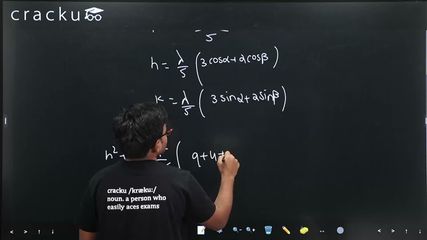
Since P divides AB in the ratio 2:3, its coordinates are $$ P=\frac{3A+2B}{5}=\frac{\lambda}{5}(3\cos\alpha+2\cos\beta,\;3\sin\alpha+2\sin\beta)\,. $$ Writing $$h=\frac{\lambda}{5}(3\cos\alpha+2\cos\beta)$$ and $$k=\frac{\lambda}{5}(3\sin\alpha+2\sin\beta)$$ gives the coordinates of P as $$(h,k)\,.$$
Next, compute $$ h^2+k^2=\frac{\lambda^2}{25}\bigl[(3\cos\alpha+2\cos\beta)^2+(3\sin\alpha+2\sin\beta)^2\bigr] $$ which simplifies to $$ \frac{\lambda^2}{25}\bigl[9+12\cos(\alpha-\beta)+4\bigr]=\frac{\lambda^2}{25}\bigl[13+12\times\tfrac12\bigr]=\frac{19\lambda^2}{25}\,. $$
Therefore, the locus of P is the circle $$x^2+y^2=\tfrac{19\lambda^2}{25}$$, whose radius is $$\tfrac{\sqrt{19}}{5}\lambda\,$$ and this corresponds to Option 3: $$\frac{\sqrt{19}}{5}\lambda\,. $$
Was this solution helpful?
Click on the Email ☝️ to Watch the Video Solution
Create a FREE account and get:
_1.webp)

Educational materials for JEE preparation

Ask our AI anything

AI can make mistakes. Please verify important information.
AI can make mistakes. Please verify important information.
