
Join Our JEE Preparation Group
Prep with like-minded aspirants; Get access to free daily tests and study material.
Sign in
Please select an account to continue using cracku.in
↓ →
Join Our JEE Preparation Group
Prep with like-minded aspirants; Get access to free daily tests and study material.
The position of a moving car at time $$t$$ is given by $$f(t) = at^2 + bt + c$$, $$t > 0$$, where $$a$$, $$b$$ and $$c$$ are real numbers greater than 1. Then the average speed of the car over the time interval $$[t_1, t_2]$$ is attained at the point:
We are told that the position (displacement) of the car at time $$t$$ is $$f(t)=at^{2}+bt+c$$ with $$a,b,c>1$$ and $$t>0$$. We wish to know at which point inside the interval $$[t_{1},t_{2}]$$ the average speed (average velocity) is actually attained.
First, recall the result from basic calculus called the Mean Value Theorem (MVT) for derivatives: if a function $$f$$ is continuous on $$[t_{1},t_{2}]$$ and differentiable on $$(t_{1},t_{2})$$, then there exists some number $$\xi$$ in the open interval $$(t_{1},t_{2})$$ such that
$$f'(\xi)=\frac{f(t_{2})-f(t_{1})}{\,t_{2}-t_{1}\,}.$$
The right-hand side of this equality is the average rate of change of $$f$$ over $$[t_{1},t_{2}]$$, which, for a displacement function, is the average velocity (average speed in magnitude, because the motion is on a straight line). Hence, by the MVT, the instantaneous velocity at some interior point $$\xi$$ equals this average velocity.
To locate that $$\xi$$ explicitly, we must compute both the derivative $$f'(t)$$ and the average velocity.
We differentiate $$f(t)=at^{2}+bt+c$$ with respect to $$t$$. Using the power rule $$\frac{d}{dt}(t^{n})=nt^{\,n-1}$$, we obtain
$$f'(t)=2at+b.$$
Next we calculate the average velocity (average speed) over $$[t_{1},t_{2}]$$:
$$\frac{f(t_{2})-f(t_{1})}{t_{2}-t_{1}} =\frac{\,\bigl(a\,t_{2}^{2}+b\,t_{2}+c\bigr)-\bigl(a\,t_{1}^{2}+b\,t_{1}+c\bigr)\,}{t_{2}-t_{1}}.$$
The constants $$c$$ cancel, leaving
$$\frac{a\,(t_{2}^{2}-t_{1}^{2})+b\,(t_{2}-t_{1})}{t_{2}-t_{1}}.$$
Now, recall the algebraic identity $$t_{2}^{2}-t_{1}^{2}=(t_{2}-t_{1})(t_{2}+t_{1}).$$ Substituting this into the numerator, we get
$$\frac{a\,(t_{2}-t_{1})(t_{2}+t_{1}) + b\,(t_{2}-t_{1})}{t_{2}-t_{1}}.$$
Since a common factor $$t_{2}-t_{1}$$ appears in every term in the numerator, it cancels with the denominator, yielding
$$a\,(t_{1}+t_{2}) + b.$$
Thus the average velocity is $$a(t_{1}+t_{2}) + b.$$
By the Mean Value Theorem, we must have some $$\xi \in (t_{1},t_{2})$$ satisfying
$$f'(\xi)=2a\,\xi + b = a(t_{1}+t_{2}) + b.$$
Subtracting $$b$$ from both sides gives
$$2a\,\xi = a\,(t_{1}+t_{2}).$$
Because $$a>0$$, we can divide both sides by $$2a$$:
$$\xi=\frac{t_{1}+t_{2}}{2}.$$
This point $$\xi$$ equals the arithmetic mean of $$t_{1}$$ and $$t_{2}$$. Looking at the listed choices, this corresponds exactly to Option C:
$$\frac{(t_{1}+t_{2})}{2}.$$
Hence, the correct answer is Option C.
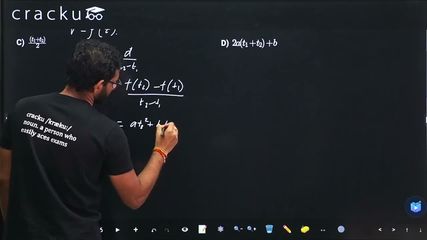
Click on the Email ☝️ to Watch the Video Solution
Create a FREE account and get:
_1.webp)

Educational materials for JEE preparation

Ask our AI anything

AI can make mistakes. Please verify important information.
AI can make mistakes. Please verify important information.


