
Join Our JEE Preparation Group
Prep with like-minded aspirants; Get access to free daily tests and study material.
Sign in
Please select an account to continue using cracku.in
↓ →
Join Our JEE Preparation Group
Prep with like-minded aspirants; Get access to free daily tests and study material.
The relation in the question is $$^{n-1}C_r = (k^{2}-8)\;{}^{n}C_{\,r+1}$$, where $$n$$ and $$r$$ are integers satisfying $$n \ge 1$$ and $$0 \le r \le n-1$$.
First write both binomial coefficients in factorial form.
$$^{n-1}C_r = \dfrac{(n-1)!}{r!\,(n-1-r)!}$$
$${}^{n}C_{\,r+1} = \dfrac{n!}{(r+1)!\,(n-r-1)!}$$
Compute their ratio.
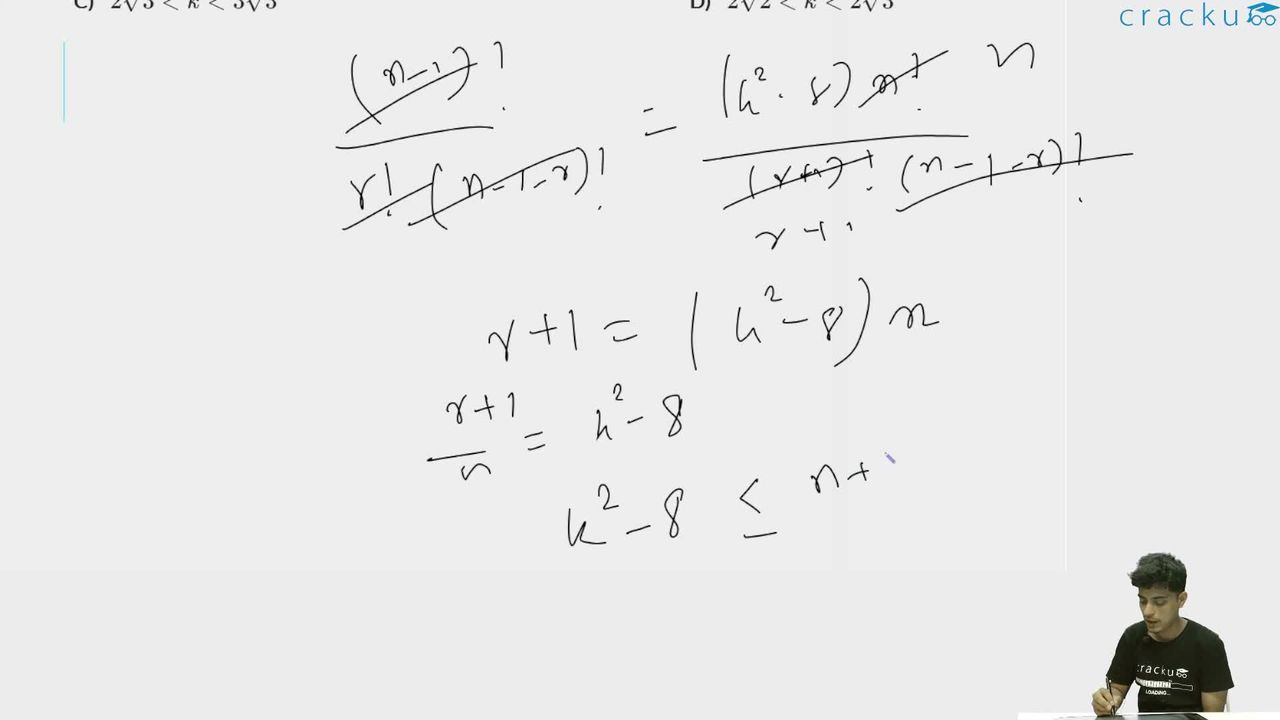
$$\dfrac{^{\,n-1}C_r}{{}^{\,n}C_{\,r+1}}
= \dfrac{\dfrac{(n-1)!}{r!\,(n-1-r)!}}
{\dfrac{n!}{(r+1)!\,(n-r-1)!}}
= \dfrac{(n-1)!}{r!\,(n-1-r)!}\;
\dfrac{(r+1)!\,(n-r-1)!}{n!}$$
Simplify step by step.
• Because $$(r+1)! = (r+1)\,r!$$, the factor $$r!$$ cancels leaving $$r+1$$.
• Because $$(n-1-r)! = (n-r-1)!$$, these factors cancel completely.
• Use $$n! = n\,(n-1)!$$ to cancel $$(n-1)!$$.
After cancellations we obtain
$$\dfrac{^{\,n-1}C_r}{{}^{\,n}C_{\,r+1}} = \dfrac{r+1}{n}$$ $$-(1)$$
Return to the original equation and divide both sides by $${}^{\,n}C_{\,r+1}$$:
$$\dfrac{^{\,n-1}C_r}{{}^{\,n}C_{\,r+1}} = k^{2}-8$$
Using $$(1)$$ gives
$$k^{2}-8 = \dfrac{r+1}{n}$$ $$-(2)$$
Now analyse the fraction on the right side.
Because $$0 \le r \le n-1$$, we have $$1 \le r+1 \le n$$.
Hence
$$0 \lt \dfrac{r+1}{n} \le 1$$ $$-(3)$$
Combine $$(2)$$ and $$(3)$$ to bound $$k$$.
From $$(2)$$ and the lower bound in $$(3)$$:
$$k^{2}-8 \gt 0 \;\;\Longrightarrow\;\; k^{2} \gt 8 \;\;\Longrightarrow\;\; k \gt 2\sqrt{2}$$
From $$(2)$$ and the upper bound in $$(3)$$:
$$k^{2}-8 \le 1 \;\;\Longrightarrow\;\; k^{2} \le 9 \;\;\Longrightarrow\;\; k \le 3$$
Together,
$$2\sqrt{2} \lt k \le 3$$
This interval matches Option A.
Therefore, the given equation holds if and only if
Case Answer: Option A, $$2\sqrt{2} \lt k \le 3$$.
Was this solution helpful?
Click on the Email ☝️ to Watch the Video Solution
Create a FREE account and get:
_1.webp)

Educational materials for JEE preparation

Ask our AI anything

AI can make mistakes. Please verify important information.
AI can make mistakes. Please verify important information.
