
Join Our JEE Preparation Group
Prep with like-minded aspirants; Get access to free daily tests and study material.
Sign in
Please select an account to continue using cracku.in
↓ →
Join Our JEE Preparation Group
Prep with like-minded aspirants; Get access to free daily tests and study material.
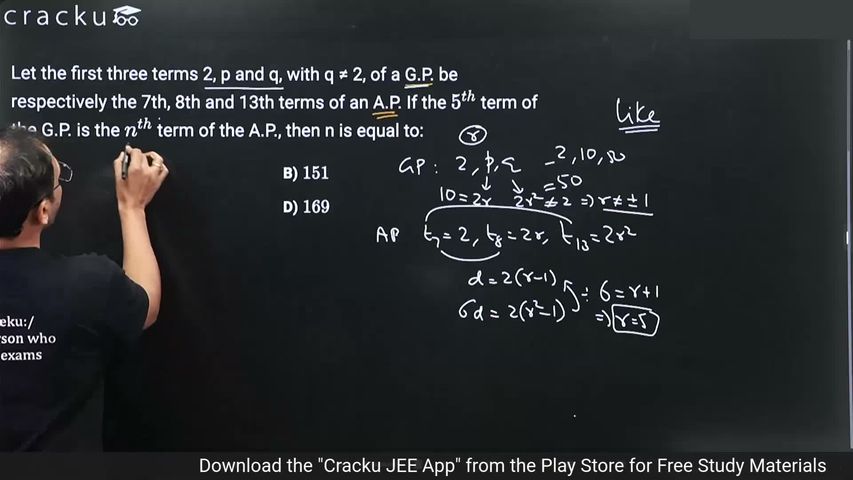
Let the first three terms 2, p and q, with q ≠ 2, of a G.P. be respectively the 7th, 8th and 13th terms of an A.P. If the $$5^{th}$$ term of the G.P. is the $$n^{th}$$ term of the A.P., then n is equal to:
GP: 2, p, q (first 3 terms). So p/2 = q/p → p² = 2q. Common ratio r = p/2.
AP: a₇ = 2, a₈ = p, a₁₃ = q. Common difference d = a₈ - a₇ = p - 2.
a₁₃ = a₇ + 6d → q = 2 + 6(p-2) = 6p - 10
From p² = 2q: p² = 2(6p-10) = 12p - 20
p² - 12p + 20 = 0 → (p-2)(p-10) = 0
p = 2 gives q = 2 (rejected since q ≠ 2), so p = 10, q = 50.
r = p/2 = 5, d = p - 2 = 8
5th term of GP = 2 × 5⁴ = 1250
nth term of AP: a₇ + (n-7)d = 2 + 8(n-7) = 1250
8(n-7) = 1248 → n-7 = 156 → n = 163
The correct answer is Option 1: 163.
Was this solution helpful?
Click on the Email ☝️ to Watch the Video Solution
Create a FREE account and get:
_1.webp)

Educational materials for JEE preparation

Ask our AI anything

AI can make mistakes. Please verify important information.
AI can make mistakes. Please verify important information.
