
Join Our JEE Preparation Group
Prep with like-minded aspirants; Get access to free daily tests and study material.
Sign in
Please select an account to continue using cracku.in
↓ →
Join Our JEE Preparation Group
Prep with like-minded aspirants; Get access to free daily tests and study material.
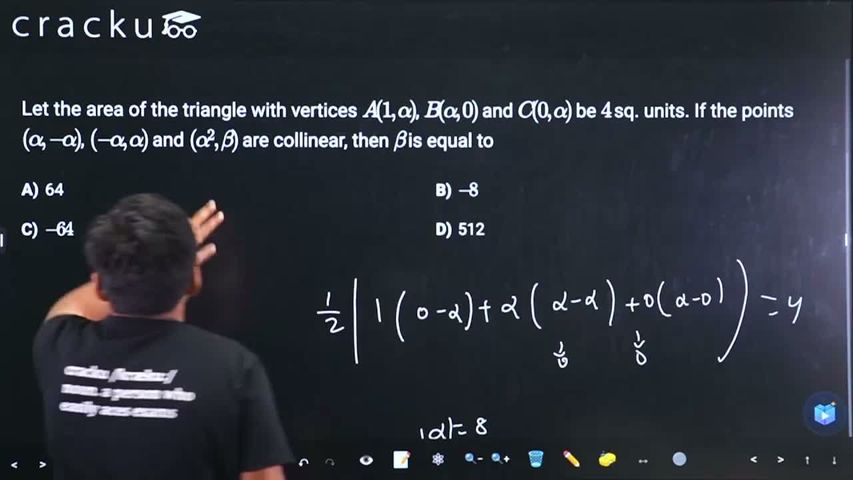
Let the area of the triangle with vertices $$A(1, \alpha)$$, $$B(\alpha, 0)$$ and $$C(0, \alpha)$$ be $$4$$ sq. units. If the points $$(\alpha, -\alpha)$$, $$(-\alpha, \alpha)$$ and $$(\alpha^2, \beta)$$ are collinear, then $$\beta$$ is equal to
The area of the triangle
$$ABC$$
is
$$\frac12\left|1(0-\alpha)+\alpha(\alpha-\alpha)+0(\alpha-0)\right|=4.$$
Thus,
$$\frac12|\,-\alpha\,|=4,$$
which gives
$$|\alpha|=8.$$
Hence
$$\alpha=\pm 8.$$
Now, the points
$$(\alpha,-\alpha)$$
and
$$(-\alpha,\alpha)$$
lie on the line
$$y=-x,$$
since
$$-\alpha=-\alpha$$
and
$$\alpha=-(-\alpha).$$
Therefore, for the three points to be collinear, the point
$$(\alpha^2,\beta)$$
must also lie on
$$y=-x.$$
Hence,
$$\beta=-\alpha^2.$$
Since
$$|\alpha|=8,$$
we have
$$\alpha^2=64.$$
Therefore,
$$\beta=-64.$$
Hence, $$\text{Answer}=-64$$.
Was this solution helpful?
Click on the Email ☝️ to Watch the Video Solution
Create a FREE account and get:
_1.webp)

Educational materials for JEE preparation

Ask our AI anything

AI can make mistakes. Please verify important information.
AI can make mistakes. Please verify important information.
