
Join Our JEE Preparation Group
Prep with like-minded aspirants; Get access to free daily tests and study material.
Sign in
Please select an account to continue using cracku.in
↓ →
Join Our JEE Preparation Group
Prep with like-minded aspirants; Get access to free daily tests and study material.
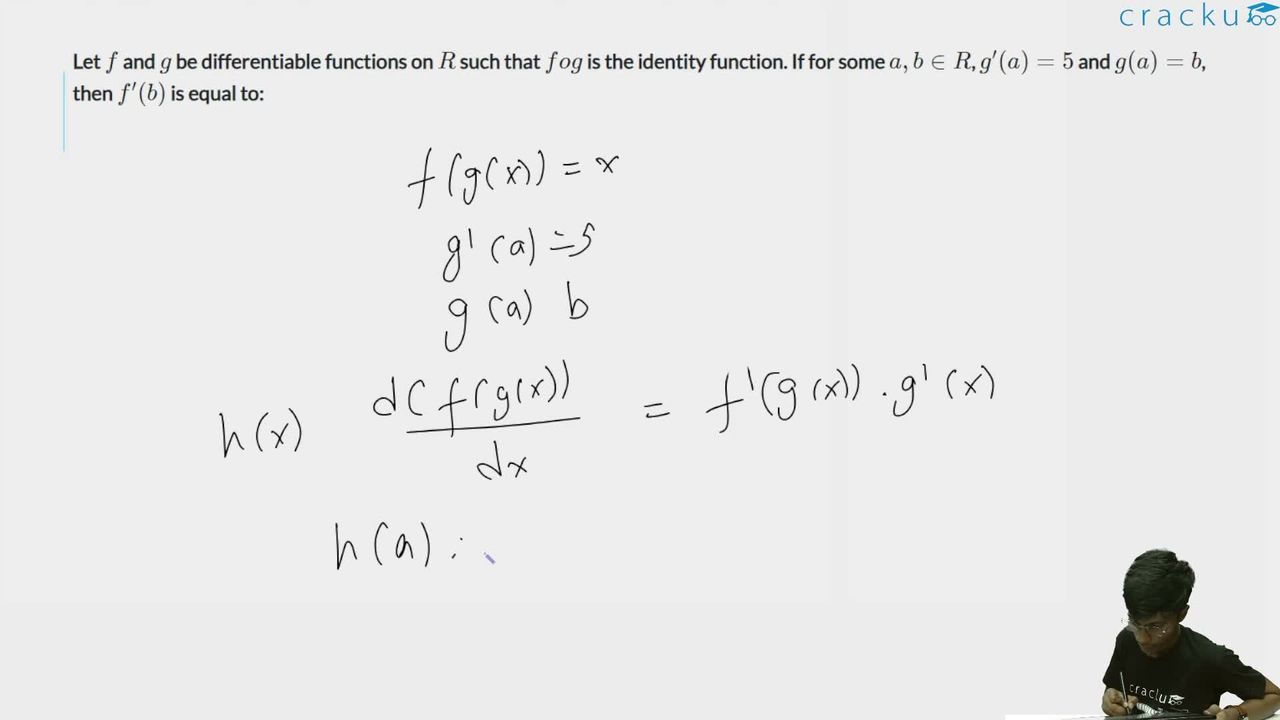
Let $$f$$ and $$g$$ be differentiable functions on $$R$$ such that $$fog$$ is the identity function. If for some $$a, b \in R$$, $$g'(a) = 5$$ and $$g(a) = b$$, then $$f'(b)$$ is equal to:
We are told that $$f \circ g$$ is the identity function on $$\mathbb R$$. In symbols this means
$$f\bigl(g(x)\bigr)=x \quad\text{for every real }x.$$
To connect the derivatives of $$f$$ and $$g$$ we differentiate both sides of this equality with respect to $$x$$. First we recall the Chain Rule:
The Chain Rule states that if $$h(x)=u(v(x)),$$ then $$h'(x)=u'\bigl(v(x)\bigr)\,v'(x).$$
Applying the Chain Rule to $$h(x)=f\bigl(g(x)\bigr)$$ we obtain
$$\bigl(f \circ g\bigr)'(x)=f'\bigl(g(x)\bigr)\,g'(x).$$
Because $$f \circ g$$ is the identity function, its derivative is simply $$1$$ for every $$x$$, so we have
$$f'\bigl(g(x)\bigr)\,g'(x)=1.$$
Now we substitute the specific value $$x=a$$ that is mentioned in the question. This gives
$$f'\bigl(g(a)\bigr)\,g'(a)=1.$$
The problem states that $$g'(a)=5$$ and that $$g(a)=b$$, so we replace these quantities:
$$f'(b)\,\bigl(5\bigr)=1.$$
To isolate $$f'(b)$$ we divide both sides by $$5$$:
$$f'(b)=\frac{1}{5}.$$
Hence, the correct answer is Option A.
Was this solution helpful?
Click on the Email ☝️ to Watch the Video Solution
Create a FREE account and get:
_1.webp)

Educational materials for JEE preparation

Ask our AI anything

AI can make mistakes. Please verify important information.
AI can make mistakes. Please verify important information.
