
Join Our JEE Preparation Group
Prep with like-minded aspirants; Get access to free daily tests and study material.
Sign in
Please select an account to continue using cracku.in
↓ →
Join Our JEE Preparation Group
Prep with like-minded aspirants; Get access to free daily tests and study material.
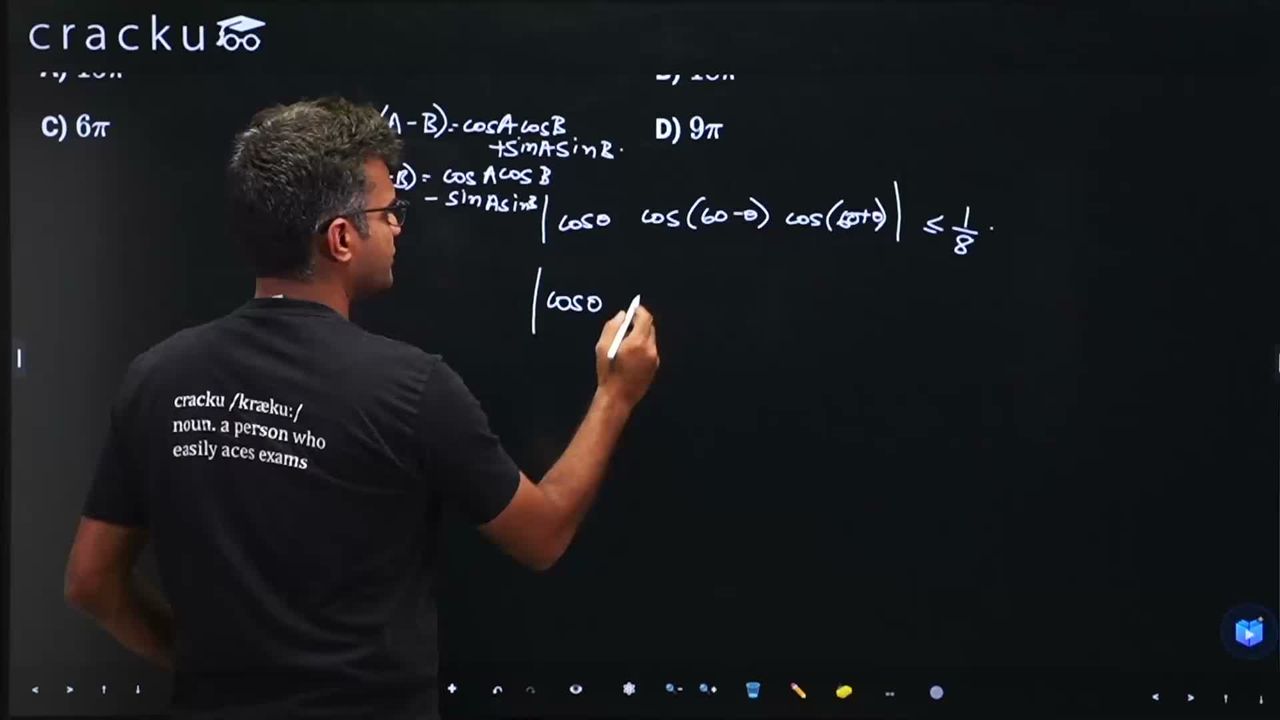
Let $$|\cos\theta \cos(60° - \theta) \cos(60° + \theta)| \leq \frac{1}{8}$$, $$\theta \in [0, 2\pi]$$. Then, the sum of all $$\theta \in [0, 2\pi]$$, where $$\cos 3\theta$$ attains its maximum value, is :
Using the identity: $$\cos\theta \cos(60°-\theta)\cos(60°+\theta) = \frac{1}{4}\cos 3\theta$$.
So $$|\cos\theta \cos(60°-\theta)\cos(60°+\theta)| = \frac{1}{4}|\cos 3\theta| \leq \frac{1}{8}$$.
This gives $$|\cos 3\theta| \leq \frac{1}{2}$$, which is always true when $$|\cos 3\theta| \leq \frac{1}{2}$$.
Given the constraint $$|\cos 3\theta| \leq \frac{1}{2}$$, the maximum of $$\cos 3\theta$$ subject to this constraint is $$\frac{1}{2}$$.
$$\cos 3\theta = \frac{1}{2}$$ when $$3\theta = \frac{\pi}{3} + 2n\pi$$ or $$3\theta = -\frac{\pi}{3} + 2n\pi = \frac{5\pi}{3} + 2n\pi$$.
For $$\theta \in [0, 2\pi]$$, $$3\theta \in [0, 6\pi]$$:
$$3\theta = \frac{\pi}{3}$$; $$\theta = \frac{\pi}{9}$$
$$3\theta = \frac{5\pi}{3}$$; $$\theta = \frac{5\pi}{9}$$
$$3\theta = \frac{7\pi}{3}$$; $$\theta = \frac{7\pi}{9}$$
$$3\theta = \frac{11\pi}{3}$$; $$\theta = \frac{11\pi}{9}$$
$$3\theta = \frac{13\pi}{3}$$; $$\theta = \frac{13\pi}{9}$$
$$3\theta = \frac{17\pi}{3}$$; $$\theta = \frac{17\pi}{9}$$
Sum = $$\frac{\pi}{9}(1+5+7+11+13+17) = \frac{54\pi}{9} = 6\pi$$.
The correct answer is Option 3: $$6\pi$$.
Was this solution helpful?
Click on the Email ☝️ to Watch the Video Solution
Create a FREE account and get:
_1.webp)

Educational materials for JEE preparation

Ask our AI anything

AI can make mistakes. Please verify important information.
AI can make mistakes. Please verify important information.
