
Join Our JEE Preparation Group
Prep with like-minded aspirants; Get access to free daily tests and study material.
Sign in
Please select an account to continue using cracku.in
↓ →
Join Our JEE Preparation Group
Prep with like-minded aspirants; Get access to free daily tests and study material.
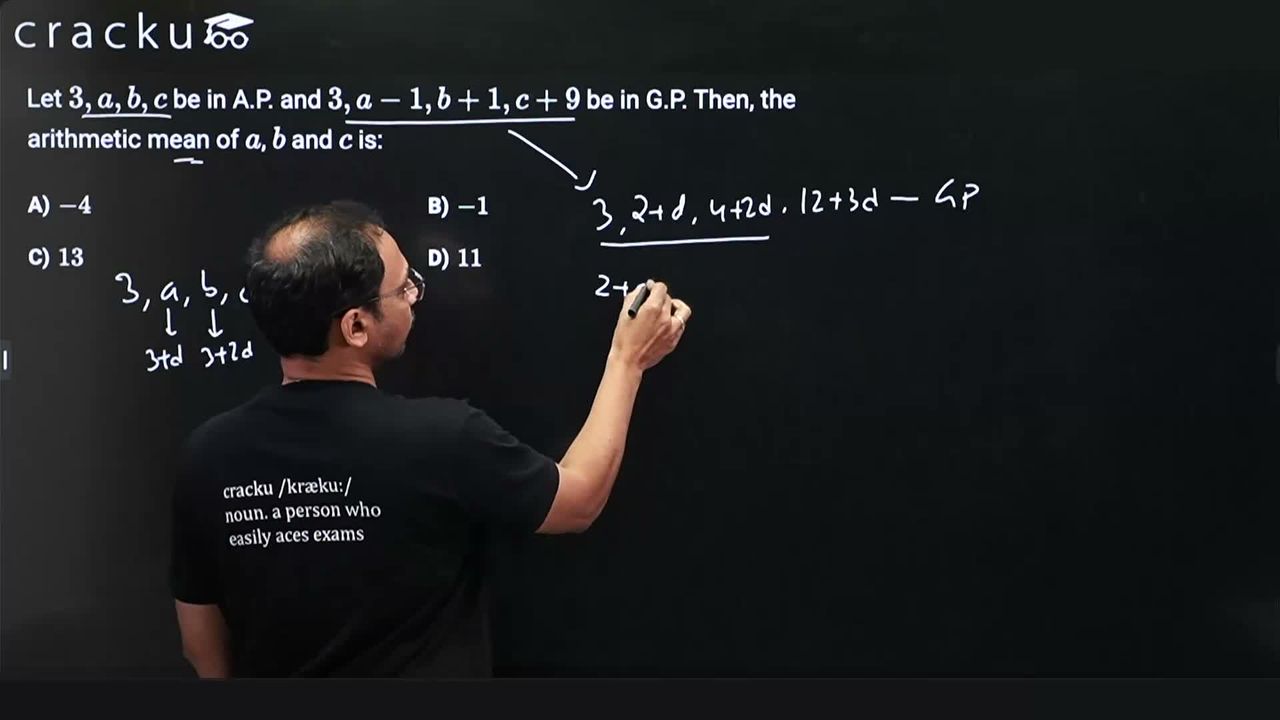
Let $$3, a, b, c$$ be in A.P. and $$3, a-1, b+1, c+9$$ be in G.P. Then, the arithmetic mean of $$a$$, $$b$$ and $$c$$ is:
Given that 3, a, b, c are in A.P., the common difference is constant. Let the common difference be d. Then:
a = 3 + d
b = 3 + 2d
c = 3 + 3d
Also, 3, a-1, b+1, c+9 are in G.P. Substituting the expressions:
a-1 = (3 + d) - 1 = 2 + d
b+1 = (3 + 2d) + 1 = 4 + 2d
c+9 = (3 + 3d) + 9 = 12 + 3d
The sequence is 3, 2+d, 4+2d, 12+3d. In a G.P., the ratio between consecutive terms is constant. Setting the ratio between the second and first term equal to the ratio between the third and second term:
$$\frac{2+d}{3} = \frac{4+2d}{2+d}$$
$$(d - 4)(d + 2) = 0$$
So, d = 4 or d = -2.
For d = 4:
a = 3 + 4 = 7
b = 3 + 2(4) = 11
c = 3 + 3(4) = 15
The G.P. sequence is 3, 7-1=6, 11+1=12, 15+9=24. Ratios: 6/3=2, 12/6=2, 24/12=2, which is a valid G.P. with common ratio 2.
For d = -2:
a = 3 + (-2) = 1
b = 3 + 2(-2) = -1
c = 3 + 3(-2) = -3
The G.P. sequence is 3, 1-1=0, -1+1=0, -3+9=6. The ratio between second and first term is 0/3=0, but between third and second term is 0/0, which is undefined. Hence, this is invalid.
Thus, only d = 4 is valid, giving a = 7, b = 11, c = 15.
$$\frac{a + b + c}{3} = \frac{7 + 11 + 15}{3} = \frac{33}{3} = 11$$
Was this solution helpful?
Click on the Email ☝️ to Watch the Video Solution
Create a FREE account and get:
_1.webp)

Educational materials for JEE preparation

Ask our AI anything

AI can make mistakes. Please verify important information.
AI can make mistakes. Please verify important information.
