
Join Our JEE Preparation Group
Prep with like-minded aspirants; Get access to free daily tests and study material.
Sign in
Please select an account to continue using cracku.in
↓ →
Join Our JEE Preparation Group
Prep with like-minded aspirants; Get access to free daily tests and study material.
Given below are two statements:
Statement (I): The metallic radius of Al is less than that of Ga.
Statement (II): The ionic radius of Al$$^{3+}$$ is less than that of Ga$$^{3+}$$.
In the light of the above statements, choose the most appropriate answer from the options given below:
The trend of atomic (metallic) radius in a group is governed by two opposing factors.
• Addition of a new shell on moving down the group tends to increase the radius.
• Simultaneous entry of electrons into an inner d-sub-shell offers poor shielding; the increased effective nuclear charge $$\left(Z_{\text{eff}}\right)$$ tends to contract the radius.
For elements just after a transition series the second factor may dominate.
Group 13 illustrates this point. The electronic configurations are
$$\text{Al : }[Ne]\,3s^{2}3p^{1}$$
$$\text{Ga : }[Ar]\,3d^{10}4s^{2}4p^{1}$$
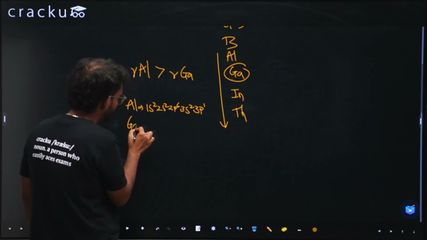
Because the ten $$3d$$ electrons of Ga shield the nuclear charge very poorly, $$Z_{\text{eff}}$$ rises appreciably from Al to Ga. The extra 4-shell is therefore pulled in more strongly than expected and the metallic (atomic) radius of Ga becomes slightly smaller than that of Al.
Typical metallic radii: $$r_{\text{Al}} = 143\,\text{pm}, \; r_{\text{Ga}} = 135\,\text{pm}$$.
Case 1 — Statement (I)
Statement (I) says “the metallic radius of Al is less than that of Ga”.
Actual data show $$r_{\text{Al}} \gt r_{\text{Ga}}$$, so Statement (I) is incorrect.
The ionic radii of the tripositive ions also increase down the group, but here the contraction produced by the 3d electrons is not strong enough to reverse the general increase. Hence
$$r\!\left(\text{Al}^{3+}\right) \approx 53\,\text{pm},\qquad
r\!\left(\text{Ga}^{3+}\right) \approx 62\,\text{pm},\qquad
r\!\left(\text{Al}^{3+}\right) \lt r\!\left(\text{Ga}^{3+}\right).$$
Case 2 — Statement (II)
Statement (II) says “the ionic radius of Al$$^{3+}$$ is less than that of Ga$$^{3+}$$”. As shown above this is correct.
Combining the two cases:
Statement (I) is incorrect while Statement (II) is correct. Therefore the appropriate choice is Option B.
Was this solution helpful?
Click on the Email ☝️ to Watch the Video Solution
Create a FREE account and get:
_1.webp)

Educational materials for JEE preparation

Ask our AI anything

AI can make mistakes. Please verify important information.
AI can make mistakes. Please verify important information.


