
Join Our JEE Preparation Group
Prep with like-minded aspirants; Get access to free daily tests and study material.
Sign in
Please select an account to continue using cracku.in
↓ →
Join Our JEE Preparation Group
Prep with like-minded aspirants; Get access to free daily tests and study material.
The correct order of basic nature on aqueous solution for the bases $$NH_3$$, $$H_2N-NH_2$$, $$CH_3CH_2NH_2$$, $$(CH_3CH_2)_2NH$$ and $$(CH_3CH_2)_3N$$ is:
We need to arrange the following bases in increasing order of basic nature in aqueous solution: $$NH_3$$, $$H_2N-NH_2$$, $$CH_3CH_2NH_2$$, $$(CH_3CH_2)_2NH$$, and $$(CH_3CH_2)_3N$$.
The basicity of amines in aqueous solution depends on two main factors:
(i) The inductive effect (+I effect) of alkyl groups, which increases electron density on nitrogen and increases basicity.
(ii) The solvation of the conjugate acid (ammonium ion) by water molecules through hydrogen bonding, which stabilises the conjugate acid and increases basicity.
Step 1: Compare $$H_2N-NH_2$$ (hydrazine) and $$NH_3$$
In hydrazine, the lone pair on one nitrogen is partially withdrawn by the adjacent electronegative $$NH_2$$ group (due to the -I effect of the $$-NH_2$$ group). This makes hydrazine a weaker base than ammonia.
So: $$H_2N-NH_2 \lt NH_3$$
Step 2: Compare alkylamines with $$NH_3$$
All ethylamines (primary, secondary, and tertiary) are more basic than $$NH_3$$ because the ethyl group donates electron density to nitrogen via the +I effect.
So: $$NH_3 \lt CH_3CH_2NH_2$$, $$(CH_3CH_2)_2NH$$, $$(CH_3CH_2)_3N$$
Step 3: Order among the ethylamines in aqueous solution
In aqueous solution, the observed basicity order among ethylamines is:
$$(CH_3CH_2)_2NH \gt CH_3CH_2NH_2 \gt (CH_3CH_2)_3N$$
This is because:
- Secondary amines like $$(CH_3CH_2)_2NH$$ have a good balance of +I effect (two alkyl groups) and solvation ability (one N-H bond available for hydrogen bonding).
- Primary amines like $$CH_3CH_2NH_2$$ have fewer alkyl groups but better solvation (two N-H bonds).
- Tertiary amines like $$(CH_3CH_2)_3N$$ have the strongest +I effect (three alkyl groups) but poor solvation of the conjugate acid due to steric hindrance and only one site for H-bonding, which reduces their basicity in water.
Step 4: Final order
Combining all comparisons, the increasing order of basic nature in aqueous solution is:
$$$H_2N-NH_2 \lt NH_3 \lt (CH_3CH_2)_3N \lt CH_3CH_2NH_2 \lt (CH_3CH_2)_2NH$$$
Hence, the correct answer is Option C.
Was this solution helpful?
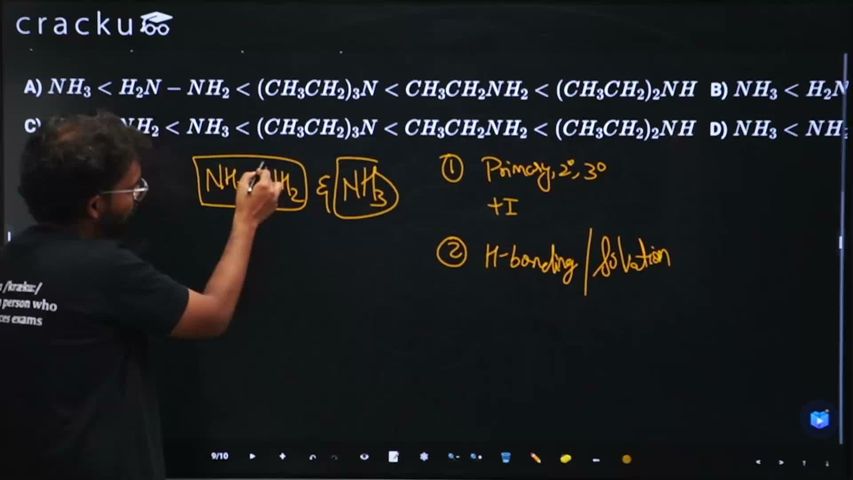
Click on the Email ☝️ to Watch the Video Solution
Create a FREE account and get:
_1.webp)

Educational materials for JEE preparation

Ask our AI anything

AI can make mistakes. Please verify important information.
AI can make mistakes. Please verify important information.


