
Join Our JEE Preparation Group
Prep with like-minded aspirants; Get access to free daily tests and study material.
Sign in
Please select an account to continue using cracku.in
↓ →
Join Our JEE Preparation Group
Prep with like-minded aspirants; Get access to free daily tests and study material.
Given below are two statements:
Statement I: $$CrO_3$$ is a stronger oxidizing agent than $$MoO_3$$.
Statement II: Cr(VI) is more stable than Mo(VI).
In the light of above statements, Choose the correct answer from the options given below :
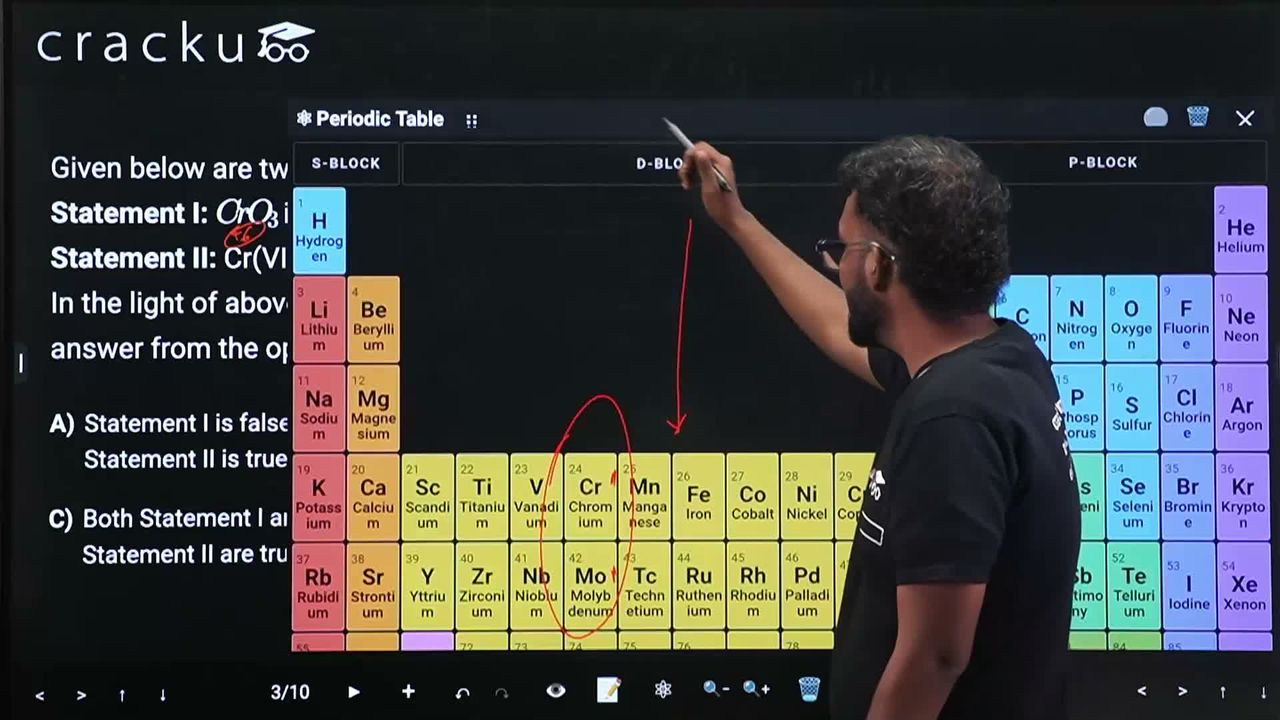
The elements chromium (Cr) and molybdenum (Mo) belong to Group 6 of the periodic table. They show their highest oxidation state of $$+6$$ in compounds such as $$CrO_3$$ and $$MoO_3$$.
Case 1: Relative oxidising power of $$CrO_3$$ and $$MoO_3$$
Within a group, the stability of the highest oxidation state generally increases down the group because the heavier element’s larger size and greater ability to delocalise charge stabilise the high oxidation state.
Hence, $$Mo(VI)$$ is more stable than $$Cr(VI)$$.
Less-stable high oxidation states have a stronger tendency to gain electrons (that is, to get reduced to a lower oxidation state). Therefore they behave as stronger oxidising agents.
Since $$Cr(VI)$$ is less stable, $$CrO_3$$ wants to get reduced more readily than $$MoO_3$$. Thus $$CrO_3$$ is the stronger oxidising agent.
Case 2: Comparative stability of $$Cr(VI)$$ and $$Mo(VI)$$
As argued above, the stability of the $$+6$$ state increases from Cr to Mo. Consequently, $$Mo(VI)$$ is more stable while $$Cr(VI)$$ is less stable.
Evaluation of the statements
• Statement I: “$$CrO_3$$ is a stronger oxidising agent than $$MoO_3$$.” - True.
• Statement II: “Cr(VI) is more stable than Mo(VI).” - False (the reverse is correct).
Therefore, Statement I is true but Statement II is false. The correct choice is Option B.
Was this solution helpful?
Click on the Email ☝️ to Watch the Video Solution
Create a FREE account and get:
_1.webp)

Educational materials for JEE preparation

Ask our AI anything

AI can make mistakes. Please verify important information.
AI can make mistakes. Please verify important information.
