
Join Our JEE Preparation Group
Prep with like-minded aspirants; Get access to free daily tests and study material.
Sign in
Please select an account to continue using cracku.in
↓ →
Join Our JEE Preparation Group
Prep with like-minded aspirants; Get access to free daily tests and study material.
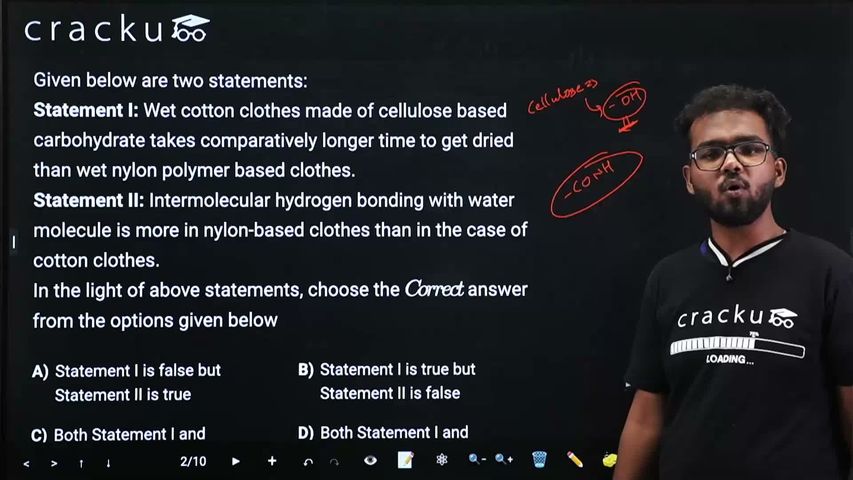
Given below are two statements:
Statement I: Wet cotton clothes made of cellulose based carbohydrate takes comparatively longer time to get dried than wet nylon polymer based clothes.
Statement II: Intermolecular hydrogen bonding with water molecule is more in nylon-based clothes than in the case of cotton clothes.
In the light of above statements, choose the $$Correct$$ answer from the options given below
Cellulose, the main constituent of cotton fibres, is a polysaccharide chain carrying abundant $$-OH$$ groups on every glucose unit.
Each $$-OH$$ group can act both as a hydrogen-bond donor and acceptor, so a single cellulose chain can form a large number of intermolecular hydrogen bonds with surrounding water molecules.
Nylon is a polyamide. Although each repeat unit contains one $$-CONH$$ group capable of hydrogen bonding, the rest of the chain is a long, non-polar hydrocarbon segment. The total number of hydrogen-bonding sites per unit mass of nylon is therefore much smaller than in cellulose, and the hydrophobic backbone further reduces water affinity.
Because of the extensive hydrogen bonding, cotton absorbs and retains far more water than nylon. Extra heat (or time) is needed to break these numerous hydrogen bonds during drying, so wet cotton garments take a longer time to dry than wet nylon garments.
Thus:
Statement I: Cotton clothes indeed take longer to dry — TRUE.
Statement II: Hydrogen bonding with water is actually stronger and more numerous in cotton, not in nylon — FALSE.
The correct choice is Option B: Statement I is true but Statement II is false.
Was this solution helpful?
Click on the Email ☝️ to Watch the Video Solution
Create a FREE account and get:
_1.webp)

Educational materials for JEE preparation

Ask our AI anything

AI can make mistakes. Please verify important information.
AI can make mistakes. Please verify important information.
