
Join Our JEE Preparation Group
Prep with like-minded aspirants; Get access to free daily tests and study material.
Sign in
Please select an account to continue using cracku.in
↓ →
Join Our JEE Preparation Group
Prep with like-minded aspirants; Get access to free daily tests and study material.
Consider the following aqueous solutions.
I. 2.2 g Glucose in 125 ml of solution.
II. 1.9 g Calcium chloride in 250 ml of solution.
111. 9.0 g Urea in 500 ml of solution.
IV. 20.5 g Aluminium sulphate in 750 ml of solution.
The correct increasing order of boiling point of these solutions will be:
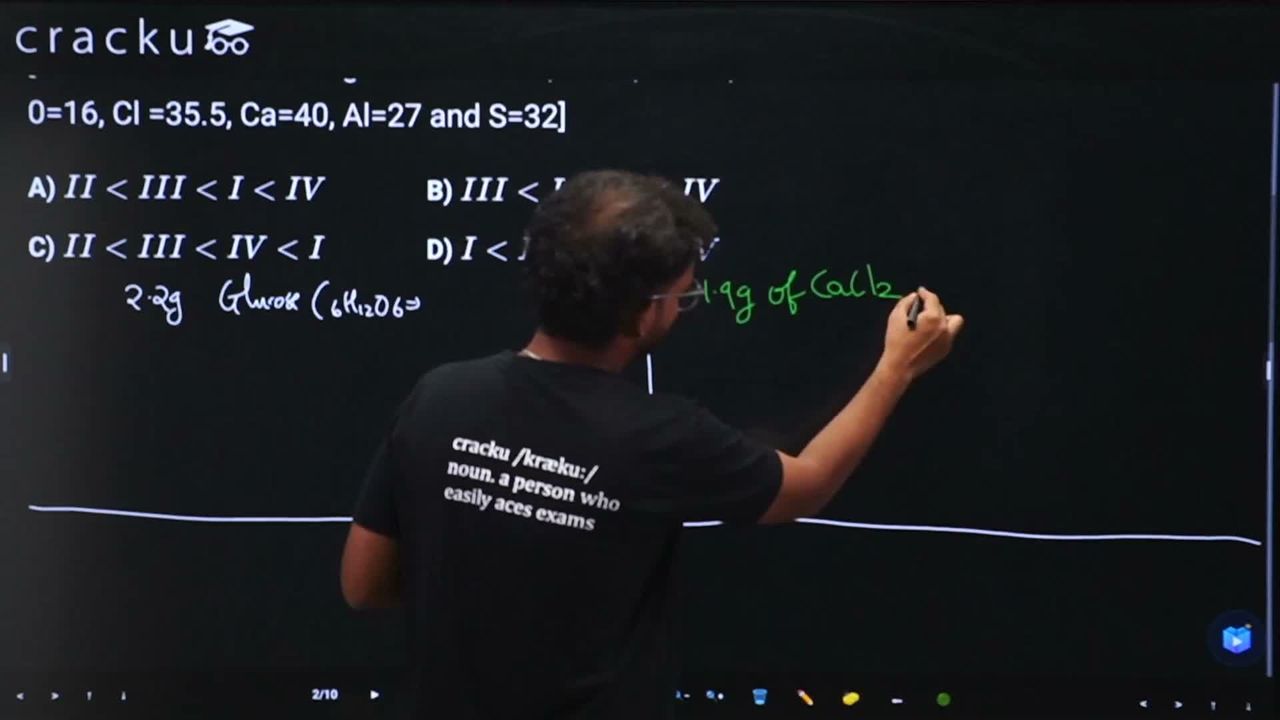
[Given : Molar mass in g $$mol^{-1}$$: H = 1, C=12, N= 14, 0=16, Cl =35.5, Ca=40, Al=27 and S=32]
The boiling point elevation ($$\Delta T_b$$) is a colligative property that depends on the van't Hoff factor ($$i$$) and the molality ($$m$$) of the solution, given by $$\Delta T_b = i \times K_b \times m$$, where $$K_b$$ is the ebullioscopic constant. Since $$K_b$$ is the same for all aqueous solutions, the order of boiling points depends on the product $$i \times m$$.
Molality ($$m$$) is calculated as:
$$m = \frac{\text{moles of solute}}{\text{mass of solvent in kg}}$$
Assuming the density of water is 1 g/mL, the mass of the solvent (water) is obtained by subtracting the mass of the solute from the total mass of the solution (since volume in mL ≈ mass in grams).
The molar masses are:
Solution I: 2.2 g Glucose in 125 mL solution
Glucose is non-electrolyte, so $$i = 1$$.
Moles of glucose = $$\frac{2.2}{180} = 0.012222$$ mol
Mass of solution ≈ 125 g (density ≈ 1 g/mL)
Mass of solvent = $$125 - 2.2 = 122.8$$ g = $$0.1228$$ kg
Molality, $$m_I = \frac{0.012222}{0.1228} = 0.09953$$ mol/kg
$$i \times m_I = 1 \times 0.09953 = 0.09953$$
Solution II: 1.9 g Calcium chloride in 250 mL solution
Calcium chloride dissociates into Ca2+ and 2Cl-, so $$i = 3$$.
Moles of CaCl2 = $$\frac{1.9}{111} = 0.017117$$ mol
Mass of solution ≈ 250 g
Mass of solvent = $$250 - 1.9 = 248.1$$ g = $$0.2481$$ kg
Molality, $$m_{II} = \frac{0.017117}{0.2481} = 0.06899$$ mol/kg
$$i \times m_{II} = 3 \times 0.06899 = 0.20697$$
Solution III: 9.0 g Urea in 500 mL solution
Urea is non-electrolyte, so $$i = 1$$.
Moles of urea = $$\frac{9.0}{60} = 0.15$$ mol
Mass of solution ≈ 500 g
Mass of solvent = $$500 - 9.0 = 491$$ g = $$0.491$$ kg
Molality, $$m_{III} = \frac{0.15}{0.491} = 0.30550$$ mol/kg
$$i \times m_{III} = 1 \times 0.30550 = 0.30550$$
Solution IV: 20.5 g Aluminium sulphate in 750 mL solution
Aluminium sulphate dissociates into 2Al3+ and 3SO42-, so $$i = 5$$.
Moles of Al2(SO4)3 = $$\frac{20.5}{342} = 0.059942$$ mol
Mass of solution ≈ 750 g
Mass of solvent = $$750 - 20.5 = 729.5$$ g = $$0.7295$$ kg
Molality, $$m_{IV} = \frac{0.059942}{0.7295} = 0.08216$$ mol/kg
$$i \times m_{IV} = 5 \times 0.08216 = 0.41080$$
The $$i \times m$$ values are:
Increasing order: $$0.09953 < 0.20697 < 0.30550 < 0.41080$$, so I < II < III < IV.
Thus, the increasing order of boiling points is I, II, III, IV.
Option D matches this order: I < II < III < IV.
Therefore, the correct answer is D.
Was this solution helpful?
Click on the Email ☝️ to Watch the Video Solution
Create a FREE account and get:
_1.webp)

Educational materials for JEE preparation

Ask our AI anything

AI can make mistakes. Please verify important information.
AI can make mistakes. Please verify important information.
